9 of 9
Transcript
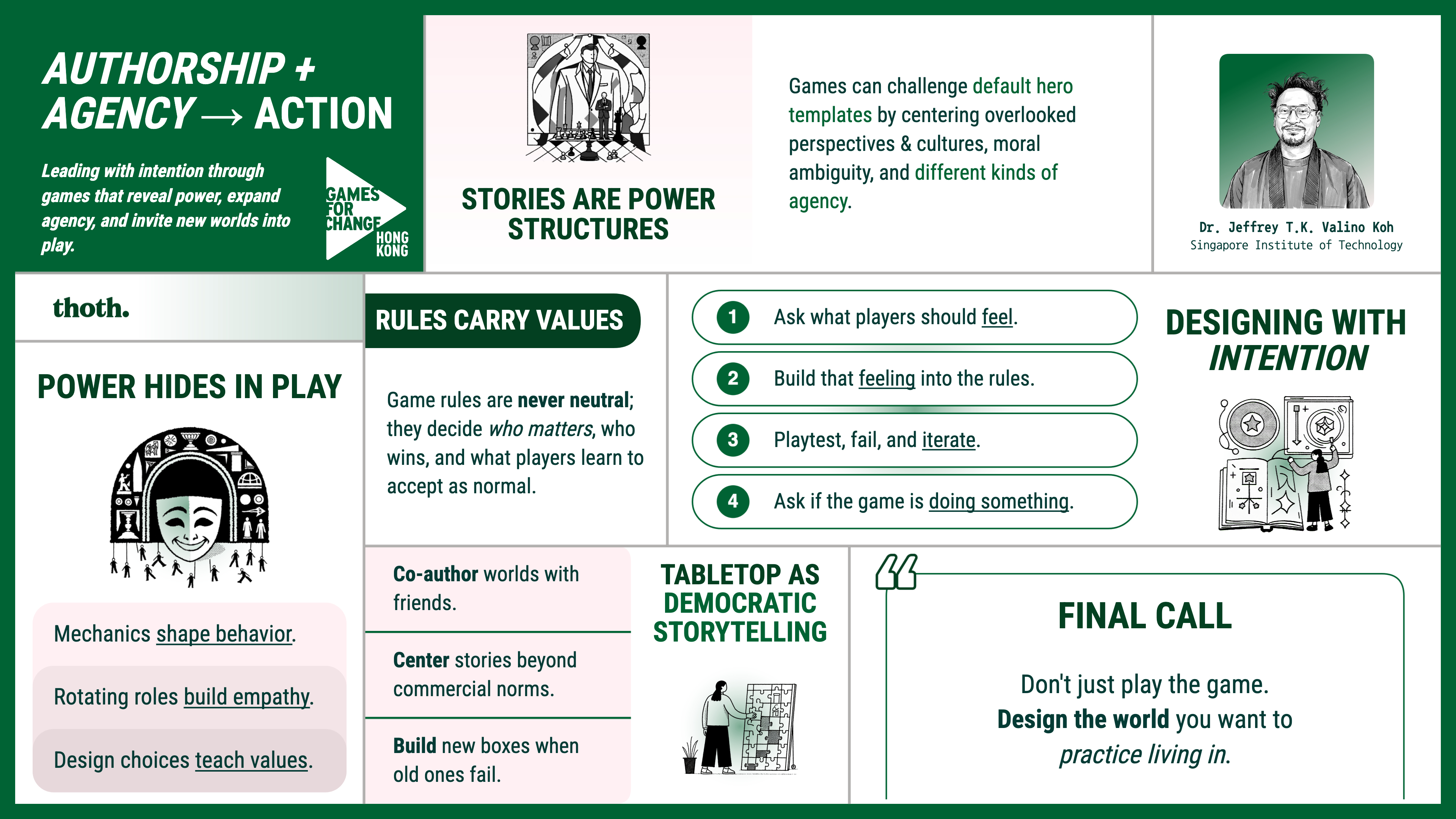
So first of all, I just wanted to thank Vince and the whole organizing committee. It's been such a great day and I've learned so much and it's been such a smooth ride. So thank you so much for organizing this and bringing everyone together. Thank you guys for sticking around for this last bit. I know it's one more PowerPoint, but don't worry, we're going to get through it and hopefully we'll have a good time. One final note is that Prof. Grace set us up so nicely and I always think about like what is the closing keynote supposed to be because I know the opening keynote is this kind of setting you up for kind of inspiration and and priming you for the day and the closing keynote maybe is something that is more emotional. Maybe it's something that you leave with and I hope to to do that today. So quick question. Think of the last game you played. A video game, a board game, a card game at 2 a.m. when you really should have been sleeping. Now ask yourself In that game, who was the final boss? Maybe it was a level 20 red dragon in your home. brewed D&D game. Or maybe it was a certain someone from Team Rocket on a card. Maybe, if you were playing Magic the Gathering, it was whomever brought the Four Horsemen deck to the Commander tournament and immediately became insufferable about it. But here is the more interesting question I want to ask. Who decided who the final boss would be? Because someone made that call. Someone wrote the rules. Someone decided who gets power, who gets to tell the story, and who gets left out of that story entirely, and that someone could be you. I'm Jeffrey, I'm a researcher and designer, and I co-built a card game called Boss Up because I became a little bit obsessed with this question. In the next 15 minutes, I want to take you on a tour through power in games, how it hides in the rules, in stories, in culture, and why you have more power in this. why you have more power in than you might think you do. So are we ready? Yes? All right, let's play. So first, I'd like to talk about how the concept of power is exercised in the rules of a game and how the rules are never, ever neutral. So let me tell you about Monopoly. You've played it. You've probably raged quit. That's normal. But here's what most people outside of this room don't know, that Monopoly was originally designed in 1903 by a named Elizabeth Maggie and she called it the landlord's game she invented it specifically to teach people about the dangers of wealth concentration how a few players hoarding resources makes everyone else miserable and her point well the game was that lesson and the mechanics were the argument and yet The version that has become globally famous is, well, exactly the thing she was warning against. You crush your friends, you buy everything, you... charge rent until they're broke and everyone calls it fun. But the thing to learn here is that the rules of a game are never neutral. Every rule is a choice and every choice encodes a value. In chess, hierarchy is everything. The king is the most important piece. The queen is the most powerful piece. And the pawns, they're expendable. Does that sound familiar? In pandemic, the cooperative board game. Power is shared. No single player wins. You live or you die together. Every rule set is a choice someone made. And those choices determine who matters, who wins, and what the game teaches you about the world. A few years ago, I was working with my company Chemistry, which is a strategic design consultancy in Singapore and in Amsterdam, and we kept running into the same problem. We'd go into organizations and run innovation workshops, and ideas were never the issue. People had brilliant ideas. The problem was always power, specifically the kind of unspoken power that makes people self-sensor in a room where their boss is present. So of course we made a game about that. So Boss Up is a card game where you work as an innovation team. You get trigger cards, you know, these are wild provocations, and challenge cards. These are real-world business dilemmas. But here's the key mechanic, and this is really the whole point of the game. Oops, everyone takes a turn being the boss. The role of the innovation director rotates. One round you choose the challenge and judge the solution. The next round someone else holds that power and you have to pitch to them. And we play tested this across Asia and Europe and something remarkable kept happening. The moment you know you'll be in charge the next round, you start listening differently. You start thinking about what it feels like to be responsible for picking the best idea. You develop almost accidentally empathy. That's of course not an accident, that's the game working as intended. We built that outcome into the rules deliberately. Now ask yourself, what did the rules of your game teach people to feel? Okay, mechanics are one thing, but there's another place power hides in games, and that's of course in the story. For most of gaming history, there's been a predictable template for who the hero is. It's usually a guy, a particular kind of guy. He saves things, he fights things, collects things. You know, the world revolves around him. When you see the same hero across hundreds of titles, what does that say to the kid who doesn't recognize themselves in that character? What does it say about whose story is worth telling? And here's where it gets interesting. Some of the most important games of the last decade, in my opinion, have challenged exactly this. In Papers Please, it puts you in the role of an immigration officer in an authoritarian state. It makes you feel the moral weight of stamp. You are not the hero here. You are the system. Undertale, that wonderfully strange RPG, was one of the first games that actually stopped and asked you, why are you fighting? Why do you assume fighting is the answer? And these games understood something crucial. The story is a power structure and you can design it differently. But if we're talking about storytelling power in games, we have to talk about tabletop. Tabletop role-playing games, Dungeons & Dragons, those beautiful indie tabletop RPGs that get made in weekend jams and go viral on the internet are perhaps the most democratic storytelling format ever invented. There is no studio, there is no publisher, there's no algorithm deciding what story is commercially viable. You and a few friends sit around a table and collectively author a world. And increasingly, the people designing those rule systems are asking, who do the rules center? Who do they marginalize? And what kinds of stories do they make possible? And of course, what kind of stories do they make impossible? There are tabletop games now designed specifically to tell queer stories, to explore immigrant experiences, to process grief, to explore what it means to grow in a city that doesn't see you. These games exist because young designers said the stories I want to tell don't fit into the existing boxes. I'll make my own box. When you design a game, you decide whose experience is worth playing. And that is a profound responsibility. And it's, of course, an incredible opportunity. We create things that reflect our world. And then those things shape how we see the world. And, of course, games are no exception to that. We've played games where violence is the default action for so long that we sometimes forget that was a choice. Someone decided that shooting, fighting, destroying would be the norm. We've played games where individual victory is the only goal for so long that collaboration can feel like a weird design choice, even though it's actually how communities work. And we've played fantasies drawn from medieval Europe so often that some people are surprised when fantasies look like anything else, as if the West invented imagination. And none of this means that those games are bad. I have around 400 hours. Witcher 3. I love that game. What it does mean though is that like all cultural artifacts, they carry assumptions. And those assumptions becomes what feels normal. Here's the latest game that my team and I are working on. And it traces Singapore's heritage. and places the player, in this case a secondary school student, in the shoes of an everyday person living in Singapore's past. We wanted to connect the player's present-day lived experience with the experiences of the people who lived at the birth of a nation. So in 1955, just a decade before Singapore's independence in 1965, a major event occurred called the Hawkeye Bus Riots. And the riots started because of confrontation between the police, the bus workers of the Hawkeye Amalgamated Bus Company, and the students who supported those workers. It was important for us to provide a neutral perspective so the player could play as a representative from each of these groups. with different stories and outcomes depending on their decisions in the game. And working with the National Heritage Board of Singapore, we accessed Singapore's rich archives of physical and digital artifacts to create an authentic picture of life in Singapore during the 50s. And some of the artifacts that we used include documents like the Labor Front Manifesto. And of course we use Agentic AI based on a custom built rag and a corpus we put together so that people could talk to the artifacts. and they would find them in their journey in the game, which they could use as quest items to solve different puzzles and situations. And we also created a virtual game master based on Singapore's iconic mascot, the Murrillion, to help players get a chance to co-create their story within that gameplay. And we're currently play testing a version of the game with learners and educators and experts in collaboration with the Ministry of Education in Singapore and hope to produce something that's not only fun to play but also connects players with Singapore's past in no way a history text. ever could. So the games made in Hong Kong feel different from the games made in Tokyo, which feel different from the games made in Lagos, which feel different from the games made in Bogota, not just in aesthetics, but in values, in what counts as a win, in who has agency. And the most powerful thing about being a game designer in Asia right now, in Hong Kong right now, is that you carry a cultural knowledge that most of the game design canon has never accessed. It is completely new. The mechanics, the stories, the cultural frameworks that are second nature to you, they are genuinely new materials for games. They're not decoration, not as an aesthetic layer on top of familiar Western genre structures, but as the actual architecture of play. And that is not a small thing. And culture doesn't just influence games. Games are how culture practices itself. And right now, the culture... of games needs you. Alright, let me come back to boss up for a moment. When we designed it, we kept asking, what do we want people to feel when we play this? Not just think, but feel. We wanted people to feel what it's like to hold power, then to give it up. and then to hold it again. We wanted the mechanics itself to be the lesson. Power isn't something that you have. Power is something that you do. It circulates. And a well-designed game can teach you... body what that feels like before the real world gets a chance to and that insight came from playtesting from failing a lot and iterating from asking not just is this fun but is this doing something and that is the practice of game design and it's available to every person in this room You don't need a budget. You don't need a studio. You don't need to know how to code. You need paper, pens, ideas, and people willing to sit across the table from you. And if you think you don't know those people, well, they're potentially sitting beside you right now. So here's what I want you to take away with. Power in games is not accidental. It is a design decision. Who has agency? Who tells the story? Whose values get baked into the rules? These are choices. Someone makes them. It might as well be you. There are stories in this room, your stories, your community's stories, your culture's stories that have never been told through a game. There are mechanics that could teach people what it feels like to navigate a world that was wasn't ever built for them or to find power in unexpected places or to win in ways that bring other people with them. You are the generation of designers who gets to make those games. And to this generation I'd like to say don't just play the game. Design the world you want to practice living in. Thank you.
MADE WITH