8 of 9
Transcript
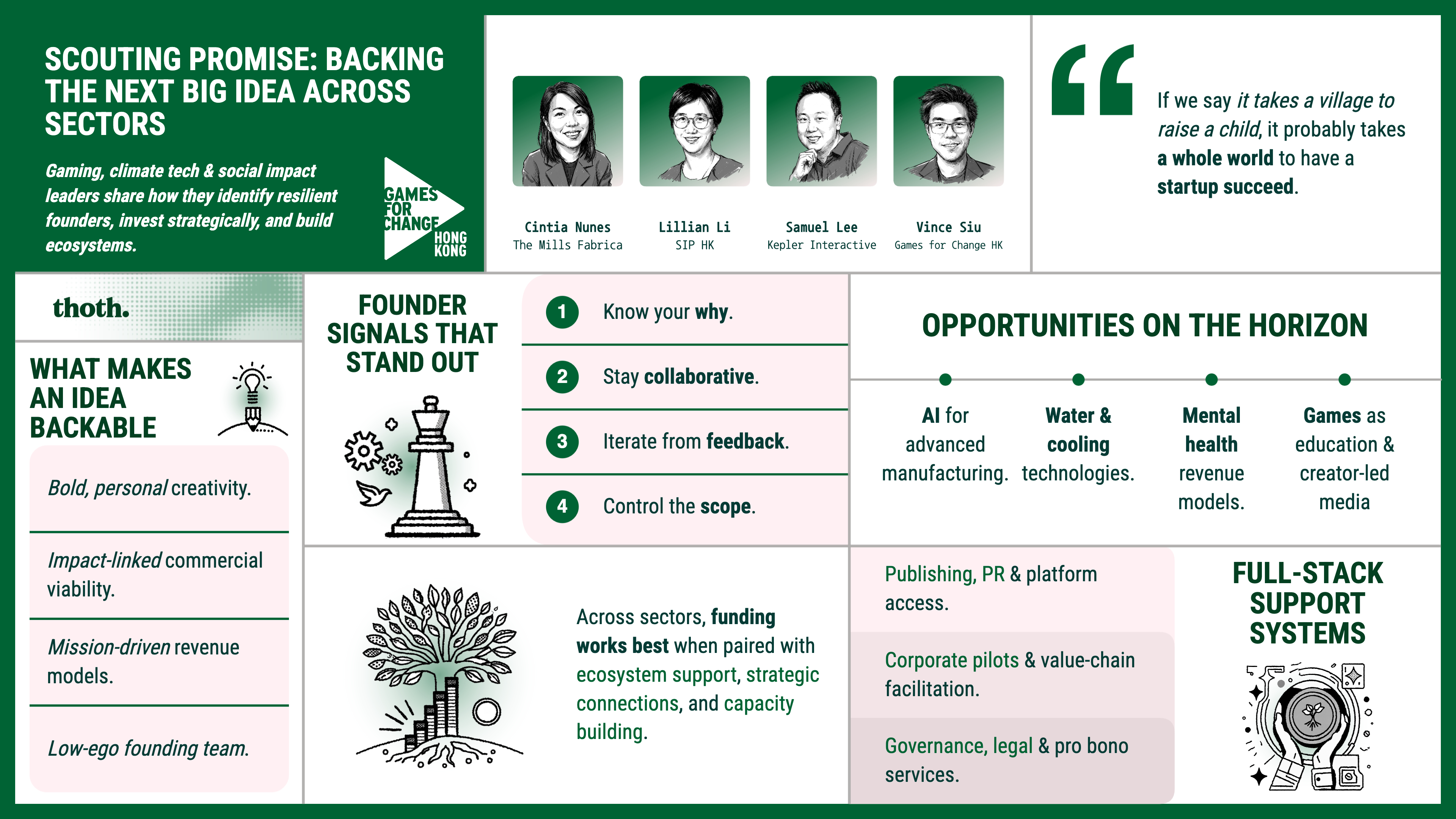
Scouting Promise: Identifying, Investing, Incubating the Next Big Idea
[00:01-00:40] His mic is kind of cutting in and out. Can y'all hear me okay? Ah, okay, great. Um, so— Before we start, I will mention really quickly what's going on here in the background is actually, um, if, if some of you might have caught, uh, my opening, uh, in the morning, um, Yi over there, give us Wade? Yeah. Yi, uh, is actually a founder of a startup that, uh, does live AI transcriptions and infographics. And it just so happens— I think Yi might have picked this room because we're doing this panel in this room, I don't know.
[00:40-01:33] Uh, and so we're going to, uh, live have infographics and notes that y'all can look at. Yeah. Okay, so, um, actually we have a pretty diverse, uh, crowd here. We have folks from games, we have folks from, uh, uh, TEDx Hong Kong. Um, and we have folks from academia, uh, which is quite interesting. And I know that there will be some others that are floating back in as well. Um, so this is going to be a nice diverse cross-sector crowd for a nice diverse cross-sector panel. I'll try to make, uh, as much time as possible for questions because I think that there's going to be a lot of really interesting things that we can talk about here. The title of our panel is called Scouting Promise: Identifying, investing— investing in and incubating the next big idea.
[01:34-02:18] Um, you all can look at our website g4chongkong.org for their detailed bios. Um, but who I have here with me on the panel, uh, first is Samuel Lee. Sam is the co-founder and COO of Kepler Interactive. If you have not heard of Kepler Interactive, you might have heard of Claire Obscure, Expedition 33, and other amazing, amazing indie games that have set the world alight. Kepler is the publisher of all of those amazing games. Next to Sam, we have Cynthia, who is the general manager and head of Asia at The Mills Fabrica. How many of you have been out to The Mills out in Chinguang? Great. Uh, so Cynthia runs that whole arm.
[02:19-02:57] A third of the project. And did you know that the Mills Fabrica is actually also a venture capital firm that invests actively in climate tech ventures? So Cintia also oversees all of that. And finally, we have next to her Lillian, who is the Executive Director of Social Impact Partners, um, which supports NGOs and social enterprises with a variety of different, uh, funding mechanisms. mechanisms right here in Hong Kong. So why I wanted to gather all three of them is actually for us all to be able to learn across sectors how we do what they do.
[02:57-03:48] And what they have in common is how they scout the next great project. How they invest in them and how they incubate. So— I have a couple questions prepped here. Uh, we'll let the conversation flow. We can, you know, ask each other questions as well. Um, and then we'll make sure to have enough time for questions from the audience. My first question is very, very simple. What makes something worth backing? I think I'll start. Um, so, uh, for us, uh, we look for games to publish and we also look for studios to invest in and acquire. So we have two parts of the business. Um, and I think the common theme between the, the, the The things that we do is that we look for boldness and creativity. We look for things that are very unique.
[03:49-04:18] Whereas, um, a lot of other publishers, they would have their sort of expertise, like some are in certain genres, some are in certain art style, some are in certain gameplay mechanic. Those things actually don't matter to us. So if you look across our portfolio, portfolio, like our games range from horror games or like kid-friendly games and other things, and our styles all look different. Um, and, uh, some of the common themes that we have when we look for games, uh, I said, uh, one, how we define creativity is that, um, we look for games that are inspired by not just other games.
[04:18-05:19] games that have personal meaning to the creator behind it. So a couple examples, um, Sifu is a martial arts game made by a French studio. The creative director Jordan, he played— he did martial arts for 15 years. um, and he also loves, um, Hong Kong-style movies, martial arts movies, and that's why he wanted to transcribe the experience into a game. Um, Expedition 33 is a very, very French take on the Japanese RPG genre and And yeah, it's now record-breaking Game of the Year now across the world. Um, yeah, most— 500-something Game of the Year awards, um, which is never done before by any other games. So, um, and they succeed because they lean into their own culture and their own personal things and not just, oh, because this genre is good, or, oh, this, like, um, this art style is trending or whatever, right? Um, they try to be very, very different. And because the game is so different, um, we also say that our games are timeless, and that's something we look at. Uh, when we say timeless, what it means is that it's a game that if we launch now, if we launch 3 years ago, if you launch 3 years from now, it doesn't matter. You'll still be unique, exceptional, and you and you still do well?
[05:19-05:47] And it is not true for many other games, right? Because, you know, when Vampire: Survivor breaks out, a lot of people start making Vampire: Survivor first game. But Lashworld breaks out, many people start making them. But by the time you actually make and try to copy and make small twists to it, 50 other studios are doing already. So for us, that's actually not interesting. When, you know, a studio come to us and say, "Oh, we're gonna do this because this thing is popular." Nope, that's it. Sorry, go find some other publishers, okay? Um, yeah, so there's some sort of things that we look at, which is a bit, I think, different from some other publishers.
[05:48-07:50] Thank you. So, um, earlier Vince said that, um, there's the Mills project in Tiong Bahru, and I typically look at the— a third of the project. And what I mean by this is that I guess some of you have been to the Mills, you've probably seen the shopping You've probably seen the museum, but many of you may not know there's a third arm called the Mills Fabrica. So, uh, what we do is we have a platform of resources, capital connections, all sorts of different resources to support plant-positive change in two industries, uh, textile and food and agriculture. Actually, these two industries are responsible for globally 40% of greenhouse gas emissions. So if we were to ever, um, um, move the needle or want to revert, re-engineer, whatever words you want to use, uh, I guess to put it simply, not to be so close to apocalypse, uh, we need to do something about these two industries. So, um, for today's, uh, topic, I guess we can drill a little bit more about the ecosystem building, but also back to Vince's question, uh, what makes something, uh, backable. So, um, within my I have a team with 20, um, 3 of them focus in my investment portfolio. Um, my portfolio, we focus in venture investment. So we are a VC investor, but I wouldn't say we're the most typical VC. Um, we We do have, I would say, um, adjustable returns financially and also from impact perspective, and we back ventures, very early-stage ventures that are— they provide a solution solutions to change, er, the two industries that I mentioned. So, uh, very early stage, uh, very resilient teams, but also they have a very clear pathway to commercial viability. Uh, we typically come in, um, uh, around seed to B stages. So I guess the team size around 10 to 100, um, and we can come in with like a $3 million to $5 million check. So that's kind of our role as an investor, but we also have this whole ecosystem building approach, which we should talk a bit, uh, later, later, uh, in how we support these innovations. Because typically speaking, like, capital is one thing, but it's not everything. So, uh, we need, uh, uh, support from all over the place. So that's, that's me.
[07:52-09:01] Thank you. Um, hello, can you hear me? Okay. So, uh, for us, uh, what are the projects that worth to back? Um, for SIP, we look for organizations with social missions, so it has to be mission-driven. And, um, okay. And, ah, er, hmm, like, and you know unless needed to be— it has to— got a revenue model. So basically, we focus on 3 SDG goals, uh, well-being, climate, and reduced inequalities. For example, recently our Our latest deal is about, uh, a fish farm in Hong Kong. They grow fish in a sustainable way and they, uh, train and hire SEN youth— special education needs youth. So both inequalities and climate, uh, topics, um, we offer them, uh, loan and match with other fundings. Um, in return we ask for interest rate. and, uh, the capital will come back and recycle to the next deal. Alongside the, the capital, we also provide a lot of capacity building supports.
[09:01-10:40] networking, things like that, because as Cintia said, money is important, but not all. because we need an ecosystem and, uh, many things to support a business to grow. So, um, basically for SIP, my, my answer would be, um, It has to be hitting our SDG goals, has to— got a revenue model, and scalable. Thanks. That's a— it's a good start, um, and hopefully we all start to get a sense, um, that, um, our three guests here, um, have a quite visionary approach to, to, to, um, supporting startups. Now, that's actually my next question about that support, right? Because there's a lot of investment — a lot of, uh, publishers, um, that might look at financial support as the main thing. Uh, but I know all three of you, all your organizations are looking at more of an ecosystem system level support mechanism, right? What Kepler is doing now, uh, with Kepler Ghost is to also help, um, gaming companies do things that are not — maybe part of their core competency, right? So maybe helping out with marketing and things like that outside of the game design side, right? Uh, my understanding with the Mills Fabrica is also with a lot of their global partnerships like the Earthshot Prize and with H&M Foundation, there's a lot of different opportunities for exposure and outreach that your startups that you fund, uh, would be able to get additional brand awareness, um, Um, and also, um, traction.
[10:41-11:16] And lastly, for SIP, like Lillian was mentioning just now, on the capacity building side, um, I know that you all work especially with, like, corporates to provide pro bono support for NGOs and social enterprises for them to be able to build capacity. So I'd love to dive a little bit more into that, right? Um, one thing that I'm starting to hear about is the idea of full-stack support systems, um, and what that means in in terms of how you can help these companies grow, help these ideas that you think are backable, um, actually fulfill their potential. So can I ask you all to elaborate a little bit and share sort of the thinking behind— maybe we can start with Lillian Li.
[11:18-13:11] So I can continue about what we offer. Um, so what we mean about capacity building, it's, uh, usually the— when they start the business, they have a They have a strong, uh, passion on something, um, but then they keep their passion and chase the goals, focus on how to, um— deliver the message to the public, but, uh, at the same time, they need— also need to do the boring parts. That's governance, finance, uh, costing, etc. but they don't like to do so. So, um, we help them to structure how they can do it and keep reminding them, you need to do it, and offer them, uh, put , the support they need. For example, we partner with different, uh, professional firms like financial firms, the Big Four, or law firms, um, marketing firms, PR, etc. They will offer pro bono services to our portfolio companies. And, uh, that is very important because usually they cannot afford that kind of, uh, of services by themselves. themselves. Um, so other than that, we will also look at their plan in a strategic way. It's— um, sometimes it's quite, uh, lonely to be a you may not be able to share a lot of the information or thinking, uh, to the— to the team or other people because they may not be able to echo what you're thinking. So we will, uh, discuss with them, uh, sometimes provide emotional support and, um, connect them with other founders in the similar status. so that they can build a group to support each other. Things like that.
[13:13-16:54] Um, so yeah, I think a lot of founders, especially very early-stage tech founders, they hugely underestimate the difficulty in plugging themselves into the current existing value chains. Um, and And when I, when I say that, I think once it gets to a stage where they're looking at working with strategic partners like manufacturers, brands, and suppliers, they actually don't know how to even begin. And you get stuck there and then like, "Oh, okay. I've only got 3 months of runway in, in terms of cash." And that's it. Done. And so, um, what we realized that there's a huge gap with the availability of really cool innovations innovations and IPs, and then market demands for these innovations and IPs, and then this huge gap in between, which is facilitation. So we've actually— um, so from day one, I intentionally built this team when I said, I have a team of 20, 3 of which is an investment team, out of 3 people who looks after our partnership team. And they work side by side very closely with the biggest conglomerates, the retailers and brands, to help them set scout innovations to achieve their sustainability agenda. So, for example, uh, we have a startup that, um, ferments— it may sound crazy science, but like they ferment fava beans and turn them them into cacao beans. So they would have the same texture, same smell, same taste as chocolate, but it's fava beans. Um, and if you think of them very early— see, startup, they're a team of 3, um, strategic investors like us would then connect them with the right manufacturers, like to the chocolate companies, to the confectionery companies, and so that they can really pilot with them in order for them to really pass that stage stage where we say, "Now you're proven to have commercial viability." Now, that's very important. Um, and so, you really need a team to really, one, understand and be humble enough to listen because there's just — so much that each and every individual may not know. And so when we have this ecosystem of manufacturers, suppliers, brands, um, retailers, academia, and all sorts of different individuals within the same value chain, we can all synergistically pull together our pain points and our demands and feed those knowledge to that one single startup to let them know, hey, we can actually help you with this because we are in connection with who— so-and-so, who and who. And if you were to say fundraise by the time you're at seed stage, perhaps we can connect you to this investor. So now, by now, I think We've been operating for 7, almost 8 years now. So we have this mega ecosystem that comprises of all sorts of different stakeholder groups within the same value chain, including the startups, innovators, uh, investors, um, academia, brands, manufacturers, so that we are in a very good position to really support the startups besides funding. Um, as I said, uh, a fund can only do so much. Um, I could at max invest maybe 3 startups and 3 funds out of the 1,000 startups that we review. And, and that's really much like pretty much what a VC does. And so if you think of those maths and numbers, you really need to figure out that ecosystem to support those startups that get funded in order for them to get there— get those successful cases and signal to the market that they're doing great, so that they get more support, and then the following startups get more support. Which is why, like, playing as a strategic investor role, we actually think— we oftentimes overthink because who Whoever we invest, it signals something to the market. And whoever we support, through who, this manufacturer or which brand, that also signals something. And so, I think the beauty of having this ecosystem um, uh, approach to investment is so that you get the right intel.
[16:54-18:32] You can say, pat on the shoulders of an investor and go, "Hey, are you going to invest?" "Oh, yes. What do you think?" "Okay." Then we exchange a lot of intel. And that actually also helps that investor circle to think how we can support a a great innovation, a great team to get to a place that we want to get to. So, yeah, so it's a lot of soft skills and communications, um, and also navigation. And actually, again, investment is just— a very small part to, uh, a startup success. And if we say like it takes a village to raise a child, it probably takes a whole world to, to have a startup success. So So, uh, for Kepler, um, again, we have, uh, two sides of business. One is what we call the first-party studios, is studios that we have invested in, whether it's minority, majority, or fully owned. Um, the other side is third-party, where we only work with them on a project project basis. Um, and across the two, there are support that we will give both sides. Um, so things like publishing— because we're publisher, we have a whole marketing team that does all the PR, marketing, events, etc. to build up the hype of the game, to help sell the game. So that's something that we provide across the two. Uh, we also help them negotiate with, uh, platforms. So like try to get Xbox Game Pass deal, try to get PlayStation, uh, facilities on things like that. That's also something that we provide to all the games, and it's easier for us because we have a portfolio of games instead of just one developer, one title trying to pitch. Um, the platforms are always very happy to see us because we— they know that we have many things and and they are usually very good. Um, and then, uh, one more, uh, thing is, uh, IP expansion. So there's more and more things moving beyond games now. So whether it's movie, films, TV, or merchandise, etc.
[18:32-19:40] Um, that's something that we also help all our developers with. Um, in addition to this, um, for our own studios, the ones that we've actually invested in and have a stake in, uh, we then provide all the operative support as well. Um, and that's the team I manage myself. I'm the CEO, so, um, the finance, tax, legal, Uh, HR, IT, etc. So my team of roughly 20 people, um, would actually not only work for our own Kepler organization but also provide support when the studios need in these areas, um, and The studios we have in the group range from like 10 people, the biggest one is 150 people. So you can imagine the 150 people one, um, would have internal HR, IT, finance, so they are more self-sufficient than we more hands-off and we're there when they need help. Um, the smallest one will have none in, um, like internal, maybe just one person trying to do multiple tasks as well. For those ones, then we have to be more hands-on with them, provide more help to them. Um, so, um, so yeah, I think, yeah, back to your question, I think we— in order to be successful, they need to have more than a game. Uh, they are the best at working in games and making games, and there's something we don't do So we help them try to load the burden across everything else so they can focus on making the game.
[19:41-20:20] So, I think that, um, hmm, is emerging, uh, for me is that— I feel like the industries that— or the sectors that, um, our three panelists are representing, um, are starting to melt away, right? I think, I think there's a lot of common language and a lot of common approaches that are, um, transcendent across, um, the sort of three sectors that are represented here, um, which is exactly why I wanted these three to be on a panel. Now, uh, I am very curious. I do want to speak and ask about your specific sectors. This is not in the notes. Uh, um, and I do want to ask specifically, why are not so many companies in your sectors doing what you do?
[20:20-21:11] Why are you guys special? Not why as in like, what, what are the things that make you special? But why as in why are other companies like you, other game publishers, other VCs, uh, why are they not doing what you are doing right now that makes you guys, um, the best? So, um, I think, uh, so I mainly talk about Kepler today. We also had a previous company that, uh, fund actually that's called Kalu Knights, which we started in 2017. Um, I think both of both of these— what makes us special is that both of these, when we were concepting and starting with the idea, was to fill something that the industry we think needs, and also they're showing nothing similar. So Just some background, Cowry Knights is a fund. What we do is we provide fund— uh, funding to PC console games, but without publishing.
[21:12-22:06] It sounds weird that without publishing, it's actually a selling point. What happened was that the decade before, there's more and more independent studios that are able to, uh, promote their own games, to market their own games. They actually want funding, to be safer, or they are more ambitious for the next game, but they actually don't want a publisher. They want to have— control their own destiny, they want to publish their own games. And we saw that, uh, but before Kalu and I started, there's no option for that. Like, you either find your own funding, or you get funding from publisher, or you find funding from platforms, so Xbox, um, PlayStation, etc. But those usually come later. Like, you cannot just send them a PowerPoint and get funding. You have to be quite far along the journey. Um, so when we started that, we saw that it was a gap and we decided to— you know, fortunately we have some investors believing in us, so we actually got some funding to do that. Moving on to Kepler. What we saw in the market at the time is that there was a lot of consolidation, a lot of acquisitions going on.
[22:07-23:13] In general, there are two types. One is the strategic investors, so like Electronic Arts, Microsoft, the big game companies. When they acquire, they usually acquire 100%, and then they try to basically control you, right? You have to follow them, you're just a Microsoft employee, you follow their policies and stuff like that, you use all their systems, software, et cetera. Other extreme was the— not extreme, but the other option mainly is, uh, VC or PE. They're financial investors, um, they give you funding but they are very hands-off. They try to bring value to you in other ways, but generally they're much more hands-off. We're We're somewhere in between as Kepler, and we think that there was a need. So again, the main thing is that we want the studios to keep the creative freedom, but we also provide enough support to them when they need. So we're not forcing ourselves onto the— —like the big companies would, but we are also not completely hands-off. So we are always there when they need different things. So, um, one more thing was actually before Kepler started, um, we actually did some focus groups with some friendly developers we have. So it's not something that we just came up with and think, oh, and then we think it works, right? Um, we actually talked to like 10, 15 different developers that are potential— some of them actually end up joining the group, but we also asked them already before we actually started the deck.
[23:13-23:41] for the fundraising? Oh, so we have this idea in our mind now, uh, tell us what you think. And then this group of people range from studios that never got funding, range from some— there's someone who acquired before and now starting their second studio, there's one that got some more funding before, so like all different stages, and the input they gave was very valuable, and that also helped us, um, with, ah, coming up with the idea and the pitch as well. So I think, yeah, that's sort of why we are special, because by design we were supposed to be special and doing something different.
[23:44-25:19] I think it's just really hard to answer that question, Vince. Are you comparing us with a VC or an innovation partner with a corporate or a partner to school or coworking space or event space, or— what are you comparing us with? I think, okay, if you compare us with a typical VC, obviously we're not typical VC. Like, we are an impact lens VC that, um, and we do it not because of just profit making. We do it because of profit and purpose. And I think that's what sets us apart. But obviously, if you compare us to an impact fund, then, then, okay, you know, there's a lot of really great impact funds out there, especially in Europe. If you talk about, like, uh, maybe an innovation partner to schools, I think we still play a very unique role because— oh, it's a very— it's like a thing that I've built together with my lab team in the past 2 years because I realized that in order to really make change, we needed to work with schools because these are the seeds that you need to sow, um, to work with future leaders who are kids. Um, and so we built out, uh, a team— well, I built our lab team, um, that works, uh, together very closely with principals and school teachers, um, so that we can influence the curriculums, uh, by enabling them with the content that we have within what sits with with our investment team. So bringing the future of food and fashion to current world so that these kids would grow up knowing that in the future your— the steak that you eat or the fish steak that you eat would probably be, um, not protein— is probably carbon dioxide.
[25:20-26:13] Um, there are technologies that do that nowadays, but many people don't know that. So I think— and I, I may sound cocky, but actually a lot of people have asked me that question, and I just say I don't have a competitor. I don't have something to reference with because I think from day one the intention of what we're trying to build, um, has always been change. And in order to make change, you need to influence all sorts of different stakeholders. And in order to do that, you need to have a very specific function that works with different stakeholder groups to speak their language and provide something that meets their needs. demand, speaking their language first, and then, you know, really facilitate that change. And so we— well, at least from, from my point of view, my VC fund, the way how we we work with corporates, the work— how— the way how we work with schools, they're all agents and catalysts to change.
[26:14-26:44] And so, none of them work standalone and I don't ever have— although they could, like, they all— each of my team can work in their own silos, but I never want that to happen. My investment team works very closely with my school team. My school team works very closely with my partnership team. My marketing team works very closely with my investment team, and you know, vice versa. And I think the whole point of that is to— I don't know. understand that each stakeholder group matters to the value chain.
[26:44-27:19] And so we're not just a VC fund. The VC fund is a tool to get to where we want to be. And so at least, you know, from my calendar's point of view, my VC fund maybe just takes 20% 80% of my time. And so, I, I just see every part of the functional team as very cool— like a very core important part to driving that change. And that is the vision of the No-Code Fabrica. not just by running a team for my portfolio or the school program or the partnership. They all matter. So, I don't know if that answers your question, but— We don't actually have a reference.
[27:20-28:23] Yeah. Oh, thank you. Yeah, thank you. So I believe everyone is special. And, um, talking about special, we have to talk about our parents as well, because they're, they are where we come from. Uh, so for organizations, the funders, um— About 20 years ago in Europe, especially UK, the social enterprise concept is evolving, and they're, they're paying very well there. Um, a gentleman called Doug Miller Samuel Lee, who's our founding member who initiated everything, um, just started, ah, to build a group or ecosystem called EBPA, EuroVenture Financial Bean Association. uh, to network with all the philanthropists, um, to support the community. So, uh, that's very successful. And then about more than a decade — a goal, he came to Asia, set up a— AVPN.
[28:24-29:48] Uh, Asia Venture Philanthropy Network. Along the journey, uh, he noticed that there's no impact fund in Hong Kong by that time. So 12 years ago, after he set up AVPN, he come to Hong Kong and set up SIP. There's another SIP in Japan. Uh, so we are kind of sister organizations, and ABP and EBPA— all these platforms are our cousins. Um, so this is the ecosystem and why we Um, we are registered charity, so we are quite unique in this way. We invest as a charity, but we use the private equity model, or, or my— mindset to, uh, collect the donations, but the donors don't get back their money, but the money will keep recycling within our organization. So they are really offering— So basically those are private equity firms, funders, partners, and high net worths. They donate usually— always every year they donate a lot of money. but after the charity spend the money, they will come back and ask for another donation. They think that's not a sustainable way. So, uh, they want to test the impact investing model in Hong Kong. That's why we have SIP here.
[29:48-30:55] So we are actually really unique in Hong Kong because we are charity, we're investing, uh, we keep the money within our organization and recycle it to the next round. And we work with a lot of pro— professional firms, offer pro bono partners. So, it's why we started. And we just keep doing that until it's not common in Hong Kong. That is a lot of, uh, lore that I never knew. That's really cool. Um— Amazing. Thanks for sharing, because I think that there's, um, there's a lot of really interesting sort of best practices, um, that, uh, might actually not be— applicable for all the other companies that are out there because like Cynthia said, do you actually have competitors? And a lot of that is, is to do with like the positioning and things, right? Um, just, just, just to to understand our, our crowd here, um, how many people are running their own practices?
[30:55-31:58] It doesn't have to be a startup. It's like you are trying to build something, um, that you are owning. Okay. Um, and I know that there's a lot of, um, like, professors, academ— academics here as well. Um, And obviously, you know, um, from— I know NUS is here and HKU is here, um, and there's a lot of focus on— from these universities in terms of incubating the next generation of creatives. the next generation of entrepreneurs. Um, I do want to ask a little bit about that, right? Because we're talking a lot about, like, the changing funding landscape, uh, and how funding is drying up a little bit. bit, but also what you are looking for is maybe a little bit different from, uh, from other folks in the market. So for the next generation of folks who are building their own — things, um, just like a generic general piece of advice, uh, on what they can do to stand out and impress somebody like you.
[31:59-32:49] Cintia, I'll start with you this time. I think you just need to be very intentional. Because— I think I've— well, myself, my investment team, we've heard so many great ideas, great IPs. But when we drill into the whys for the founding team, many people actually don't know why. And so that— then it's what that indicates is that for us, we'd know that they'll not be resilient enough to go too far, because, well, I guess I can only speak from the — Stanford in an agriculture perspective, because these two industries are extremely hard to navigate.
[32:49-33:30] Um, it's very complex, very fragmented. and extremely price-sensitive. And that means— you would very likely would need to be pivoting all the time. And so if you don't know— have your why— if you don't— if you're not intentional about what you're trying to drive, you'll never get there. So I think that's one. And two, don't think that you need to do everything. Like, have a very collaborative mindset and find strategic partners, find strategic investors who are like-minded. And you will get that multiplier effect.
[33:30-34:17] And what that also indicates is, I know money's drying up. especially for the past 48 months? Um, but when investors come to you with money, you don't need to take it. if they are not aligned with you? Because they could easily take over if they want to. Um, especially if you're a first-time founder. Um, and not knowing kind of the game of, like, equity fundraising. then you just need to be very careful. And so, um, be intentional, be collaborative, have a resourceful mindset, and work with strategic partners that share the same values as you because they would be a lot more patient with you.
[34:18-35:04] — whilst— not trying to eat you up? — that's a good— Well, for us, uh, we are social impact fund. Um, we always look at the, you know, passion of the founders because that's the first thing basically that's why would they set up— why they are doing this, and what they have been doing. uh, the track records and the team capacity. Also, uh, if it's, um, funded with, uh, high ego, then that's a really a red flag to us. No matter what resources we offer, they may not take it, or even they take it, they won't do it.
[35:05-35:42] And that's a waste of resources. So, um, we are looking for collaborative mindset and, um, also how to build an ecosystem together, how to collaborate collaborate with our other portfolio founders, not just, uh, by themselves. So that's what we look at in a high way. And actually, we build a fund of them, uh, to come together and then, uh, just have drinks or food and talk about collaborations, difficulties, or whatever they want to talk about. And two of the founders are getting married this year.
[35:47-37:35] Yeah, I think a few things for us, uh, I'm focusing obviously on the game side of things. Um, first of all, idea itself— you take risks, be bold, don't just follow another game, try to make small twist to it, it's just not interesting. There are more than more than 10,000 games launching a year on Steam now. Like, you can— you need to stand out. Like, something has to be special for your game that it cannot just be another game but slightly different. So that's the first. Uh, I think second thing is, uh, be— control the scope. Um, so, um, something interesting because last year with the breakout success of Expedition 33, a lot of people asked us like, oh, so are you going to do like bigger games now or higher budget games now, like AAA games now? Our answer is no. No, we are staying in our current budget. And also, even if we have more funding available, we want to constrain the budget to the developers so they actually focus on a very, very, very good core of the game. instead of just, oh, I'm gonna throw in more characters, more maps, more weapons, and stuff like that. Like, that's something you see a lot from Triple-A these days, right? A lot of the sequels now, like Spider-Man 2 costs 3 times Spider-Man 1 or something, but it— I don't think it sold 3 times as much. So, like, for a lot of big AAA companies, they just think throwing more content, throwing on more money, throwing more people will solve everything, and the game will amazing— will be amazing and sell more. We've already proven that it's not true. Like, the latest Call of Duty served— sort of a flop compared to the budget as well. So, um, just control scope. If the quality is good, you don't need a long, long, big game. Um, that's like— that's why Seafood is like 10 hours long, Expedition is like 30 hours, which is not not that long for a JRPG experience. Um, yeah, and then, ah, third thing I think is, ah, be iterative. Um, get feedback very, very early. And there are many ways you can do it, right? Um, some people do Kickstarter, some people start taking some screenshots, you show your friends and family, you show people in the industry. Um, best example here, again, I would say Expedition 33. The one that used— the game that launched at the end is not the original Expedition 33.
[37:36-38:07] original one, um, if you find online, you can still see some images. It's still a JRPG, but in a Victorian setting that I, I don't understand. But anyways, um, it's just very generic. They just say, oh, we love Final Fantasy, so we're going to make something similar to fantasy. They pitched to many publishers, and we— my co-founder, um, Alexei, he's also French— he just told them, hey, you want the, you know, the, the honest feedback or product feedback? They said, okay, we are both French, so tell us the honest feedback. He said, like, if you want to do this genre, you cannot just make the Final Fantasy but worse.
[38:08-39:14] like, find your own angle. —being your culture, find other things to make the genre special again. Um, and they actually, you know, I can imagine some people take it very hard and say, oh, you don't understand my game, walk away and keep doing the game, whatever. After that call, they actually said— you can find also this in this story in the public realm as as well. They actually said, okay guys, we're gonna reset the project, we're gonna scrap what we do now, we're gonna reset, we're gonna— you'll still be a JRPG, but we're gonna come up with a new story, new setting, everything. And 18 months later roughly, like they had this— they didn't talk to us, right, for a while. Suddenly we get another email, then they said, hey, I have a new version now, do you want to see it? We saw it, we like, this is good, we have to sign it now. Um, and because we're the ones that actually gave them the honest feedback. They— and we're like the two companies about same age as well, so they like, they like, they like that we're both like 6, 7 years by now. So, um, they enjoy the conversation with us, so at the end they signed with us. Um, So if they were— again, if they were not going to be iterative, or like, let's say, high ego, and just being very defensive, explanation would not have existed the current form. So, um, so yeah, these are my things.
[39:16-40:13] Taking feedback and being original and pivoting and being resilient. Those are the keys, I suppose. Um, I want to see if anybody in the audience has questions. Can be about games, can be about investing in general, um, funding. other things. Did everybody hear that question? Okay. That was a mandate that no— like, it's just something that we cannot do because it's very, very sensitive in terms of— it's a— well, okay, it's an ag tech, it's a satellite tech. And when you say satellite tech, you cannot not think that is something to do with military.
[40:14-41:00] and defense. So that's something that we cannot touch. I think that's very straightforward, but it's a really cool tech because it's able to spot a lot of the early signs of, like, yield, crops, deterioration, and things like that. It's a very straightforward model. We thought it was like, okay, pretty really cool. And you're working with, like, those partners that are able to shoot 1, 2 satellites up there and do— and that could actually probably save a lot of, um, ah, crops, um, they could, you know, preempt a lot of the, uh, um, things that could happen to these crops due to climate change, pretty much. So very, very simple. But yeah, because it's a satellite tech, we cannot touch those areas because of potential military defense, uh, sensitivities.
[41:17-42:48] What do you mean, a reflex— a reflect— relaxed approach, do you mean? What— But the pitch was an ag approach, as in an agriculture approach, uh, i.e., to the use of civilian— civilian because you get better crops, better food, etc. Um, and it actually makes a lot of sense because of climate change. A lot of yields are, are losing their yields because of temperature. And that's actually— that segues because that, that's exactly why we invested into, uh, alternative cacao investments because we're losing chocolate, guys. In 5 years' time, if we don't have a better alternative— ask bar prices, the chocolate bars were raised by 9 times, FYI. Um, so So back to your question, um, the pitch was a startup that we believe there was a very strong commercial viability potential case, um, but because we We also have to have a kind of investigative due diligence to every investment that we make, and that's a mandate from our group, sort of the— that family. So we're from the, the Nanfeng Group. And so there are several mandates that we just cannot touch, especially if they are very sensitive.
[42:48-43:26] Um, it may not be due to politics, it would just probably be something that we may not agree with. Um, but if, if you were to touch on geopolitics, um, yeah, there could be some technologies that are harder to get investors' money. You're right. And for us, uh, we do see a lot of games that we like but at the end don't invest in for whatever reasons. And, um, yes, we do invite— the ones that we truly believe in, we'll try to help them do some introductions to other developers, so to other publishers or investors, so they can find the funding.
[43:28-44:04] Um, as we also have our mandates, so for example, uh, we do see some organizations with really good services, but they don't have revenue model. Usually those are the charities. And we can't do that because we require a revenue model that can potentially be financially sustainable. Um, so we— if that's a really impressive organization, I usually will keep, keep in mind, and we work with a lot of family offices and foundations. Sometimes I would just refer them, uh, if I know they are looking for something similar.
[44:05-45:56] And also some organizations, we really like their impact. and they are financially sustainable. But the founder is really— Alpha male? then we cannot do that because that's a big red flag. So things like that, we, we will try to convince and discuss. Uh, maybe he can just let others make decisions, something like that. But if we can't convince him, then we will just leave it. Um, I, I can't say if there's a rise, but they have always— I think there are two things, right? One is, uh, the, like, core games but have some social messages in it, which we are involved in the field. Like, we have a Kimiko Kasumi that is talking about diet, basically. We have a spirit fair which is dealing with death and loss— actually, same for expression, there's a lot, a lot of, um, death and loss, teaming it, how you deal with it, things like that as well. So that part, it's always been around. Even in, uh, The Game Awards, which is the biggest award show, there's a category called Games for Impact, and that's to address that, right? So that's always around. For the other part, which is sort of games that are made for that purpose, um, it's not in our realm, so we, we don't— we don't— we just don't see those games, so I can't, I can't comment on it, unfortunately.
[45:57-46:50] If from our investment lens side, uh, it's not typically something that we invest in, um, because, um, 4 years ago we— um, when I took over the team, I've decided to build the thesis from scratch again, um, and we We mapped the entire impact— I don't know if you heard of the Planetary Boundaries from the Stockholm Resilience Centre, that's our impact framework. Um, we mapped the entire impact framework to the industry, then to subsectors. Actually, we realized is that in short, 70% of environmental impact comes from upstream side of the production value chain. And so that's why we decided all of our investment dollars will go towards upstream. Going back to your point, um, doesn't necessarily mean that these are low potential— is very high potential, and we see them as very, um, great educational tools. And that's why we actually have gamified approach to work with schools. So It's the best way to get kids curious and interested to learn about fashion and food.
[46:50-48:00] Although fashion is probably something that's closest because, like, you, you need it every day. But when everything's gamified, it just makes them a lot more curious, love to learn, ask all sorts of really crazy questions. We also send our in-house scientists to schools, um, and he does it in a very gamified way. And so, um, yes, absolutely, very high potential from the educational standpoint. Oh. I went to a lot of, uh, competitions or exhibitions. Nice. Uh, in the past years, we, we see fairly little on, uh, edutainment or gamified organizations, but these years we do see a few of them. being funded by the social enterprise sector, which is rare before. So, uh, I think in— within the impact sector, there are more and more, uh, gamified products Um, and I personally like that a lot because I'm not that kind of student that can sit in a classroom like you now, um, listening to the tutors, uh, ah, er, hmm, mm, like, and you know unless needed to— But if it's a— a game for me to play and learn, I would love it.
[48:01-49:34] So— Hope to see more coming. It's a— yeah, it's a very industry-specific question. Um, for us lately, we have been building some thought leadership around AI application to physical manufacturing and smart advanced manufacturing. Um, we're not seeing that many out there that is— that are impressing or impressive to us. And that's also why this year I'm spending more time in— traveling to China. because there's actually a lot of cool AI tech that's happening to manufacturing specifically. And we know that China— Asia is the powerhouse of manufacturing. So this is very industry-specific. And then the second one, in terms of textile and food and agriculture, is water technologies.
[49:34-50:20] Water technologies is a very interesting topic because there's definitely a huge demand from a to-be perspective. But the very fine line of what makes us successful is that there has to be a public play into water technologies. It cannot be pure private play. And so for us, us in that sense, we see a huge demand, but we're waiting for that opportunity. Because we are eyeing on at least 3 startups right now. that are extremely— like, one is like really cool. One's like a Dyson co-founder who came up with like a physics IP that could spin off all germs and like dirt from wastewater. Like, there's an angle that it gets swung, this whole water tank?
[50:20-51:39] And then the output of it is clean water. And then our scientist actually did a bit of, um, he did it because he has a PhD and, you know, he studied into that tech. He was like, wow, actually that science makes sense. Um, and so we're waiting for the opportunity for for, um, this technology to work. Not that because it doesn't have a very strong tech— is a very strong tech, very strong team. But the public sector is not ready. And so that's a very, like, chicken and egg thing because if there's— if there's not a regulatory push, then it's not gonna work for sure. Um, and then another one we saw is like cooling technologies. Cooling technology applies to all sectors, not just fashion and food. Um, there's one that, um, there's this founder, this, this doctor who went to a conference and noticed there's this type of ant that lives in Sahara deserts, and they never die because of the heat. Apparently, their skin— and, and there's an element of the skin— reflects heat, so they can walk around the desert feeding so chilled, feeling really cool because of the element and the, and the component that it has within the skin. And so they are able to create nanoparticles that holds the same spec and to be applied to paint, film, textile, all sorts of really cool things.
[51:39-52:26] We're do— doing due diligence on them. And the only question we had that's holding us back is— What are you guys, like, strongest at? You're doing everything, but you only have a team of 3. And so with an example like that, very cool tech, we want to see more of these knocking on doors because we are the— we're in a very good position to help them. Because we can tell them, like, you can do this, exactly this, because that this investor and this brand and this manufacturer is looking for this. And so we hope to see more of this type of technologies, I guess. Yeah, I don't know if that answers— For us, from a very different industry, um, we do see some deals, many deals from climate side, um, reducing inequality side.
[52:27-54:45] but not a lot on the well-being side, especially for mental health, because, uh, mental health projects are— quite difficult to get a revenue model. So, uh, I think that's what we want to see more. And, um, yeah, especially the demand is quite a lot, especially in Hong Kong. For us, um, I guess sort of answering— so a bit different from how they talk about theirs. Um, so, uh, we are gaming company, uh, but same time we always say that we are the first generation growing up with the games. And games should be as important as any other media, so TV, films, books, arts, etc. But somehow games has always been seen as a separate niche, nerds, or whatever. Um, so we started doing things things to try to help elevate the medium. So there's more things we've done, right? I think the jersey I'm wearing is with this company called OTP. It's a Korean company that actually, um, does football-inspired jerseys, um, and partnership with us, so we have these nice dresses now for ourselves. Uh, just a couple weeks ago we launched a magazine, uh, it's, uh, it looks more like a— just go online, search Reset Kepler Magazine. It looks much more like a a fashion magazine than a game magazine. If you see, you would not see that it's a magazine. You would also not see any games being in the magazine, but we focus on the creators. So we treat the creators of games and other media format. They're also like fashion designers in it and things like that. We treat them like a fashion designer or other designers that, you know, it's not about the game, it's about the person behind it as well. So we are expanding to other things. We also make a small investment in a— keyboard company that makes very high-end, like, £300, £400, uh, keyboard— mechanical keyboard as well. So we're going beyond, um, what we— the core gaming, uh, that we do, uh, but Because we are still a gaming company, like, we don't— we don't get to really see these pitches, so it's more usually someone like, or a friend recommends someone, and then we take a look and things like that. So it's quite, um, you know, quite, uh, opportunistic so far, the things that we're doing. Uh, but hopefully now that we started doing a bit more, um, uh, over time, uh, that, uh, people start recognizing, oh, actually, Kepler is not just a game company. They would also consider things beyond just gaming. And then, you know, some— maybe hopefully some other Small, interesting, experimental things would also pitch us— that are like gaming adjacent.
[54:56-55:06] Okay, um, that is all we have time for. Actually, we overran a little bit, um, but can I invite all of you to give our three wonderful panelists a round of applause?
MADE WITH