7 of 9
Transcript
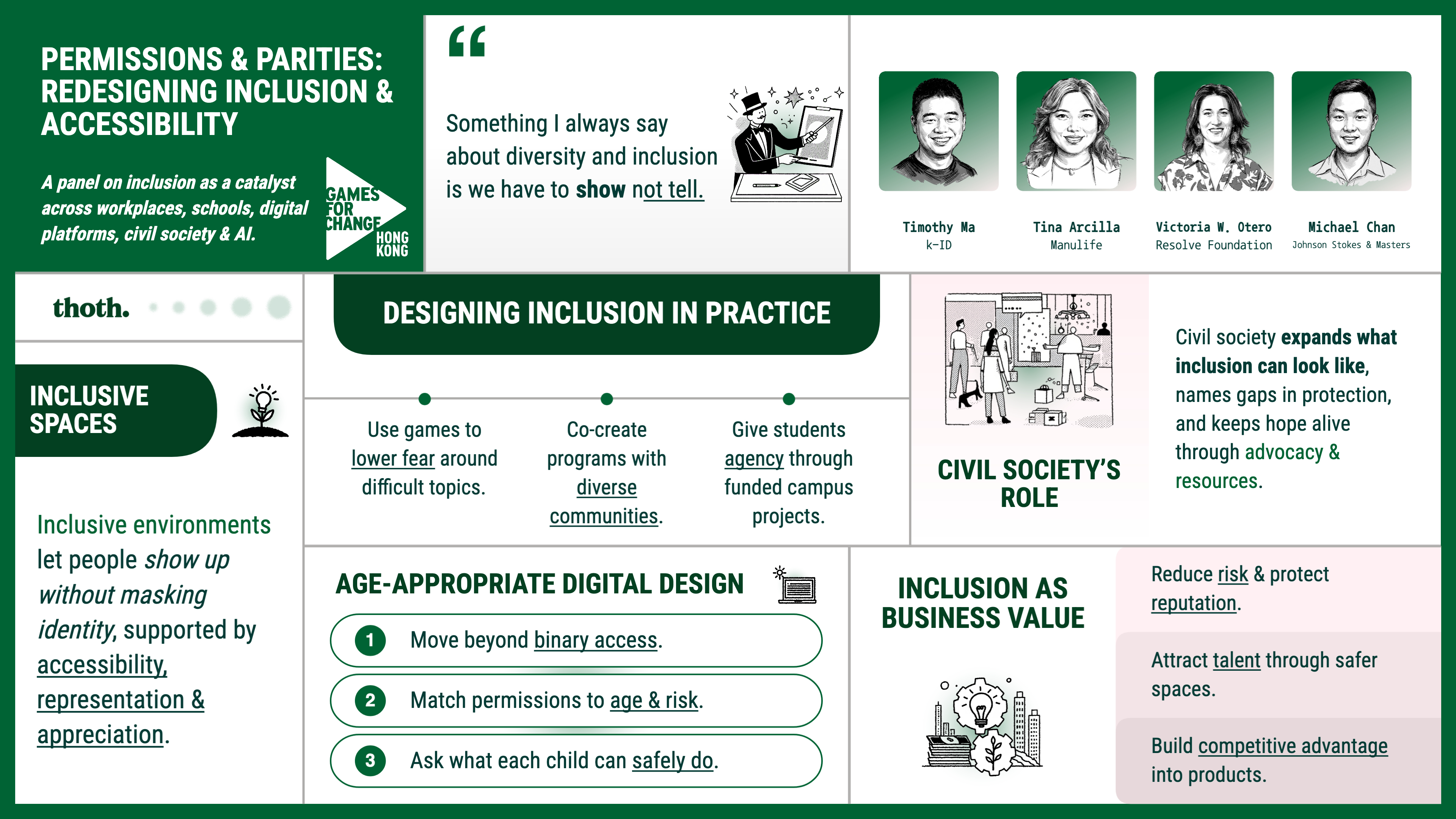
Okay, all right, let's get started. Hi everyone, morning. Welcome to this panel. Oh, let me look at it. So the title is Permission and Parities Redesigning Inclusion and Accessibility. My name is Michael Chen and I'll be the moderator of this panel today. A one-line self-introduction. So I am the responsible business lead at Johnson Stokes at Masters, or you might have heard from Vince JSM. So we are an independent law firm here in Hong Kong. I look after basically what people call CSR within the law firm. So I look after diversity, equity, inclusion, pro bono legal service, donations, volunteering. And now we are also taking care of sustainability as well. So on the panel, we have Tina, Tim, and Victoria. So Tina is from Manual Life. Would you like to say a few words about this one? One line, right? Yeah, one line, yes. Hi everyone, good morning. My name is Tina Arcelia. I work at Manualife, which is an insurance, wealth and asset management company in Hong Kong. You'll know us for MPF. So I work specifically in inclusion or DEI. This is cutting in and out. Hello? Yeah, it's okay. So yeah, I work in inclusion or DEI and I've been working 17 years in just good governance. 15 of those years have been in DEI, so across Asia, Philippines, Hong Kong, etc. Great. Not fair that everyone is using more than one sentence. I'll take that benefit as well. Thank you. Good morning. My name is Timothy Ma. I'm one of the founders at KI. I'm a lawyer by training, have been practicing law for almost 20 years. So KID is a Singapore startup that provides a technical solution to help companies and platforms to create age-appropriate experience. So it starts from age assurance, determining whether a user is a child or not, to whether parental consent is required, how that is being obtained, to any feature management, etc. etc. So we are serving some of the world's largest gaming companies and social media platforms like Discord, Twitch, Tumblr, favored it, cake, uh, supercell, central games, blah, blah, blah. So, you know, if you're interested, please go to k-id.com to take a look. Thank you. Hi, my name is Victoria. I'm the founder and CEO of Resolve Foundation. We are a charity based here in Hong Kong, and our mission is to amplify marginalized voices, empower diverse changemakers, and build intersectional communities. But in a nutshell, we help people advance social inclusion in big and small ways. I'm also a mom of four kids. I had four kids in three years. They're all really young and I live in and I love the biodiversity of Hong Kong and that's who I am that's how I show up good morning it's a pleasure to be here great thank you very much all right so let's start right in So based on the description of the panel, it mentions how inclusion and accessibility can be approached not as limitation, but as catalyst for better design, innovation, and participation. So my first question to the panelists is, what does inclusive space mean to you and why does this matter to the audience? Okay, so at Resolve we have two kind of signature programs. So one is a community change maker fellowship and we have grassroots leaders from really diverse backgrounds. Some people with a refugee background. Our youngest fellow is 18 years old. Our oldest fellow was in their 70s. We have people who come from the LGBT plus community, people who are wheelchair users. So in our program we really try to cater for all these different audiences and make sure that it's a welcoming space for them. And then on the flip side, we're also doing work in secondary schools. aren't the privileged secondary schools. These are band three schools. Some of them are very ethnically homogenous, but they might have high special needs kids. Some are very ethnically diverse. And I was trying, you know, these two programs are very, very different, but I was trying to really boil it down to the essence of what do we try to ensure across all our programming. And so when I think of what is an inclusive space, I think the bare minimum is that people don't feel when they come into the doors that they have to mask their identity. Actually, they can wear it with a badge of honor. So what the common denominators we try to promote is, I boiled it down to accessibility, representation, and appreciation. So what does accessibility mean in how we create that inclusive space? So it looks like the languages that we're operating in, in the secondary schools, we have to make everything not just bilingual, but trilingual. What is the experience of being in the venue? Is it accessible for people who might have some physical needs or wheelchair users, for example? Is it conducive to there being childcare support? is also the experience of getting to the venue, not just when they arrive. And also, can we help give people a transport allowance to come if they need that, so that we're catering for people from socioeconomic backgrounds, lower socioeconomic backgrounds. On representation, it's about how do we have people from diverse backgrounds within our leadership team in different advisory bodies. Recently, we also came up with a new participatory grant making body that is people from the community. How do we also ensure that we have co-creation in how we do our programming? And then appreciation. So are we valuing people's times? So we give, for example, people who come to our fellowship speaker honorariums. How do we also celebrate aspects of diversity and value them? And also, and this is the most crucial point, is how do we make sure that our philosophy when working with marginalized communities comes from a strength-based approach, not a deficit-based approach? So that's something that's important to us. We're not perfect. You know, I think that there's a lot of things that we wish we could do better, and we're committed to that. But yeah, we really try our best within our means as a small NGO. Thank you. Yes, deserve a round of applause. So, you know, for KID, as the name suggests, right, we work on kids' privacy and, you know, online safety for kids and young audience. And so when we talk about inclusion, From our perspective, inclusion actually means kids' participation with the right safeguards. So what we believe is that it is not enough to say that someone technically allowed in a space if the space was never designed for them to participate safely or meaningfully so there's a very important distinction for you know children kids and teens online a lot of the digital spaces right now were originally designed around adults So say for example, right, with Instagram, WhatsApp, Facebook, Snap, and et cetera, et cetera, right? A lot of these online, you know, digital spaces are actually not designed with kids in their mind. And therefore, if you look at their terms of service, a lot of them will say, if you are under the age of 13, please do not. use our service. But I think in reality, a lot of us know that kids are spending a lot of time on these platforms. And in a gaming context, say for example, Roblox, right? We have majority or they've got a lot of the kids and teens are actually playing on that platform. Even though like, you know, companies like Roblox are spending a lot of time and efforts to try and create a safer space for kids and teens. But, you know, from our perspective, just opening doors to them is actually not sufficient. This is not meaningful, inclusive. or inclusion for kids and teens. What we believe in is that it needs to have the right safeguards so that when kids and teens go onto these platforms, they feel safe, they feel confident. So by way of analogy, if the kid is asking the parents, Daddy, Mommy, please bring me to Disneyland, right? they happily enter into the gate, look at the trains, look at the castle, it was a happy playground. So sometimes people would say that this is inclusion already. But just imagine when you are lining up for, say for example, it's a small world right and all of a sudden zombies you know jumping out of bushes and start scaring and and chasing after kids that is not safe that is not inclusion right and kids would never want to go back to Disneyland again so I think inclusion would really mean that yes we need to you know create a safe space we have to you know create a space for kids and teens to be to board to those platforms but it has to be have some you know safeguards and you know in a later part of the panel we'll also discuss a little bit on what does that really mean that's really Interesting. I love that idea of safety, the basic requirements, but actually even like not having zombies is about having suitability as well, right? Like what will make them feel comfortable. And that for me is really important when you talk about inclusive spaces. So I think in manual life, one of the things that we pride ourselves in doing is making sure that the physical space is accessible to all, but also helps Not just people, I think when we say accessibility, people automatically think of physical disabilities, but it's really about making sure that the space is adaptable. and usable for everyone. There's enough ways to customize the way you use the spaces and that also extends into the digital space but again we are also not perfect. I think that's something that we need to work a lot on, the digital access. I think when we talk about inclusion For me particularly, yes, it includes the communities that Victoria works with. But the other thing that we need to do within Manual Life is to think about those who don't identify as being part of certain communities, whether because of just not aware of it or they're not yet part of it so for example we are all potentially going to get disabilities as we age or just go through the world but also to expand that thinking into their loved ones the people that they cherish but also even beyond that into community so allyship that's something that Victoria's organization does as well and that we need to do within the corporation of manual life But when I talk about inclusion, it's not just a feel-good feeling and that sense of belonging within the organization, which is important, but as a profit-making... company it's also about making sure that we engage with our customers and with potential customers for a service like include sorry like insurance it's actually a very valuable service and so many parts of the world are underserved underinsured it's tended it they tend to put it aside when I think a lot of people would benefit from it, especially with all the uncertainty going on in the world. So part of what we're doing now is extending the discussion of inclusion into products and services. So how can we protect those who who traditionally have been forgotten or intentionally just not included or thought of as valuable enough just because of certain, I think, practices culturally, historically that have been in place. Great, thank you. Thank you all for sharing. So the next question is, How do you design or embed inclusive and accessible sort of concepts in your line of work? So I think we have alluded to that, right? I think we have talked about co-creation. We have talked about strength-based approach. We have talked about about user centric, so Tim mentioned like kids as being the center of the designing the digital space. So how do you embed those values, those concepts in your line of work? Maybe let's start with Tina again. So you, we will based on from our one on one, we talked about like there are two examples, right? One that is embedding it in your learning and development practice. And the other is You mentioned participation of your general employee using them as a center to bring those ideas to your practice. So could you share a little bit about that? Sure. So the first point is really around using games within the organization. So I'd love to bring in, so we actually worked with Press Start, Vince's organization, to design a game. It's set in outer space, it's really fun, but at the same time it tackles unconscious bias, specifically in talent management. But at its surface, it's just a really fun game. And so that is something that we and my team recognize because I think the topic of inclusion tends to be quite scary for some people. They don't want to say the wrong thing. People are kind of pressured to be in quotes politically correct and therefore they're too scared to engage in dialogue. And so that kind of breaks down that fear and provides a safe space and mechanism to actually talk about things in an indirect way, but actually during the facilitation process they eventually bring up real life examples because I think they feel safe to bring it up. We've also experimented with other types of games. So in talent development, leadership development, for example, working across different markets. we've used like a virtual escape game so teams across the region could collaborate and solve a problem together. The other thing though is around that idea of feeling safe enough to pitch ideas and be part of that process and so I think it's really important to build scaffolding around obviously games, but in the workspace it's providing very clear reasons for why you're doing inclusion, so your purpose, the mechanisms that you have in place, but also encouraging people to take part and play. And so for example, I had a colleague who's not engaged in inclusion work at all, just a regular employee, reach out and say, hey, I saw that you're building all of these policies and everything. I didn't see anything around people with dyslexia. So I was really interested in that. I used ChatGPT, generated a few... a few tips and here they are. And so I think that idea of just making people feel that they're part of the process and making adding input into it is part of the work that I do and then giving them feedback and saying okay this is how we've integrated it thank you for being part of this and so they see themselves as an active player in building inclusion within the organization great thank you Tina I want to move to you Victoria because I I one of my aim for this panel is really to bring these like concepts of inclusion and accessibility to with really concrete examples that are happening right now in the workplace and in schools um so uh and also in digital space so from tim's perspective so victoria so you You just mentioned that Resolv has been deploying like uh like games in in school programs. So could you share a little bit about how you're doing it uh in in different schools? Yeah so um I think with uh inclusion issues something I always say about diversity and inclusion is we have to show not tell. Because there's a lot of jargon. you know, this unconscious bias, microaggressions, intersectionality, lots of acronyms as well. And I think that, you know, stories and storytelling is definitely something that results has been dialing up because that's a way more powerful tool and games are also a really really important tool as well especially with young people because if you go to young people don't be a bully don't discriminate you know it's not really gonna work so we have developed three opportunities for play in schools the first is the kind of I guess the gateway and we do it in a school assembly and it's to teach kids uh unconscious bias and so they're like in a kind of survivor situation where their you know their boat has landed on desert island there are like a few characters at first we were having them role play so they literally had the character on their head that they would wear we quickly realized that was way too complicated in a assembly style setting with so we failed fast and we made it more simple but they're only given very uh like very small information about the character. Maybe it's a man in his 40s who's very muscular, or maybe it's a 79 year old woman. And they have to pick which character they would choose for a certain mission, like hunting for food or taking care of the children. And they make a choice, they lock it in, and then later more information about that character is revealed. And it makes them realize that actually they had, you know, it kind of shocks them about their own assumptions that they had. So, for example, the seven-year-old woman is a survivalist who has a lot of first aid experience, but they put her with child care, for example. And, you know, just to give you, this is an actual testimony from a secondary school student after having done that game. So this is someone from a Sheckley school, and she said, I had a very big awakening about myself. I discovered how much I judge people. by their appearance. I knew I did a little bit, but this game made me clearly see just how much I judge by looks. As soon as I saw the characters, I quickly came to the conclusion, thinking that because he was so muscular, he must be a bad person. But it turned out he was actually a very gentle father. The second game which we do to student leaders who attend a leadership academy is a choose your own adventure and that's a way to teach them about how to be an active bystander. So there's a 5D framework. If you witness an oppressive moment or a discrimination or bullying, you have direct, distract, delegate, delay and document. And they choose one, and then there's kind of these consequences, and they go on the, you know, and then sometimes things, if they direct, for example, which is more confrontational, the conflict escalates, and then they have to figure out how to come down from that. So it helps them understand that there's actually no one-size-fits-all formula and how to adapt in the moment. That's the second game. The third is not a simulation game. It's a real-world sandbox, which is that we actually give the students funding. So we give the students 10K in funding to drive their own inclusive campus project. And for a lot of these students, they've had to come up with a budget they've never had to pitch something and for some of the schools it's the first time that us there's a student-led initiative on inclusion and some of the issues that the students identify as the problem areas that they want to address aren't necessarily the first things that the teachers would have thought of so it's really about giving students agency and giving them the resources so that they can be active architects in driving inclusion in the campuses. Thank you. Great, wonderful. So now you heard from a corporate perspective how games are being used in the practice from from a nonprofit perspective like how games are being used to explain very complicated ideas regarding DE&I and inclusion and accessibility. Tim now I'm going to move to you not exactly like designing games or deploying games but you are creating a safe digital space for kids and teens to, one of them, play games. So could you share a little bit about how you... create that space? Thank you for the question. And I really love the games that you've shared, Victoria. Sometimes I do feel that even adults would benefit from those games as well. So thank you for sharing. So in terms of the digital space, I would say that an age-appropriate digital space does not mean that, okay, it's either a kid's game or we block kids completely outside of the games. And let's face it, right, every kid is different. Every family is different. Every country is different. Every culture is different. And even like, you know, if a kid with the same age, same culture, same country, you know, some of the family values could be different as well. So in our mind, there's no one size fits all. The online experience has to match with the users, you know, stage of development, the risk of the different features within the games, the expectations of the families, and, you know, myself being a lawyer in training, we also need to look at, you know, the laws of different jurisdictions. So what does that mean? A 7-year-old, a 13-year-old, a 16-year-old could all be minors, but they do not need exactly the same digital experience. So the practical way to create an age-appropriate digital space is to really break down the experience into different features and permissions. So say for example, can this user chat with strangers? Can they receive personalized recommendations? Can they make in-app purchases? Can they join any chat groups? Can they share location or personal information with third parties or with the platform providers? Can they see certain content? I think those are not all or nothing questions. They can be really designed differently for different ages and at different levels of risk. So, we strongly believe that this is an important design shift from binary access that is yes or no, you can or cannot get into certain platforms, to adaptive access. So, instead of asking only, hey, can the kid enter into this service, perhaps the better question that we should ask ourselves is, what can this child safely do here? and what support or permission is needed for the next level of experience. And if we do that well, we believe that we will be able to avoid too worst outcomes which is number one young people being treated like adults or young people being excluded entirely thank you great thank you team um so it sounds like there is um like a there is a more a a flexibility in terms of it's not like a binary decision it's like it's not yes or no it is really about depending on like many other features uh including like different locations jurisdictions uh and and its laws and regulations right um so Speaking about laws and regulations, this we have talked about, I think, with Tina and with Tim, is compliance enough? Or what are we trying to do here, right, when we talk about inclusion and accessibility? Is it just about meeting the basic hygiene level or basic minimal requirement? Or are we trying to achieve a little bit more than that, right? So now moving into like when we talk about laws and regulations, usually as a profit making company, like sometimes it might be constraints and challenges to move. around so um is profitability of a game or any kind of business really a dichotomy of incorporating like inclusion and accessibility elements um or like what are some of the key elements uh that could make a product or a business um a a success while incorporating inclusion and um accessibility values in it I think Tim or Tina, who would like to go first? Sure. So one of the very interesting The journey of starting a company is when we're selling compliance tech to our fellow game studios or any platform companies, the major concern is if I comply with the laws and regulations around the world, is that going to substantially affect my monetization, my user acquisition? I think the journey that we'll walk through also teaches us a lot of things on how to balance the two, which is profitability and Inclusion. We think that when inclusion is treated as something that you bolted at the end of the process, or when safety is only designed as a blunt interpretation or interruption rather than part of the product experience, or if a company builds an adult experience first and then add the compliance pop-up at the end, it is not surprising that it is typically seen as a use of friction that could cause a more substantive business interruption. So I would like to you know introduce the concept of good safety and bad safety over here so a bad safety is you know a confusing pop-up a hard logout or repeated consent process or process that asks you know kids and families for too much information too early a good safety is a proportionate privacy preserving future based and built into the experience Bad safety creates friction, but good safety creates trust. As I've stated earlier during my introduction, we serve many of the big gaming companies around the world. And if we zoom into, say for example, Brazil, Brazil is really the first country in the world that is requesting game companies to implement age assurance measures when users are accessing certain features or certain services. So what is age assurance? Age assurance simply means you know technical solution to determine what the age band the user belongs so say for example you know there are methods like facial age estimation we scan your face and we're able to determine what age band you're in there's an id verification where scan your ID and then we'll be able to determine your date of birth and there are some localized methods as well. So when we're working with a lot of these you know game companies we encourage you know good safety and so it becomes part of the user process right we determine what features are of high risk and what you know what age bands of the users need to go through this age assurance process. What we found is that when we do it right, we are actually able to achieve a very high user stickiness. So just give you some examples. There's one localized method in Brazil called the CPF checks. So, you know, everyone in Brazil understand what that is. And so they are very, very, you know, they trust this process. They trust this method and it's very privacy preserving. All they ask for is your CPF number and you will be able to determine the age band of that user. So we've seen a super high level of success in this where we get like, you know, around 95% of users completing the age assurance process and then, you know, they will be able to have an age adaptive experience. KID also provides another you know product called H-Key. You might be able to read that as an open H initiative in the world. It's covered in in major press as well. Essentially what this product is is that you know an H-Key is being stored on your device using passkey technology. And so it only takes 15 minutes or less to complete an age assurance process. It's as simple as you unlocking your iPhone using your Face ID or using your fingerprint to unlock your Android devices. Using this method we also have you know over 91% success rate for users to complete age assurance process so all these numbers what does all these numbers mean right it means that with good safety with you know compliance with you know age adaptive experience with inclusion being designed as part of the gaming process it actually does not create a substantive you know business interruption and so you know are you if you do this right you get the best of both worlds thanks Tim from my perspective you You can go about incorporating inclusion as part of your business in at least three ways. One is around risk and reputation. So the risk of not, you know, doing the CPF and all of that, there is a risk associated with that. So you get penalized. you know, even thrown in jail if depending on what that law that you're breaking is. So very, very important. And in some jurisdictions, there are quotas to do certain things to meet, you know, DEI requirements. The second thing is around people and talent, so attracting the best talent. So if you do the right thing, if you make sure that your spaces, both physical and digital, are inclusive, you tend to get people who want to be in that space, who want to feel safe, want to feel that their ideas, no matter how different, are welcome. The third piece is around competitive advantage. And that's really looking at how can you include inclusion from the design from the start and offer that as something of value to customers. and something that will give you actual dollars as a company but also add to your reputation and so I don't think that doing anything around inclusion is automatically gonna take away from your bottom line I think it adds to it for sure just a really quick thing around our inclusive business strategy. It started out a few years ago and where we started was really understanding the communities that we wanted to open up to. And so that started with empathy sessions, going across Asia, looking at gender spaces, looking at LGBT communities. people with disabilities, people from different socioeconomic backgrounds. And so that started there. What are the pain points? Where does the friction happen when they interact with financial institutions other than Manulife, but also with Manulife? We wanted to know where we were getting it wrong. And so that's really important. And so actually, instead of locking out certain communities, we were starting to open it up again to people who have not been offered insurance before, but also the people who support them, the people that love them. And so even in markets, like Indonesia for example which we know is tends to be quite conservative and in religious they actually approached my team and said we love what you're doing how can we make sure that we are being inclusive to our LGBT customers or potential customers and so they came up with a tagline of protecting the ones you love very simple does not lock away certain demographics but also it I think it's a very soft way of signaling to the communities that we are ready for you as well as keeping them safe so that it doesn't say, hey, we're an LGBT friendly organization and everyone who comes to us. be from that community so there's layers of that and that comes from empathy and that comes from a very strong adherence to human-centered design principles which I think permeates through how we design products and services in manual life great thank you Tina and Tim I was looking at the time and we still have a couple minutes i do want to pose a final question to victoria before we open up the floor for q a victoria this is a relatively um well i'm going back to the concept and philosophical question because um we Like, throughout the panel discussion today, we have covered different sectors, right? Corporate and school, education, nonprofit. We have talked about physical spaces. We have talked about digital spaces. And at the end, we covered community and societal and how, like, in different... buckets, different parts, different sectors. Like everyone is doing something on like making sure that others feel included and and and they can access spaces, right? I want to sum up as a final question, and this is also related to everyone here in the room, so to what extent civic society plays a role in enabling inclusive and accessible values to be incorporated into different industries and different sectors, let it be the gaming industry or education sector, workplace, any thoughts on that? Who wants to play a game? Yeah? Okay, all right. I'll give you a hint. You only need one hand for this. How many anti-discrimination ordinances do you think there are in Hong Kong? Hold up the number with your fingers, please. I'll give you to the count of three. One, two, three. Okay, okay, interesting. So, thank you. So the answer is four. Can anyone popcorn style shout out which ones they are, what they cover, what kind of discrimination they cover? Disability, that's correct. Any others? Race, yes. Sex, yes. Sex and also family status, which is kind of the odd one that people are like, what does that mean? So I think that that's not good enough in Hong Kong. What's left out in that? Age. So do you think it's okay for young people to be discriminated against in the workplace? I think no, right? Religion, sexual orientation and gender identity. Those are all left out. I think the role of civil society is to have more aspiration for what's possible and to expand the imagination of social inclusion. And we are small potatoes. fraction of the resources that you know corporates might have but I think we play a big role in advancing certain norms and standards and I think that there is a world you know there is a Hong Kong that has gender neutral bathrooms in public facilities, that has wheelchair users that can hop on and off public transport without needing help, that has gender neutral parental leave, for example, and more amounts of it, by the way. It takes time, and a lot of times we don't see this in our lifetime, but it's a worthy cause. And I think the role is not just about forward thinking and noting the gaps. but also celebrating the hard-earned wins. I mean, the fact that children have free schooling, the fact that everyone kind of knows that women should be on boards, that kind of equity isn't by chance. It's because people pushed for it. The race discrimination ordinance, for example, only came into effect in 2009. And that was because of a lot of work that civil society groups did. to advance it, decades of work. So I think that is what civil society can do. Now, I also think that nonprofit organizations for myself We often look at the role of our organization in the world, but we have to look at the world of our organization. And RESOLVE is actually an acronym. It stands for Rights, Equality, Solidarity, Organization, Leadership, Voice, and Empowerment. Those are intimidating values, even to me sometimes. But I remember a disability advocate I talked to. He said, the scariest companies are the ones that say that they're doing great. And so I acknowledge that there's more that, you know, even organizations like myself can do and role model. I've said a lot of the big stuff, but I think there's also small stuff as well that matters. You know, small actions, ways that we show allyship in our... everyday life. And one of the things that civil society can do and that we've done is develop resources. So we actually have a free bilingual equality toolkit for allies that is available on our website that teaches some of the concepts that I've mentioned today. We ourselves are organizing an inclusion quiz night. So if you liked the little game you played, we have more of it. And we're going to do that on the International Day of Friendship in late July. So, you know, please stay tuned for that. And ultimately, I think I see that civil society, we are custodians of hope. And we do need that in these times. Thank you. And that wraps up the panel discussion and I'm now gonna open up the floor for one question. I saw Vince was doing that. Questions from the audience? One or maybe two? One? Okay. Two? Okay. Hello, hello. Okay. In recent years, many digital spaces for kids like Club Penguin or Animal Jam. They've been a lot of them have shut down or shifted towards a more like commercial way of marketing to the kids, right? So what can game developers do to create more safe but also fun spaces for kids? Tim, that's for you. The simplest answer is come talk to us and use our solution. That's the easiest way. I mean, From our perspective, I think this is actually a good sort of, you know, okay, let me take this back. From our perspective, right, we are glad to see that, you know, there are businesses that are, you know, starting to really focus on delivering, you know, child appropriate or age appropriate experience for kids and teens. They appreciate that there's a commercial opportunity over there, right? And I think that, you know, I mean, every company apart from non-profits, you know, profit-making organizations. And so they just need to find a way to commercialize and be able to build a sustainable business to deliver an age-appropriate experience for kids and teens. So one of our clients is Coverstar. I don't know how many of you have heard of that social media. platform great because that platform is designed for kids and teens right um but this is great because like it really provides that sort of platform for kids and teens to really enjoy what an online experience would would look like so just going back to your question right i i think all these gaming or companies or all these social media companies should look at what sort of features are safe for kids and teens right um they need to think about say for example chatting with strangers could be you know dangerous for for kids and we know from the experience from you know some of the largest you know child oriented gaming platforms there are a lot of you know um um sex portion and stuff like that on those platforms so i i think we need to look we need to look to look at you know future level controls um let the parents you know get back into the picture and have a meaningful discussion with the kids on what sort of you know online experience um they should have um i just want to thank you for asking that question because it allows me to bring up an anecdote that i was hoping to share as a parent So my kids are finally out of the goo-goo-gaga stage and the the oldest she's five years old She can finally start to play board games, which is really exciting for me. So I was really You know looking forward to playing Candyland with her. I don't know if you all know that game, Candyland, but it's been around for decades and I bought it and when I opened the board game it looked so different to what I remembered as a child because the characters were so much more diverse they had different skin tones there were kids with different abilities in it it was just amazing and I remember being really impressed by that and kind of looking this up a little bit like how did that happen? Because before all the kids were, you know, white, blonde hair, blue eyed kind of thing. And I learned a concept in the education space called mirrors and windows. So Timothy mentioned about safety and another aspect is belonging. And so when a child opens a game like that and they see someone that looks like them, it validates their existence in the world. And that is the mirror aspect. And then there's the window. So for kids like my daughter, I love that she can see kids of diverse backgrounds in those kinds of games and in stories and everything. And I try to expose her to different aspects of diversity. And that is a concept called windows, that the kids can see windows into other worlds. So I would encourage people in the gaming community to always keep that in mind. What's the mirror? What's the window? Yeah, thank you. One? Okay. All right, one more question. Thank you everyone for the talk. Since we're talking about age appropriateness and safety, I want to bring the question to the usage of AI for young adults or children. Let's say in general purposes or even in games, for example, where they might be using AI to let children have interaction. What are your thoughts about that? How do we make... it appropriate because AI is such a it's so it can be anything right what it generates so how do you control that if you need to do we need to control that yeah just thoughts I think this is for Tim probably as well but feel free to ask Great question. I have like to said like, you know, AI is almost everything right now, right? And in the past two years, AI has gained a tremendous philosophy, philosophy, velocity in gaining adoption. And let's face it, right? Kids are using, you know, AI more and more and more. My, I have two girls, one is 14, the other is 12. They're using AI, you know, for the research and sometimes secretly, you know, they use AI to do their homework as well. So, you know, we actually have experienced a wave of like, you know, great momentum at KID where a lot of the AI companies are actually aware that, you know, they need to deliver a safe and, you know, age-appropriate experience for their kids and teens. And, you know, if we look back last year in the US, One of the largest AI chatbot companies in the world is called Character AI. In the US, they got into a lawsuit and finally settled with FTC in the US because they were not able to provide an age-appropriate experience. So, whilst we've gained a wave of momentum in terms of serving more and more clients in this space, we've also learned that AI companies, especially the AI chatbot companies, there are oftentimes in the gray area, say for example, they'll be able to make virtual friends in the AI space. These virtual AI chatbots are like, Are you lonely tonight? Do you need someone to talk to? Or like, you know, asking questions like, are you sure you should be Staying alive in this world, do you have meaning in this world? All these are super scary experience that kids could get exposed to. But what we're seeing is that yes, we need to do something about it. But at the same time, it's very encouraging for us to see that many AI companies really have this awareness now. like you know open ai and frog pic and some other you know companies are already doing something about it even for like you know x and grog you know they're internally thinking about this on how to do this right yes i know um but yeah but it's it's pretty encouraging 30 seconds. Sorry. I think beyond the safety issue, it's about teaching kids and adults to use it as a tool and use it responsibly. Taking it back to when I was a kid, Googling was seen as something bad because we would forget how to use the library, how to use the card catalog system. It is a useful skill, but technology does move on. There are ways to use it responsibly. My team uses it, but we're very intentional in how we use it. Dr. Lindsay said it earlier. It's about collaborating with it and iterating and all of that. So, yeah, let's not... be scared of AI, let's be cautious and use it as a tool and but use it responsibly. Thank you all. So I don't... Alright, I'm gonna wrap up the panel discussion. Just a quick few words. First, thank you very much for... We have a very diverse... panel from different sectors with different expertise but with the same goal that is to design and to embed the value of inclusion and accessibility in their line of work and I would like to encourage you all to really reach out to them and to chat more and to learn more about their work and with that thank you very much and we'll see you in the rest of the conference thank you Thank you so much. Thank you so much. Thank you all for coming
MADE WITH