6 of 9
Transcript
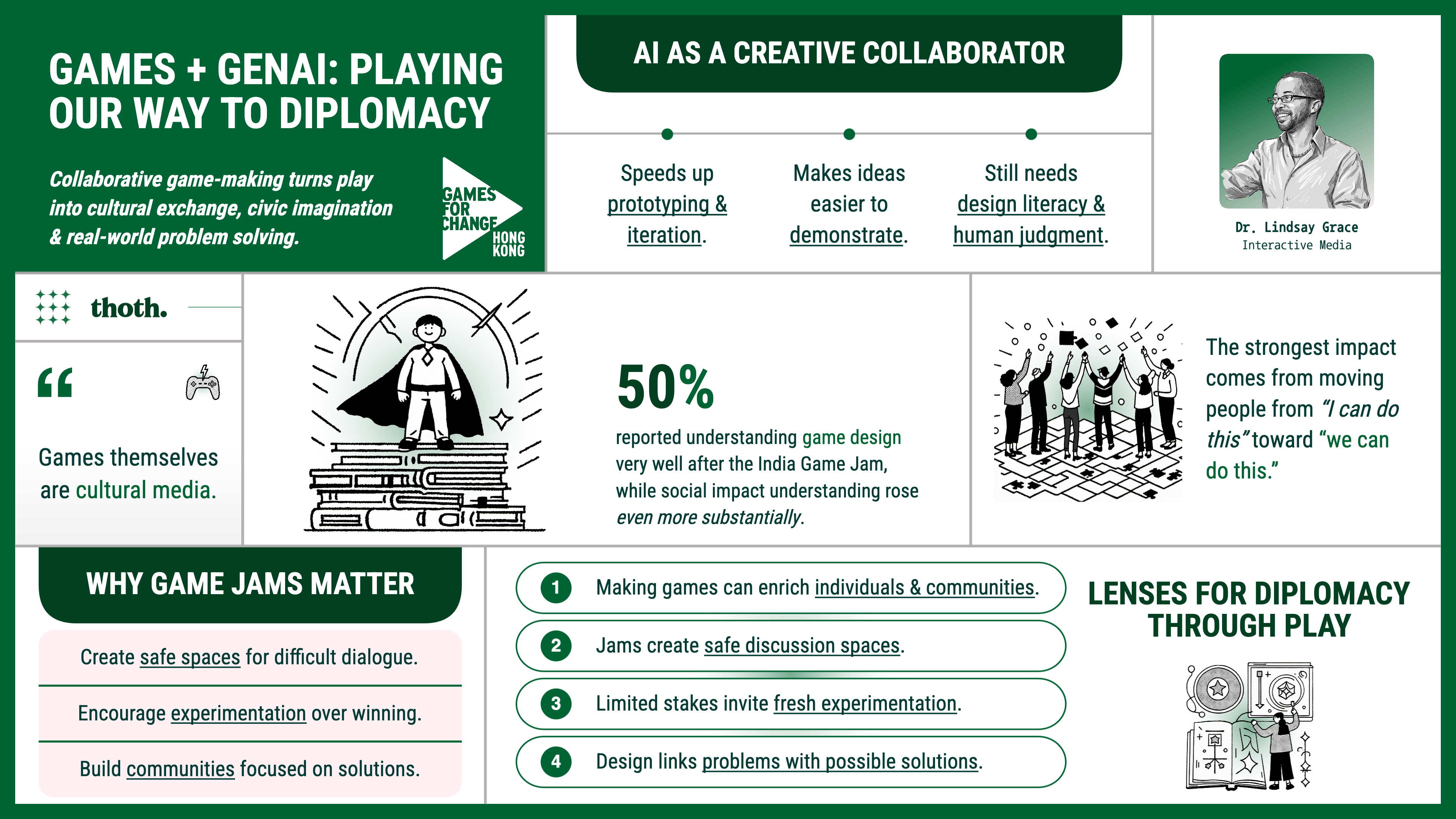
Is this is yours unknown content should we be protected? We will oh, okay, thanks Jack There you go All right, thank you. Thank you Before I get started actually, just a little context. So I have curated, I think, two or three games for change. And because this is a festival, if I can ask you guys to applaud Vince one more time, because I don't think if you've never done this before, you don't realize how much work it is. So you should really appreciate what he's done. Great. Okay, so I'm just going to get into it. If I talk too quickly, let me know. Otherwise, I'll go at my usual pace. So what I'm trying to do with this talk is kind of introduce this notion of global lessons in games for cultural exchange. But I'm also, at Vince's request, going to cover AI and social impact games. So it's going to be a very quick tour in 20 minutes. Basically, one of the things I often talk about is game jams as a means for structured social intervention. So as just mentioned, games are actually about people, not just the experiences we build. And so I'm going to focus on the sort of people aspect. And what I'll be doing is drawing from my prior experience, co-organizing game jams in places like Malaysia, some participants are actually here, as well as Istanbul, Kyoto, Osaka, in Japan, India, and many others. And basically the idea is to sort of expound on what I've learned from running workshops around the world around social impact games and game jams. So the idea behind a lot of this work is basically practicing cultural diplomacy. This is the reason that the US State Department has funded this work and why others continue to inspire it, including Games for Change. And really the idea is that games themselves are cultural media. So I've spent years doing a variety of sort of exhibitions, both formal and informal experiences designed to help people understand that games are cultural media. And if you combine these two concepts, the core thesis here is really games as modern cultural media and a means of communications diplomacy. So you can kind of think of it as a solution for game making instead of gun making. And games are often aligned with things like violence, so I see that feels appropriate. And the simple way to think about it is that when we do this kind of work, what we're doing is the kind of quiet work of diplomacy. And that quiet work of diplomacy is focused through making games together. And I emphasize making games together. Sitting down with workshops, helping people through their various problems. And I'd also argue... that it's a way of sort of facilitating engaging civic imagination. So encouraging people to see their world and imagine new solutions through gameplay and game design. So when I sort of frame this, this is one of my more recent pieces of research, a lot of impact-driven games, this is when I get academic, are often sort of focused with this pre-post experience where we think that we're going to get a person, turn them into a user, that user is going to become a player, we're going to change their behavior through some cool little game, and then we're going to change the outcome. And it's a very linear perspective on how people change. And I actually think that that's an inaccurate frame. So I'm going to give you a little foundation for what I've seen most of in this domain. And I kind of call it a game engine for change, referencing the way that an internal combustion engine actually is about rotating through a series of chemical and physical changes. So basically, Game Engine for Change works like this. You've got users at one end and you've got players at the other end. And they, as users, have an extrinsic motivation. This game was assigned to me. I was required to do this game for some reason. I'm curious about this topic, so I decided to come in as a user. And ultimately, what our responsibility as designers are is to change them into players, people who are intrinsically motivated, engaged in the experience, and they want to stay there. So while they know that they're users and there's the world outside, they're trying to stay in this play state. space in between. And so most of games for change efforts or social impact games efforts are really about managing the difference between the extrinsic motivators and the intrinsic experience that we've created, bringing someone into a world and keeping them there. And so I think a lot of the change occurs at that point. The gameplay itself is a sort of engine for change, that domain of play. So I think it's important to recognize that game making is sort of the engine that keeps people staying and that game making, just like game playing, can function the same way. So these players here, AI generated, are basically engaged in trying to solve the problems and explore the topic that we see in an often in game jams. So really, I think one of the things to recognize is there's renewed benefit or renewed value in the actual process of making. And I say this full well, knowing that lots of people are probably vibe coding solutions and thinking game making is gonna be simplified by a couple of prompts and an AI agent. But I'm gonna get there in a second. So I think it's important to recognize that the engine isn't just the software, it's the actual event. It's the way that we interact with people. It's the kind of experiences that we're having right here that you'll have throughout the day where you're having conversations that you might not have had had you not been in the room with others. So the play of game making itself is part of the power of the change. And I think that we should emphasize the value of events for this specific reason. So there is an opportunity in these events to create a version of diplomacy that's really about diplomacy through design and play, thinking critically about the problems we're trying to address through our game design and working together as community members to understand them and potentially create solutions. And so in a lot of these, of course, we recognize that we're changing people through education. You're in an educational institution right now, and we recognize that there's sort of propensities for education to change, but I'd also argue that there are ways in which making games with other people changes us even more fundamentally. It's not a foreign concept to people who are, say, in art practices and recognize that art collaborations have real world change for both the collaborators and the people who experience the outgoing art. So the idea is to really focus on the process of design as beneficial to changing not only the people who experience the outcome but also the designers themselves. I think there's something very healthy in designing games and working through problems that way. And I can give you some published peer-reviewed controlled environment study. So we published back in 2025 using our India Game Jam at a not university an analysis of how people changed during their game jam experience and of course as one would expect they felt like they had understood whoops I'm going back. They had understood basically the fundamentals of game design and that they had improved them, but you can see it's a marginal improvement. They went from somewhat well at 47% to very well at 50%. But when you look at how much they understood the social impact issue that they were trying to create a game around, it is far more substantial. And I wanted to be able to quantify this because I think it's really important to recognize people learn more about social impact issues they design around than about game design. So I think it's incredible given that that's a simple weekend and their confidence and their interest in these domains change. So I want to kind of share with you how we produced this change. The easiest way for me to describe it, this is similar to something I just did at GDC, is to try and basically show you these five lenses that I've derived around how game jams as one case study in game making actually work for diplomacy. So really it's just about understanding how jams create dialogue, fresh solutions, and new perspectives. So research foundations basically from 15 years of doing this game jam work. I used to be on the board for Global Game Jam. I've done 10, 15 game jams, and my own art practice was focused on a kind of jam approach. So lens one is basically about game making as similar to art theory or art therapy, and you can think of it as sort of enriching individuals and communities simply by making games. Jams are often about doing things like sharing human experiences, like food. We often try to do sort of localized food and share what we've what we've made or what we've done. But also it's about sharing problems. You're often trying to deal with the same kinds of questions both as designers but also as people investigating social impact issues. Similarly, when you create an environment where it's non-competitive and it's really emphasizing creation over winning, what you're doing is helping people work together as opposed to work against each other. Similarly, I think it's important to recognize that we often structure these as separate from the everyday, which is the core concept in most art residencies, right? It's sort of you can go and do your work without some of the daily pressures that you might if you were at home. Similarly, when you cover things like food, space, and tech, what you're really doing is saying, we've got the basics handled for you, just think intensely about the problems you're trying to solve. And so I like it framed as sort of a mini arts residency, a weekend-long arts residency, and I encourage anyone to do this. Lens 2 is basically about creating safe discussion spaces. And if you think about a lot of the process of a game jam, it often starts in this sort of dialogical space where you're often sort of just saying any idea is good, we'll work through which ones will work in the future. And that ideation stage is really good at encouraging people to sort of have this no bad ideas mindset, to start fresh with a set of solutions to the myriad of problems they might be examining. And I think it's important because it helps us understand problems together. I think the problem is this, you think the problem is that. Let's converse about it because we're going to have to make a game about it in about 48 hours. And it also helps people negotiate uncomfortable topics, topics that they might not have been willing to talk about otherwise. And obviously in the world, especially in a lot of these exams that we produce, there are a lot of uncomfortable topics to discuss like climate change and mis- and disinformation and gender inequity. But basically the idea is to help people find a common language so that they can discuss these both during the jam and after the jam. And you'll notice that people interrogate assumptions as they try to work through these problems together. And they also work within these tight constraints basically to facilitate their focus. They know they don't have a lot of time, so it's like, let's really get to the heart of the problem. Similarly, jams require sort of openness to understand each other because you're working on teams, you're working with people that you might not have worked with before. And if you create a fun and inclusive environment, it really feels inspiring and good. Similarly, when we create a sort of low-stakes environment, what we're doing is we're giving people the space and freedom to explore these ideas without feeling like they're going to get an F if they don't do it right or other sort of external stimuli. So, lens three is about recognizing them as experimental spaces. Basically, a limited investment inspires experimental mindset. If I'm only spending a weekend doing this, it's okay if it's not perfect. And I think that's really good when you emphasize not winning, but actually trying something new. And it gives you some really fresh ideas. So I've talked about this and actually Vince just talked about improvisation. I wrote a paper years ago about the idea that game jams are really more like improvisational music than they are sort of competitions. And that's the spirit change between that and a hackathon, which tends to be very goal-oriented and maybe a little less festive. So jam outcomes are really like improv, and I think improv is wonderful in this context. They really say... seeds for rhizomes for further development new ideas fresh thinking and it's also shaped by community experiments the things that we've seen in these jams are things we never predicted would occur and it's because of that sort of freshness that occurs in having people mix that might not have mixed their ideas before I also think it's important to recognize that improvisation encourages any solution not optimal solutions and that sounds counterintuitive but the best thing about that is you see paths you hadn't seen before it's really about experimentation revealing alternative paths because I think sometimes when we hyper-optimise as a hyper-optimizer what ends up happening is we actually miss some paths that just didn't seem obvious at first. So really it's just about understanding that they inspire new ways of thinking. And then lens four is about solution-based activities. So when I provide pre-jam training, as I often do, I usually teach from my first book, Doing Things with Games, Social Impact Through Play. And the core, one of the core thesis in this early on in explaining how game design works is basically to help people understand that designers create problems, you probably recognize this game, and designers offer solutions, right? We say this is how you're going to solve the problem, which is why it's so interesting in a social impact context. And so meaning is often interpreted through gameplay. So what we're doing is we're writing problems as designers and And we're having players read them or ludologically experience them through gameplay. They're interpreting what we've designed as a problem and solution set. So more design can often mean, and more design plus design, a deeper analysis can actually mean more complex solution pairs, more complex relationships between solutions and problems that the designer creates. And so it encourages perspective on how each problem solution fits together. And when we work with each other, what we're finding is that synthesizing new problem-solution pairs has been interesting in looking at how we might solve a problem in the real world. And then lens five is basically this seemingly neutral environment that a game jam offers. Games have political neutrality in part because games are the kind of thing that cross all borders. Lots of people and lots of cultures have games across the world and they've been historically important for more than two millennia. And so when they're shared across cultures and time as they are, there's an opportunity to kind of see how we might actually find informal spaces to meet since many games are considered informally. So jamming creates this informal space and creates a sort of less politicized space for meeting than say a boardroom or other formal spaces. So the jam environment fosters community and support and the harmony often develops from the shared goal of actually making a game. together. So I've talked about this in some other peer-reviewed publications like Leading Social Change from the Journal of Leadership Studies. If you want to read more on that, I don't have enough time to cover it. But basically the core concept is getting people from individual agency, I can do this, toward community agents, we can do this. And I think that's really important. The I to the we and then scaling that up. By building these micro-communities of game makers, what we're actually doing is creating micro-communities of people who are looking to create solutions. And so they've become communities that support civic imagination, as I mentioned in sort of lens one. So when we do this, we're not just building games, we're building communities. And we see this When we connect through play, as many people just naturally play, and I'm showing you actually scenes from places like Miami, that's Domino Park in Miami, but we not only connect with each other, whether it's a mahjong table or a domino table, we also try and solve these problems together. We connect to solve problems. And so understanding complex ideas through this sort of playing together solution is not new, it's just that game jams and other game making experiences support them in a very specific way. So I like to remind people as I kind of close out that play is innate to human psychology. And we have nearly 100 years of academic research to support this. These are kind of my favorites that I always reference. And I have personally been researching and teaching games for 20 plus years. I've received several career awards this year. My big award was the Lifetime Achievement Award from IndiCade Horizons. Thank you, IndiCade Horizons. But I really do passionate believe as an author of 100 plus publications and books, et cetera, that, and Vice President of Global Game Jam, that play itself is practice and laboratory. And that if we understand the value of play, we recognize that play supports real world skills. So that community building is actually innate to how play has always benefited humanity. And those life skills might be things like hunting, like this adorable cat is doing. And we know that games like tag, as it's called in the US, we're basically practicing hunter and hunted, is also good practice for the real world. So historically, you had to teach children how to run from a threat, but also how to run toward opportunity, right? Like this flaming golden chicken. So... The idea is that play itself, as we've evidenced through psychology, sociology, and more, basically it supports informal experimentation. It helps us find solutions, which is why Lego is such a wonderful toy. And in the serious games context and simulation context, it's also really great at developing situational understanding that we can apply in non-safe spaces like the military. So games themselves are actually... just structured play. So we take that play and we structure it and that's what makes a game. And it's structured play to practice, experiment, and understand. That's how it benefits humanity in my understanding in 20 plus years. So you have to remember that humans play with problems. It's a very sort of human way to solve a problem. And we don't compute them. That's why we created machines and computers. And so when you think about creative solutions, it often, as in theater, requires, which employs improv, Creative solutions often require us to play with the idea, not compute them. And when we're optimizing through play, what we're often doing is actually exploring in a different way, a distinct way to the way the human brain works. So as a human... we actually tend to discover solutions instead of calculate them. This is the joy of a discovery. And when we think about things like AI, what I've found is that it actually made some of the logistics of that discovery easier by making it very easy to make lots of prototypes and demonstrate ideas to other people. But there are a lot of shortfallings that I'm going to share in a second. So for context, I've released four apps in the last six weeks that were all vibe coded. And it was in some ways very simple, but also mind-numbingly frustrating. for reasons that anyone who's worked with agents has discovered before. And for context, when I produced games myself through my critical gameplay in Mind Toggle, companies what I was doing was actually making games at about one game a week so vibe coding has actually been a little slower for me but the scale of the games has increased and so I emphasize that AI is really great at supporting scale But it's important to understand that when we understand when we describe games if you look at Tracy Fullerton's Game workshop or you look at my book or others We always emphasize this iterative cycle the idea that ideas come in we prototype we play test evaluate and it should be pretty evident that the prototyping process is supported by AI So I like that end of it and I think that if we think of them as dialogical designer prototype designer prototype constantly iterate back and forth between those, we're in a better situation for understanding how AI can improve propensities. Basically what it helps us do is shorten that iterative cycle with the recommendation that, as I mentioned, sometimes it can't be shorter in time, but you can produce more quickly. So I think one of the things I'd encourage anyone to do at this point as I close out is to encourage people to understand how to practice playing with AI. So the idea is really that you should recognize the Pandora's box is out, it's the AI is probably not going anywhere. And I think it's important to recognize that you can actually play with it the same way you play with others. And that's usually the most productive means. Basically to allow ourselves to play with the logic and computation, recognizing our own humanity in the ways that we can actually learn and teach. So play with AI is often a means of finding new ideas. And if you think about the way this works, basically, I'll give you a super concrete example. This is a game called ChemMatch that I was working with a researcher on. And I vibe coded it. And the short version is, I was like, this is really not playful. This is really dull and feels like a quiz, which is always what these things start as. So I was like, all right, great, make this more playful. This is what it suggested. It was like, I'm going to add animations, color, engaging feedback, and vibrant design, which is what I would tell a first year game design student is not the right way to go. Because that's not more playful mechanics or experience. That just makes it look more playful. And so it attempted to make things look more playful, and it was junk. Because colors and animations aren't the heart of what we do. There's far more game verbs, the kinds of nouns we're playing with, etc. So making something more playful is not a useful prompt in this current context, because you just get something that looks marginally more playful. That doesn't really change it much. And so when I think about... playfulness, it's not really a math problem or an easy substitution. It's something more human. And this is not a more playful interface. This is one of the adaptations it made. It was pretty junk. And so I think the equivalent using that same illustration that was AI generated before is this sort of, it's hard for some of these agents to identify what playful means. It can grab from some of the histories and say, ah, well, you know, I'll add a bounce effect, whatever. But it's still quite short, and that's because we, as soon as we play something, realize that we want some other dimension to our play. So this is why the iterative works. And so in my book I talk about the game design is about working with people and I still very much believe this even in the contemporary context. This is a diagram from it. Basically we span out and spin out towards more and more people and learn more from their gameplay experience. And I've argued before that AI is a rising tide and basically as someone who lives in Miami where we are threatened by climate change and there are definitely lots of rising tides, I think the idea is often to build above, so you've got to understand design well enough to actually exceed the fundamentals of game making or code. So good art prompts require a kind of visual literacy. So for example, this one recognizes impressionist painting and wide shot, which is very different than just make me something, and that's why I do think it's important to teach art history. And the iterative design, especially with AI, is really informed by an understanding of game design or understanding of art or an understanding of whatever you need to be better than the AI about. Because we've made these kinds of mistakes before. This is one of the mistakes I actually include in my book. This was junk. Sorry. Captain Novel and Makers, it was early, we're figuring it out. So, um, we know that we could potentially repeat the same market saturation problems we once created before, um, resulting in games that are rushed, poorly, uh, implemented, and not very good feeling. I think some of the, uh, app stores are struggling with this a little bit because it's so easy to make new content. Uh, and we could easily end up in a sea of game clones. But our goal is really to try and build, learn, and adjust. And so AI is going to support us in building faster with tighter iteration cycles. But it's still our responsibility to be humans thinking through human problems. So designers actually need to know where they're focused. should be and it might not be on some aspects of code although I can tell you right now there's a lot of spaghetti code in a lot of the agents I've been using so be careful. So we are not mathematical beings in my thesis. Instead, I think we're, and we're not always logical ones, instead I think we have to recognize that we might be governed by math and that math is part of the physics around us and a way of explaining the world around us. But ultimately, the optimization for whatever you're building is going to come from a balance of these sort of logical computer-based structures and our own humanity, our own psychology, sociology, etc. So we've been researching this. If you want to do more, this is sort of a plug for for a second year of a conference that we've been running within another conference basically about creative process and AI. And I have another paper that I wrote with a Google researcher to help us understand how this is being used operationally. This involved more than 250 or 230 creatives from all ranks. So if you wanna see how AI is being used, this is a decent section of our research to help you understand that. But ultimately, I think it's... realistic that we are going to see AI as a catalyst and collaborator for creative work. It's going to be part of the process in much the way you use an Adobe product as part of the process. And that's not new. If you were around in the 1980s, there was a threat that's threat that desktop publishing was going to kill greeting cards and all print and it obviously did not. Print shop was perfectly fine but everybody sort of just raised their standard when they saw what print shop and other solutions could do. So I think it's important to imagine a world where we employ the power of play that we sort of dream and employ our own humanity in computational systems. I'm focusing on digital play but also believe this in analog and where we work through problems together. to practice problem solving together as I've described and game jams frequently do, and also to support global diplomacy, solving a kind of better future through the community, expanding that community from a few designers to a larger community and ultimately globally. And that's your awkward AI animated video showing that, ooh, AI. So I wanted to make sure that I completed an AI talk with some ridiculous AI generated representation of my theme. So you got that. And if you didn't, if you didn't catch it, look at that magic. Oh, no, magic's not happening anymore. Oh, well. Oh, there it is. There's your magic. That's it. Thank you.
MADE WITH