5 of 9
Transcript
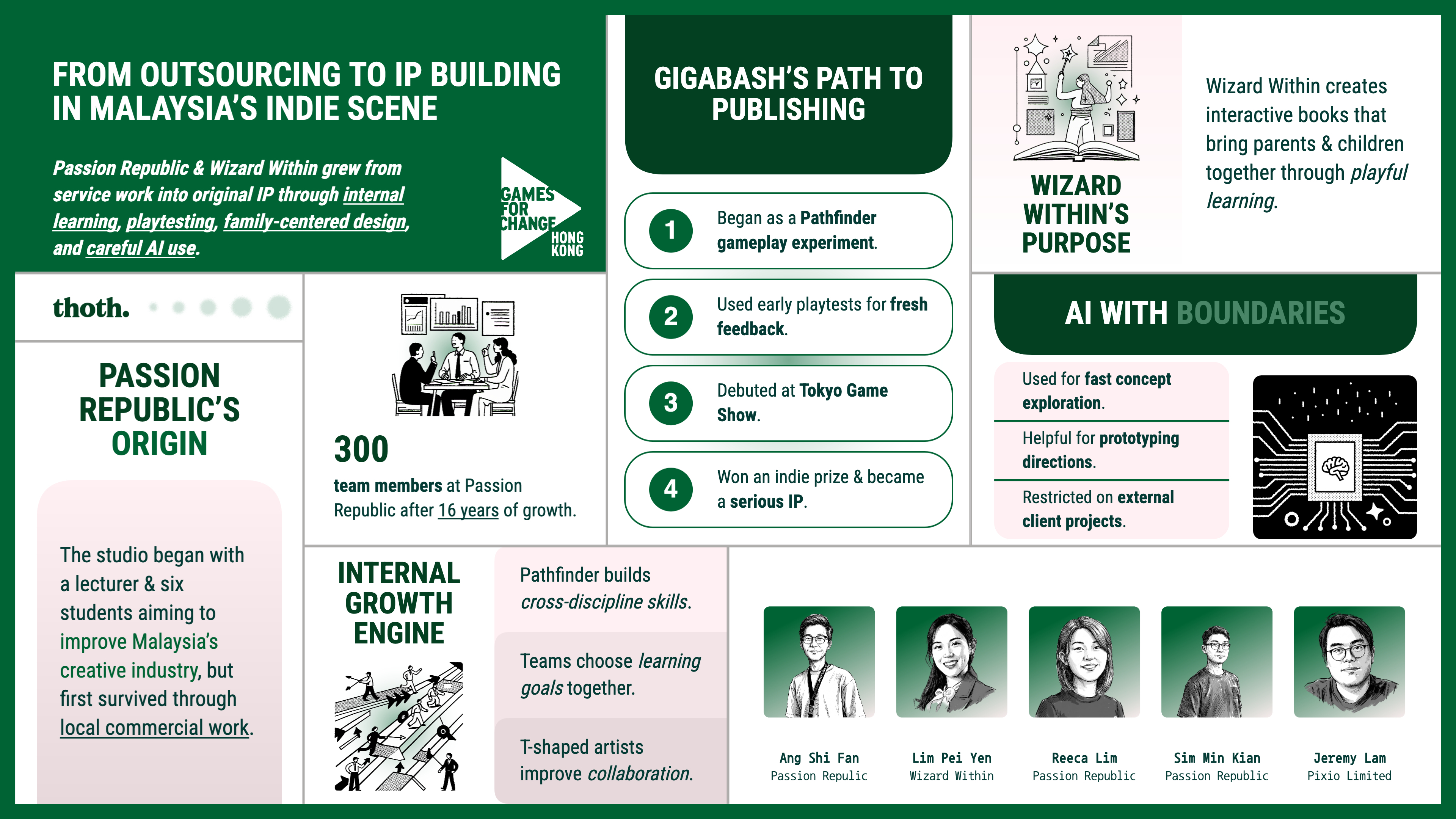
Good afternoon everybody Welcome to the Indie Track. I'm your host Jeremy Lam. I will be hosting this panel today With us We have a great panel that's through all the way from Malaysia who's gonna show us how they created their own IPs So first of all round of applause for them On my left we have Min Kian, a lead modeler at Passion Republic. And then is Rika Lim, a senior brand manager at also at Passion Republic. And then we have Shifan An, a senior modeling. artist from Passion Republic and we had then we have paying them a producer at Wizard within so before we start though uh Passion Republic has asked me to show a video of their company so can we play that oh no sound oh no sound Yeah it is on. I think it's okay I think it's okay Yeah I think so yeah I probably like it yeah I don't think it's fixed yet I'm gonna go for a little bit more I'm gonna go for a little bit more I have no idea because this is all XKU stuff. No, I can't plug these things. Thank you. I'm so sorry for the technical difficulties. I didn't go to HKU, so I have no idea how to deal with that. Anyways, thank you all for being here, and thank you guys for also being here, flying all the way from Malaysia. The video just now was basically Passion Republic's show reel. and it's their portfolio in the AAA industry. And today we're going to talk about how they went from building, not games, going to building games. for other people to building their own games. And we also have Wizard Within, who's publishing their own books, children's books, who's also building their own IPs while publishing those books. So thank you all for being here. Can I start with Passion Republic? Can you tell me a little bit about your company's history? How you guys got started? Yeah, I will start. All right. Yeah, first of all, thank you for invitation to be here. Yeah, so as you guys can see from the video that we show, it's pretty cool stuff. But then we were not starting. from there. We actually started from a diaper advertisement. It was cute. Yeah. Yeah, it's very, very contrast. So just a little bit of history about Passionate Republic. We actually started in year 2006. So a very important person is a founder called XERN, S-E-R-N CERN. We don't have his photo here. Yeah, and then CERN is a passionate artist and also right after graduate he stepped into the education industry as a lecturer in one of the art college in Malaysia called one academy and he was very passionate in education but he also see the flaws in the industry and he taught in the one academy for four and a half years and after that he kind of see that the issue in the industry which is generally people are having very unhealthy kind of timeline budget and then work overtime a lot it's very hard to to to have work-life balance back then because there are a lot of jobs the industry back then no no it's very few very few jobs yeah yeah yeah so that's that that was the situation um and uh sir was a very friendly lecturer and he always always wanted to like hang out with uh his student uh i'm not sure you guys know in malaysia we call like mama uh it uh roti chana something like yam cha ah yam cha yes uh so they always have these sessions like chit chatting uh and then he realized a lot of uh his students brought up that actually uh they're very unmotivated motivated, demotivated and also very lost in the industry back then. And they had a lot of discussions like, oh, how bad was the industry was. And that's where he started to think that, hey, why not we like form a team, like made up his mind and then let's do something for the industry. Yeah, this is how passion, it's called Passion Republic, but initially it's called Passion Fruit. animation studio yeah it's a it's a very cute name yeah fruits yeah i think uh he likes passion fruits but there's also a definition behind that but that's that's too much Yeah, and yeah, and that's how Passion Republic started initially. And it was started with just six of his students together, you know, just strive to wanna make impact for the industry. That was the vision and create inspiration. Unfortunately, and you know, the realistic side is not like that. It wasn't the dream of work-life balance is way way um too far from the reality yeah and then because that time we just do a lot of like commercial and advertisement any job that come to us which is local one um we will just take it for survive for the sake of survive and you're still talking about the commercial jobs right yeah yeah commercial job advertisement advertisement hi hi yeah um yeah and and in commercial line and uh tv series as well uh and also advertisement the the budget is very unreasonable unreasonably uh tight the budget and the the schedule as well uh so basically people don't have the time to um do something great or for growth or for improvement basically people just chase the timeline to just complete for just complete um yes were you there during that time uh i i'm lucky enough when i joined the game started the game yes yes so i uh mostly i heard a lot of the story that how how they uh you know like work over time you know back then tell me about how cern found out about the game yeah yeah that that was um the time that we started to realize we couldn't continue like this because they found that it's like a loophole we just continue to over time and then just for surviving right so they decided to hey i think we need to get a project from oversea and from there uh patron take like six months six months time to just mainly use uh cerns saving and also the loan for from the relatives to support a team to create like a in-house project called uh Ark Avarie, yeah. It was like, it was an animated short film. And yeah, and then we brought that project to GDC. in year 2009. To show off your skills. Yeah, to show. And there's a lot a lot of people loves our our work at time. But then you might imagine that, hey, it's yeah, we got a job because we got good portfolio. What was the first game that you guys got? First game it was a from Sega or something. No, I think our first project since there's okay, I'll just chip in further from part of the history just to give everybody a a snapshot of where do we come from so I think we actually started to have our first was actually a local animated series yeah so like Mingyan has mentioned you know back then everyone actually worked very long hours tight deadlines and all that and sometimes we also didn't we ended up didn't get getting paid well as well because everyone was lack of experience back then and we were very naive we just want to make a just to pursue our passion in art but we didn't we don't really have equipped ourselves with the right skill and knowledge and even the due diligence in getting paid beforehand with our clients how to deal with clients and all that so all this cycle you know keep happening you know people still feeling demotivated and all that and after two years the team feel that hey we must do something about it let's get project from overseas but before that we do not have a portfolio so we have spent like six months time to come up with our internal project called Avari that the team actually survived based on this uh their personal savings and loan from relatives that all yeah so uh cern brought it to gdc everyone loves it we get compliments however the big break uh never came never come in not during that not during that time it only happened the big break only come in like years later yeah so we continue doing TVC something that the team are not really wish to you know pursue even we have artists who are aspire to be a VFX artist but they still need to pick up an animator job just to help the company to stay afloat during that interval just merely stay afloat yeah so two years later I think there was a director recommended by a friend that CERN got connected through GDC to introduce a project. I think the first project is called Azures Rise. that it later on get a lot of awards and that is how Passion Republic started to get exposure and recognition you know from the industry yeah Also start receiving game asset creation projects. Yeah, from overseas. Yeah, I see so When CERN saw the whole industry, he was like, okay, there's not enough, you know, talent. There's not enough talent. There's not enough jobs in the pool. And his first reaction was, I'm going to create the jobs. I'm going to create the jobs for my students. Yes. And with him and six other students, so seven people total, you guys started the studio, did commercials. Yes. And then through perseverance of luck. You guys landed a job from Sega, you said. And then was that like a big break or was it like a small break? Was it like a small project? I think that is a big break I would consider yeah for us to break away from TV commercial and also for the team to gain confidence by taking a leap into maybe considering something beyond TVC because in TVC the the problems that we were facing back then for the artist is very short timeline you have to rush over time like within three months or six months just to make things deliver your work but in comparison to game development you know timeline that averagely taking about three years to five years somehow we find that kind of timeline allows artists a healthy time or process to produce better quality work and yeah and meanwhile it also gives more opportunities to strive towards work-life balance comparing to making a TV commercial so I think Searne has always been very passionate into nurturing talent from Malaysia that's why he actually quit his job as a lecturer and he set up Passion Republic I think his intention is to create a platform to enable more local artists to be on board with us. But I think we are very fortunate to have the pioneers who have been staying with us and then slowly the team. has been growing and up until now we are like 300 strong at the moment for the past 16 years. 300 people? Yes. Shivan, were you there at the start? Yes. I think we were 300. Oh, you want to change back? Yeah, I guess just to keep it out of area. We were also very lucky. Oh, you were. One day I wanted to get into the IPT then that's why I'm here today I remember I even saw a PS5 remake oh thank you the Blue Point games one yes correct Yeah. Yes. But all of this, but all this opportunity didn't come for like, like easy. Understand how hard for us to get into that. So when I joined, I really like grateful that we have all the pioneers like constantly showing our good works to the, to, to the clients, then eventually we have this project. Yeah, so that's I feel really like lucky that I can actually when I graduate the first project that I work on is yes, yeah the culture that Passion Republic. Yes. Can you tell me about how you guys, when you guys first started doing games and up until now, you guys grew a lot, right? So you guys probably learned a lot during that process. How do you guys integrate that into your DNA? How do you guys integrate that into your workflow? Well, like I think it's very much attributed to our past. Like how do we strive from TBCs, you know, every opportunity it doesn't come easily so i think the team really need a platform need opportunity to grow and push our boundaries then only we are able to we are capable to take in more so uh when we have the opportunity to start working on game outsourcing services, creating game assets, you know, but the team still lack a lot of skills and knowledge. So usually what the team do in order to for us to deliver on par of what our partners, you know, are looking at. So the team usually stay back after work. So to continue their internal projects and learn new skills. And this also slowly evolve into our internal initiative. We have one program we call it Pathfinder. It's like our internal projects that is usually set within to come to complete within a year with a specific goal in mind that the artist can decide what do they want to learn so for instance one of the Pathfinder program was to learn about Unreal Engine because back then when they just do when they create game assets they hardly have the chance to learn about the engine so but in order for the team to deliver better work for our client so we feel like hey maybe we should also understand a little bit about Unreal so that just to ensure that whatever we are creating is helpful, is integratable into that. Usually we will do it after work time or sometimes it's after work you know sometimes when during downtime of course the selection of the teammates into Pathfinder program is on by rotation and also by their job availabilities yeah so the artist who has the similar interests that they want to learn for example Unreal they'll come together and then they will learn like for the Unreal the first time in the project they just learn to use Unreal to make a cinematic trailer Who says the goal for that? The team. The team. Yeah. They get put together and they discuss what they want. Yes. I think this is also why we call Passion Republic because Republic... we really like the concept uh it's inspired by plato's definition it's like a nation should be ruled by the people for the people so that's why we really want to uh embrace that kind of spirit into our studios he is an enabler i would say he's always very nurturing at heart that he feels like every employee should be and able to chip in their ideas so that anyone can also benefits from that idea as well that's why we call ourselves passion republic yeah so uh okay so coming back to that decision making is always by the team of course we will seek advice you know from the and CERN but he always allowed the team to make to learn to make decision yeah any point in time during those R&D sessions where they're like we should just make our own game we've been doing so many games for other people we know how to do all these things shouldn't we just build our own thing yeah this this one is okay yeah just yeah yeah so um Yeah, definitely there was time that people were talking about, hey, maybe we should just do our game. We are actually capable and we are constantly producing like AAA. quality of art and everything right so um that's come with uh there's a case that uh one of the pathfinder project that we had before which is a mobile game um and there's a big conflict in between uh the artists so uh that from there we realized that actually uh in terms of skill sets and also the mindset as well the team at that moment uh wasn't ready The conflict about that is it was the concept artists between the concept artists and the 3D artists. So 3D artists has a very unique art style. But 3D artists will need to transfer that very unique art style into 3D and put it to game. So both of them having like the issues on in terms of bringing out the unique art style that the 2D artists want. 3D artists will asking a hey you draw like this. It's very hard for us to make it into 3D and integrating to a game. So there's a big conflict in between there. So obviously at that moment, it wasn't ready. But then along the way after that, then we constantly still having like a new pathfinder. And yeah, from there, that's where we... We started like a very just very naive and simple intention is just to learn Unreal and make like an in-game small prototype in Unreal Engine we're just starting from there and adding like an element of our childhood favorite IP like Godzilla. Pokemon and also Smash Bros. Yeah, things like that that combine together and become a gigabash today. Yeah, which brings us to your own IP, which is gigabash your first hit, right? Sure. Yeah, I'll keep talking. Yeah, so tell us a little bit about how Giga Bash came came about like, you know, Pathfinder and Rash were playing a lot of, you know, Smash Brothers, a lot of inspiration. Yeah. How did it come together actually? Actually Pathfinder, Giga Bash coming from part one of our Pathfinder program that was initially set up by the artist just to learn about gameplay. Yeah. So also back then in the... we don't really have a game engineering department we only have modeler animator riggers but we never have yeah so we have a lot of self-taught artists like they are modeler they are animators but they just come to Pathfinder and start self self-learning about programming and their goal is to is to learn about gameplay so to start it to have a simple start they just want to make a player versus player game and without thinking too much about complicated level design or whatsoever but just make a pvp game and also i would say it will tie back to one of the whole within the developers in our team that during lunchtime they will always rush for their lunch and quickly come back so that they can play smash brothers yeah so they can fight and play we have this party white you know happening every day during lunchtime so they try to tie in like we I want to create a PvP game so perhaps a fighting game and why not we just tie in with our childhood heroes and monster which is uh because in asian in malaysia a lot of us uh grew up maybe my generation you know watching ultraman godzilla you know transformers and all that so also tying in with the smash brother party game you know mechanics so they try to put everything into this pathfinder just to make it a fighting game yeah so uh i know when you guys first started um doing aaa project it was mainly focused on art right you guys said it was modelers riggers you know a lot of background work a lot of character modeling work um when you guys said we're gonna do our own game we're gonna make Giga Bash, we're going to make our own PvP Smash Brothers-esque. Where did you guys find the game designers and programmers for it? I think they are all born in-house. self-taught artist turned game designer. Yeah. Yeah, I remember Shifa talked about wearing different hats. I think this one I just want to like a quick shout out. Actually, like, you know, like making games, like engineer are a big part of it. So that time we actually have like two senior. They're actually pioneering like this like engineer department. One is called Dignishan and the other one is Kuchwan. Basically, they are artists. They also graduate from the one, they are animator, then eventually they self-learn programming and eventually help us on making GigaBash. Yeah, designer is actually our art director. Our art director become a designer. Yes. Wow. Were there any like, did you guys encounter any technical difficulties when you did your first game? Definitely when we look back to this, to our first game from now, I heard a lot of our teammates actually talk about like our code structure can be better and all that but right now we actually see GigaBaz is actually our learning process it's our our baby our first game so there's a lot of things that not going too well but we understand it's like part of the process of learning how to make a games yeah if you were to do it again would you hire programmers at the start or would you think that that learning process was good for you Yes, I think this one actually quite like our current IP team is actually like this even until now when we actually have like more specialized a teammate but uh our job scope also like just tend to like uh like require us to wear multiple hats yeah The demo is free on Steam so you guys can go and get it. I played it. It was awesome. It was really fun. I used the giant robot called Thunder. Thunder? Thundercross. Yeah, Thundercross. Yeah, that was really fun. Thank you. Thank you. When I click one of the buttons, I think L1 or L2, transform. It says transform. I'm already a robot. What am I going to transform into? I need to give a bigger robot. So you guys went from like basically doing commercials, did AAA games, you know, that was crazy move shot to land, you know, AAA games outsourcing. I don't think anybody's doing that here in Hong Kong. You did that and then you went from seven people to 300 people and now you're starting your own own game, right? What's after Gigavash? Yeah, we have released Gigavash like four years ago and up until today we have released eight DLCs and this year we have another two more milestone to achieve yeah I I wonder when it will sunset but the team now is very excited because we always receive very enthusiastic requests from the kaiju community on our discord our social followers they always want to see more even though we have bring in Godzilla Ultraman and the reason one is Gamera rebirth yeah so we will still continue to expand gigabash and internally we also have some lineup new IPs stay tuned yeah yeah but still at very early stage yeah so let's shift our gears and let's go to pay and Can you tell us a little bit about yourself and a little bit about Wizard Within? Right. Hi everyone. My name is Peiyan. I'm actually handling Wizard Within. Wizard Within is a publishing company. It's actually founded by Xerns, Cerns again. And this is the story comes from he became a parent after graduated from the one academy as a lecturer for the Taishan Republic and he started Wizard Within. So we have been established this for 10 years. So our intention is to we want to create an interactive storybook or interactive product that can brings parent and child together so at the same time the kids can get more inspiration from our products so we started storybooks back then when we started on the storybook it wasn't easy because my background was actually an artist and also a special need teacher so as a teacher I wouldn't know like how to create a I mean a product because we wanted to start on toys actually but yeah a lot of learnings stage and because of my experience so I started with storybooks so why storybooks because I remember when I was teaching in the school or special needs children because they have different behavior and different thinking perspective that we are not able to directly communicate with them sometimes if you want to teach them you have to use a very fun way interactive way to play with them and plan a lot of fun lesson so we started because of this thought we thought maybe we can create the interactive book for the children so it covers to all the kids from 0 to 99 years old yeah and storybook meant for adults also yeah so we started with a customized storybook where We wanted the parent. It's actually a print on demand storybook where the parents can actually customize the kids name in the book. So that's a purple one, the purple title, the sleepover adventure. We started this book for, we have been developed this for two. years I mean when we started so it was so difficult especially we want to build the coding in the system website to encourage the parents or adults to customize it from our website and after we receive the order we have to print it and we have to ship it to them so it's actually zero waste print on demand every book has different name so because of this book we became a bit I mean popular in Malaysia especially a lot of parents asking us whether we can do we have more books so we started with more serious of brave kitty book which is actually a customized sorry it's a non customized book but it's actually a search and find game book so you can play maybe you can play the next video so yeah this is one of our search and find content it's actually learn about family members they have to find the family members in different places like dino land many many locations as well Yeah, so this is I was an illustrator I I draw storyboard back then colories comic. Yeah, so This was our very first search and find book and after this We didn't expected. We received so many positive feedback from parents and kids. The parents told us the kids will want to read this book over and over again for a half year, for a year. That actually encouraged us, want to continue this journey. So we create a series of Brief Kitty to the ocean, to the Europe, and we are preparing to the foot land. So this is how we started our IP. Yeah, that was actually five years ago. Yeah. Thank you. And then you saw like there's other spaces that you wanted to fill, right? So how did that lead you into developing your other IPs? How did they differ from each other? Yeah, so Brief Kitty is actually a little girl. exploring many places, adventures, adventure places with family members. So we started because Search and Find Book is actually meant for like we want parents child bonding so it's actually a lot of small details as you can see and then we sometime we receive a feedback like oh do you have a maybe a more younger content so we actually create a series of molly book which is the rainforest one we started to create this ip so it's actually quite a story based it's a story based content talk about Trying new things be brave on trying new things not to escape from trying Something that you are not comfortable. So we we actually more more book the first book the green color cover that was our second IP yeah it's our second IP so we want to we differentiated the brief kitty search and find content and the Molly story based content to different target audience actually yeah and yeah we have a baby series as well you said when you were like how does your experience in special education kind of guide you through creating these books? So I remember when I was teaching in Thailand, actually I have volunteered three months in Thailand back then ten years ago I I don't even know Thai language and the kids don't even know English so we are so difficult to communicate but I volunteered as a teacher teaching in the school and I was so fresh I mean not frustration but struggle to communicate with them because we we share the different language but I need to teach them learn to learn English right so I used I tried to use different method of teaching I found out that play is a fun it's a very fast-paced I mean a more effective way to interact with the kids so I always play plan different lesson different game and I draw on the board and I use book and I found out that actually the language is not the barrier it's actually we want to create games interactive game for the for the book yeah yeah so as along the way yes I teach in special needs school dealing with children with special needs as I mentioned, yeah, I became more aware on how we interact with the kid. So this is how we started with. the interactive content. Yeah. What was your favorite book that you've created so far? I love all. I guess it's The Wonder of You, the baby book customized one, the yellow color cover. It's actually a baby newborn book. It took us three years to complete. A small cover, small book. The content is only 32 pages, but yeah, don't I show so sorry. I didn't bring it here It's actually very touching story talk about how the kids grow as a kid yeah from a newborn and how the kids grow and it's actually a customized and the parents can customize the story yeah yeah they we have a stickers inside then they can stick the stickers in the book and they can customize it so it's kind of like semi-customized The first sleepover adventure was the customized, we need to customize online, but this one they have, they can like, yeah, just stickers, they can get it from books, bookstores, everywhere. Yeah, I think that's the most memorable content that scrap a lot, we scrap a lot and we write again, because back then I wasn't a parent. I have a two years old kid. around three years old kid yeah I will I'm not the parent so writing this book was a bit struggle but I I dreamed to be a parent that time back then yeah but after after complete this book yeah I have baby and this book really create a lot of memories for me and my kid yeah yeah thank you Pathfinder was it? Yeah. Do you guys plan to make that available to public? No. Pathfinder, I think it's a good question. I haven't thought about that because Pathfinder is meant to be like an internal R and V invested program by the company with certain goal for the participants in the program. Yeah. to push boundaries. Because we believe every artist is unique. They have their own specialization in the studio. But the Pathfinder aim to foster cross-departmental, cross-discipline collaboration within the team so that everyone gets to learn beyond their specialization. And this is also one of the way for us to build or develop T-shape skill artists. So when we say T-shape skill is we encourage everyone to build their skill and knowledge sideways. So this is... This will equip the artists to collaborate better with our partners, especially when we are now into co-development project as well. Back then we worked a lot on game art outsourcing and then now we are also into co-def projects with our clients that is very demanding in terms of artist skill set. I think Minken can chip in. publish it I don't think it's possible because it is incomplete the things is just meant for learning you know and experimenting so just chipping a little bit more about the t-shapes that we talked about because we grow from the outsource production and mainly we just create like art assets and that makes our people who just like very focused on one thing deeply right And through the experiences that I just shared with you guys, one of the part fighter, the reason of fail, of failure, not consider failure, but this continue of that project is just because of conflict because game development is so it's such a complicated process and highly iterated process in between different departments like programming and and and so on right that's where we realize that hey we we need our team members every one of us like try to be as t-shaped as possible knowing what each other is doing for a betterment in terms of communication and understandable you know when when each other have a different request yes so um yeah to answer that we we're not gonna publish that those projects yeah yeah just for learning yeah I really want to know like the actual you know how you guys think and manage that. To be honest, I think we are still learning I would say but a gigabash actually give us a lot of idea about how should we like Think ahead how we scale the product and all that and up front and also I think I just want to emphasize on playtest playtest is always the like the way to help like for us to help help us identify what's the core mechanic that is right required then other things can come after it's a good to have yeah so i would just say that but i would still say that uh our team is still learning uh because having a good scope actually will meet your project the success success rate will be higher yeah scope as in like also need to be a good product because today uh if we just always based on our limitation also it's not so good because we are not really pushing it right so uh when I think my definition of like a good scope is like we also need to have like a good understanding uh on our team capability but at the same time also cannot be too safe on like oh I I know this so I only can do that but sometimes actually we need to push further like if it's a really meaningful idea then our team are ready to like face this challenge like to conquer it yeah so that's part of the process I think okay gigabash one because I'm not really involved in the like the very beginning of the stage but when I get in this project is already established but I believe based on like what my senior told me that it's always about like the the whole team is making the decision So, and this is like, like pre-testing. So, like when we pre-test, we realize that internally a lot of us is actually appreciating the, the, the product. then maybe this is like the the time that we can make a call that we need to make this as our our our a project yeah was there like the one moment that one guy was like yes we're doing this we're gonna do this and then but then the whole company needs to agree with that right sir needs to agree with that the money needs to be put into it when when was that moment who said who said let's do this republic To be honest, I think none of us were there during that, at least that point of time. as we as we always heard from the pioneers and also the previous developer who are working on it in the early stage I think the turning point was gigabash it we actually practice test early test often since the beginning because none of us are actually a full-time game developer prior so nobody has any prior experience that's why the the test actually It's taken place as early as the first week when we started Gigabash. So one year later, when Pathfinder is supposed to complete, it has somehow come to a stage that the team feels like hey we are getting good feedback pretty good feedback you know from other projects because internally we used to invite teammates from other projects to come and test on gigabash and give us fresh perspective and ideas not only that we will also try to bring uh gigabash to like igda game dev hangout just to get the community to test play and give us feedback we also invite local studio our friends from other studios to come over to our studio and test play so i think after multiple tests early test often um the team decided maybe we can try bring it to tokyo game show yeah so certain has been very supportive and yes we make our first debut in Tokyo Game Show and we were very lucky that we got nominated by four media outlet and Dengeki Online actually awarded us the indie prize. Nobody have ever dreamed about getting that award. And you guys haven't gotten the IPs? We haven't published yet. So there's no, it wasn't published, there's no Godzilla, there's no... Nothing. No, it's just, uh, it's just... I think if I'm not mistaken, the demo that we brought to TGS were only four original characters, only four playable characters. Yes, yes, yes. I think that... That actually is a big motivation boost to the developer team when they come back from Tokyo Game Show with the indie awards that, hey, we need to be serious about this, let's publish. And that is also the point when they start setting up a marketing department because we need to start learning about publishing. I think we were very, the team is very naive, I would say, and we were very ambitious for the first IP that we are making. choose to self-publish it ourselves the game whatever difficulty you guys encounter we always go reaction is i'm gonna do it myself yes we want to learn yeah Yeah, this is the DNA that CERN, I think this is what CERNs want the team to learn. Yeah. We still have time for like maybe one more question? I'm curious, since you guys are at the frontier, what's your perspective on AI? Ah, the A word. I was trying so hard to avoid that, I guess. I know we can't avoid this topic, you know. Yeah, to answer that, we use it in certain area or aspect. For example, like exploration stage in concept. We just want to have very quick iteration to coming up with a new idea, and then we paint over or something else. And also we use it for prototyping, you know, some of the asset. Initially, we don't have any idea of what kind of art direction it will be. We just quickly come up with something in the prototype stage. But if front-end, like you say, that those external projects that we receive uh there's a restriction of using ai to be honest yeah so there's a reason behind this uh private and confidential kind of like copyright issues once you upload anything to ai it's gonna be like shared to everyone that hey this is what i'm doing so you are also indirectly helping the ai to train you know by using your art so those big corporate like triple a studio they really care about that that they're highly restricted that hey there's no ai you you can't use it at all yeah yeah yeah yeah oh it's the same question so so many want to ask AI questions. Yeah. Yeah. Yeah. So. Speaking of AIs, right? So I guess you are also like try to understand like our company standpoint, like in AIs, right? So there's one thing I really like appreciate that like what our company is doing is actually we don't really stand side. We don't separate like the pro AI people and also like people who are against AI. But what we were trying to do is like we want to have the conversation. We want to always talk about this. So people who want. have certain like ideas about how the AI application they always can like bring it up to the team and discuss yeah so this is what we're trying to do yeah to be honest we also don't really yeah stand on at any side which is one the communication can like can can keep going yeah Yeah, personally my experience Yeah, it was it was Hogwarts legacy Yeah, the Harry Potter series game yeah, so um yeah initially i was the first one who started that project and when i received or just one person and the the developer is actually relatively small compared to the other studio I just think I how is and and it additionally the Harry Potter game you know based in the history there's not much of the really like outstanding Harry Potter game right so we oh sorry can you mute mute that yeah so I I mean not really like In my impression, yeah. It wasn't that mature. Yeah, it wasn't as mature as Hogwarts Legacy. Yeah, yeah, yeah. Thanks, thanks for that. Yeah, so, and yeah, and because of that, I think that, hey, it's just like a small project. I would just go ahead, right? And then, yeah, initially the... design even the the very first creature design i'm not sure you guys know it it's called grab horn which is a tentacles a four leged uh mouth creature um yeah it started from very stylized it turns to cute things and then it become realistic at the end and then three fingers to four fingers and you know there's a lot of iterations uh that solely just one creature it took me uh four months yeah four man months to just come up with that creature. They're saying they basically they were also like wrestling with the idea of making a more mature game. Yeah. At the very beginning. Yeah. At the same time, it makes me feel. like are you guys serious it's like keep on like you know having a lot of iterations and the uncertainty in terms of the design change or art direction so uh at the end yes surprisingly it's go very well you know very well yeah very well so i'm pretty proud of it uh surprise you know i never expect that happen actually how about rika what's your favorite project Oh, okay. I'm the only non-artist. I'm about to say Gigavash. Can I? Yes, Gigavash. Thank you. Yes, I love Gigavash. Of course, I'm the non-artist here. I mean, among the panelists, yeah. But what I say gigabash from the marketing point of view, because again, it's because of our ambitious and naive, you know, back then we take the courage to self-publish it. And hence, it give me challenge and opportunities to start from scratch. Like how to... Yeah, it's a, we took a leap of faith, like start learning in, look into areas that we are not familiar or we don't do not have any precedent that we can learn from. uh for instance aspects such as sound effect you know licensing ip community marketing publishing public relations what are all this about in that happened in the studio before that we need such support so when I first joined the team these are all the challenges that I have to learn and we are very I would say we are very blessed as having a lot of helpful partners along our development journeys like we have very supportive media we have very supportive industry partners yeah and also platform partners like Xbox PlayStation, Nintendo Switch, they have been very supportive into giving us guidance on our self-publishing journey. And also, I find it very fulfilling when we have the portion to collaborate with legendary IP license source such as Godzilla IP, Ultraman IP, yeah, because and and Gamera as well because they are the legendary icon in the industry that they uphold very high standard of benchmark that give us the chance to learn and so we must make sure we are on par. Yes, we have to up ourselves just to match that standard and expectation from our license source. So it's very stressed, but it's a fulfilling one. Yeah. What's your favorite one? My favorite project actually got cancelled, so I can't really show any of them. But that's the thing, when I what I learned from the project actually like meant a lot to me because I think that is actually like the first core dev project that I was like involved into. So one good thing about like being a core dev partner with like the industry veterans, right? It's like we actually get to assess a lot of their they are using my robot. So their design documents, all this is actually available for us to to to learn so the time i remember when i get into that project i actually spent so much time just to like like look into like how they make a game how their process of like uh like like ideations and all that just keep on digging stuff from them this is actually like my first taste of like making game is really fun uh i really want to know a how multiple discipline works and this what makes it very memorable to me and why i love that project so much even though they can sir i can't show everything About a year. So imagine a year of works. I can't really show it to anyone. It's a very big studio who has a name that's a synonym to a snowstorm. But that's my my like one of because it's it means a lot in my my career as in it give me a lot of insight on like how how a big company like the snow yeah approach games yeah and I learned a lot I'm at that time I actually just a artist but I just keep on digging a lot of stuff from like the designers I want to know more about their games and all that then it's a really fun experience for me and some of the knowledge that I learned from that project actually carry forward to like the IP that I'm working on right now yeah yes but before that I just want to say thank you to everyone that is there on the blog and on behalf of Games for Change Hong Kong, here's a little piece. All for you. And also you, here's a little piece. I get a hug every year. Oh, seriously? No, no, I know. I would love to have Sophie with everyone. Oh, that's great. I want to be in the middle. Okay, thank you. Wow. Oh, they want to be with the first one? They want to be with the first one? Yeah. Okay, I'm sorry. Okay, everyone. Okay, I'll go. Okay, I'll go. Thank you so much. Thank you guys
MADE WITH