4 of 9
Transcript
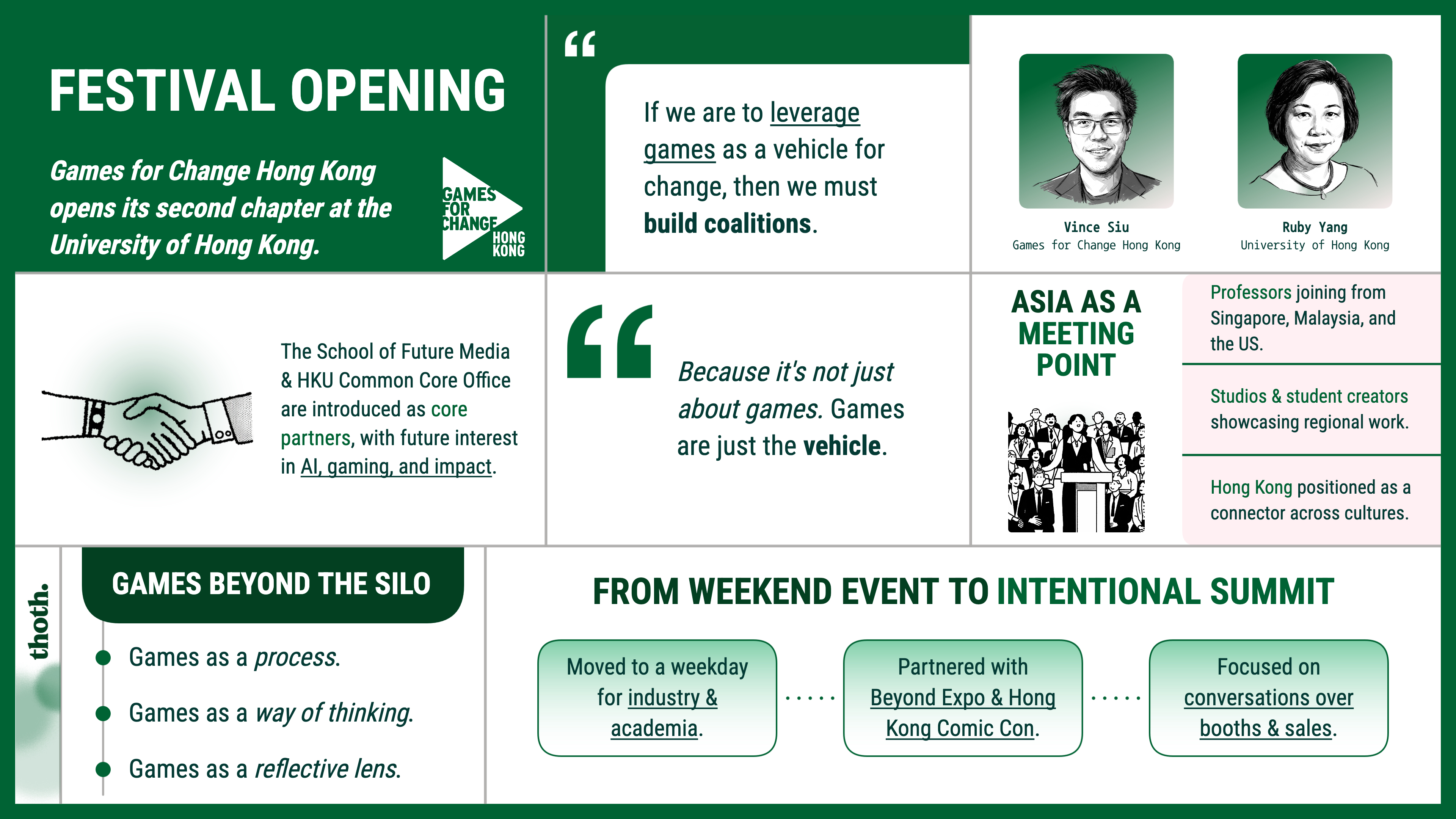
Good morning. Thanks for coming. It's gonna be a great day. I do have a little bit of an opening in a second, but I wanted to introduce to everybody one of the most important people that was that has played a part in making today happen. So, First of all, welcome to the University of Hong Kong. This is Menghua Complex. Actually, right next to here is a really, really nice building. which will be the building for the HKU School of Future Media. And the School of Future Media is actually one of our core partners for this year's event alongside the Common Core Office of the University of Hong Kong. So I wanted to first give the floor to the director of the School of Future Media of the University of Hong Kong, Ruby, Dr. Ruby Yang, to give us a few opening remarks. Ruby. Thank you. Good morning. Gaming is quite new to me. And at the School of media it was formed established October 1st in 2027 so we are very new we are like a startup and we offer journalism is one of the division and then we have AI filmmaking and documentary in one division. Another division is global creative industry which is the BA program. There are three division in our school of future media. So we will probably add gaming, AI and gaming in the future. to our program. So I'm here to learn about gaming, but it's my belief that, you know, use impactful changes and using technology as to use to make a meaningful changes. In 2005 when I was in Beijing, I was working on HIV initiative. and I want to use gaming to reach the migrant worker at that time. But of course, because they... A lot of them are illiterate and and gaming would be a good way to reach them. But at that time the platform are not ready and so I I didn't pursue it. But I think now with AI and all the technology available making game is a lot easier without all the coding and and and so I think the gaming for impact, a game for change, is very much a reality to do imperfect. impactful and good storytelling through games so I want to welcome all of you to this festival 2026 game for change festival and please enjoy the rest of the program thank you what is that Okay, what Ruby didn't mention just now is that she's very kindly sponsoring our festival social today. So at around five, after we listen to Jeff's closing keynote we will have some drinks and some snacks for all of us to meet each other and mingle even more so we'll talk more about the logistics in a little bit okay I have some stuff to say good morning my name is Vince I'm the founder and lead curator for games for change Hong Kong thanks for coming to the second ever chapter of the Games for Change Hong Kong Festival. I want to start by saying how weird it is for me to be up here reading from a tablet or a piece of paper. I never do that. I run workshops and I teach and I speak in front of rooms all the time and I never write a script because improvisation is one of the most important things I do in my work. I didn't write a script for last year's event. But this year feels different and this year is different. Last year we were a weekend event. We had a public arcade showcasing Hong Kong games that people could drop in and play. We had practitioners running workshops across different themes. We had a mixed bag of mixed bag of attendees. We had almost 300 registrants that came in and out over the two days almost 40% of our post survey respondents said that they were from the games industry. I had a blast. I reflected a lot on what we were doing and most importantly why we were doing it. I thought about how we should position ourselves. Games to Change Hong Kong is a volunteer-led initiative and it's just a passion project of mine. I don't do this for money. Maybe I should. And therefore, I don't feel any pressure to sell booth spaces or workshop spaces or speaking slots. Maybe I should. I heard feedback from people saying that if we wanted to engage industry, and academia, we should move it to a weekday because weekends are for family outings. So I did. And after learning that Comic-Con is coming to Hong Kong for the first time ever and that Beyond Expo, the region's largest tech ecosystem event in Macau would be happening this same week, I picked today for our festival and my mission became to track them down and set up partnerships with them. So we did. We're curating a half-day morning summit called the Future of Play Forum on the Beyond Expo stage in Macau as part of a 20,000 plus strong tech event. And we're bringing a tech pavilion there. We have some folks here who are speaking, who will be going to Macau with us tomorrow. And we're sending the Magic Rain, the biggest independent entertainment media platform in Malaysia, and one of our opening panelists over as a media partner for Hong Kong Comic Con. If we are to leverage games as a vehicle for change, then we must build coalitions. We can't do everything ourselves. So we find partners that can complement what we do and amplify our reach. We'll leave the B2C to the actual B2C expos who do it for money and who have the marketing power and the reach. And we'll take care of the conversations. I thought about how we should put together this year's program in light of this positioning. We had a diverse cast of workshop hosts last year. They do amazing work and we were lucky to have them show off their work to show our audience the possibilities that come with games. In the 12 months since, I've gotten requests and cold emails to consider workshop and presentation ideas to feature this year. But I didn't want to repeat the sheer amount of effort trying to weave together so many disparate themes and projects like last year. And I wanted to be very intentional about our program this year. So I did. This year the plan of attack was very simple. What comes after we play at the new frontiers? We start gaining momentum. What can we do with momentum? We can start thinking beyond the confines of games. Why are there so many other cross-sector events but game events have to be just for games only? There was a very specific story I wanted to tell for this event and had a very clear vision that we just had to execute. And so we did. As I started putting together our program for this year, that story became even stronger and that vision became even clearer. We didn't even have an open speaker application process this year. We didn't need one. The stories I wanted to tell, I knew exactly who we needed to tell them, and we got the absolute best for it. The premier English language newspaper in the region, SAMP, the best contemporary art museum in Asia, in M Plus, the world-class climate tech venture firm in the Mills Fabrica, the publisher of the world-conquering game, Clare Obscura Expedition 33, in Kepler Interactive, the leading NGO focusing on equity, inclusion, and resolve foundation, the organization with the most innovative funding models to support social enterprises and NGOs in social impact partners. Two of the most forward-thinking corporates in manual life and JSM. Our program this year is pure intentional design and pure unadulterated curation. If we are to leverage games as a platform through which transformative stories can be told, then we must look at games not as an end product, but as a process, a way of thinking, and a reflective lens. What happens when we see games not as its own silo and when we don't trivialize it? Turns out we can examine the world through games. Lastly, I thought about how we should frame ourselves as Hong Kong and as Asia. The direct result of organizing a successful first event is that I also got invited to game conventions and universities and communities outside of Hong Kong, not just as an educator, which is my primary identity, but as a game industry somebody. We are, after all, the first local chapter in Asia for the Global Games for Change movement, and with these invitations, I wanted to see how we can leverage Hong Kong. this traditional nexus of East and West, of China and the world, of cultures and stories, to do what we do best, which is to bring people together. So I did. I weaved our... I went into every single conversation I had in Hong Kong and elsewhere. I met professors who were excited to share their pioneering work and research with the world. I visited game studios who do mind-blowing work that's defining what the game industry can look like in Asia. I had inspiring conversations with industry leaders right here in Hong Kong who were excited to connect across sectors. I wanted to bring all of them here. So we did. We have professors traveling here from the National University of Singapore, the Singapore Institute of Technology, Asia Pacific University, the University of Miami, and the University of Utah. I ran the first ever game to change student game jam series here in in March and April and a team from Asia Pacific University in Malaysia won one of their students is here you can try out their game over at the showcase arcade upstairs we have major studio a serious games company based in Singapore that's done pioneering work with their government and with global organizations like OceanX. We have four members of Passion Republic, Malaysia's largest game studio, even though they don't want me to call them that, who's worked on titles like Elden Ring and Diablo 4 and is now building their own IP that's already crossed over with the likes of Ultraman and Godzilla. If we are to leverage games as a meeting point, then we must also look at bringing people together to meet. And in Asia, where travel is so convenient, it becomes almost an imperative that we meet so we can learn from each other and find ways for us to collaborate even more closely. Games are, after all, about people. Together, we can do so much. So this is why we're doing it. In 2026, Games4Change Hong Kong is here so we can leverage games as a vehicle for change, as a platform through which transformative stories can be told, and as a meeting point. Because it's not just about games. Games are just the vehicle. Thank you. So I hope you will get so much out of today's festival and you will be inspired to do more just by hearing a talk, asking a question, trying a new technology or storytelling tool, or seeing somebody embody excitement and passion at what games can really do. And so I'm really excited to introduce our keynote speaker. who is an exemplary example of all this and more. The QR codes are here so that for the rest of the day you can always scan, look at our brand new website. for the agenda and all the speaker bios so we on the stage can keep the intros brief so our speakers can do more. But because Lindsay is our opening keynote, I do have a short bio that I will read. So Dr. Lindsay Grace is the Knight Chair in Interactive Media and Full Professor at the University of Miami School of Communication. He is Vice President for the Higher Education Video Game Alliance, the Principal of Mindtable Consulting, and the 2019 recipient of the Games for Change Vanguard Award. How long is this thing? Lindsay's book, Doing Things with Games, Social Impact Through Design, is a well-received guide to game design. In 2020, he edited and co-authored and authored Love and Electronic Affection. Design Primer on Designing Love and Affection in Games. Dot, dot, dot. I will skip three paragraphs. Lindsay also served on the board for the Digital Games Research Association, DIGRA, between 2013 and 2015. And I might be hearing correctly that you're a newly minted member of the board at Games for Change, global. So, without further ado, Lindsay, Dr. Lindsay Grace.
MADE WITH