3 of 9
Transcript
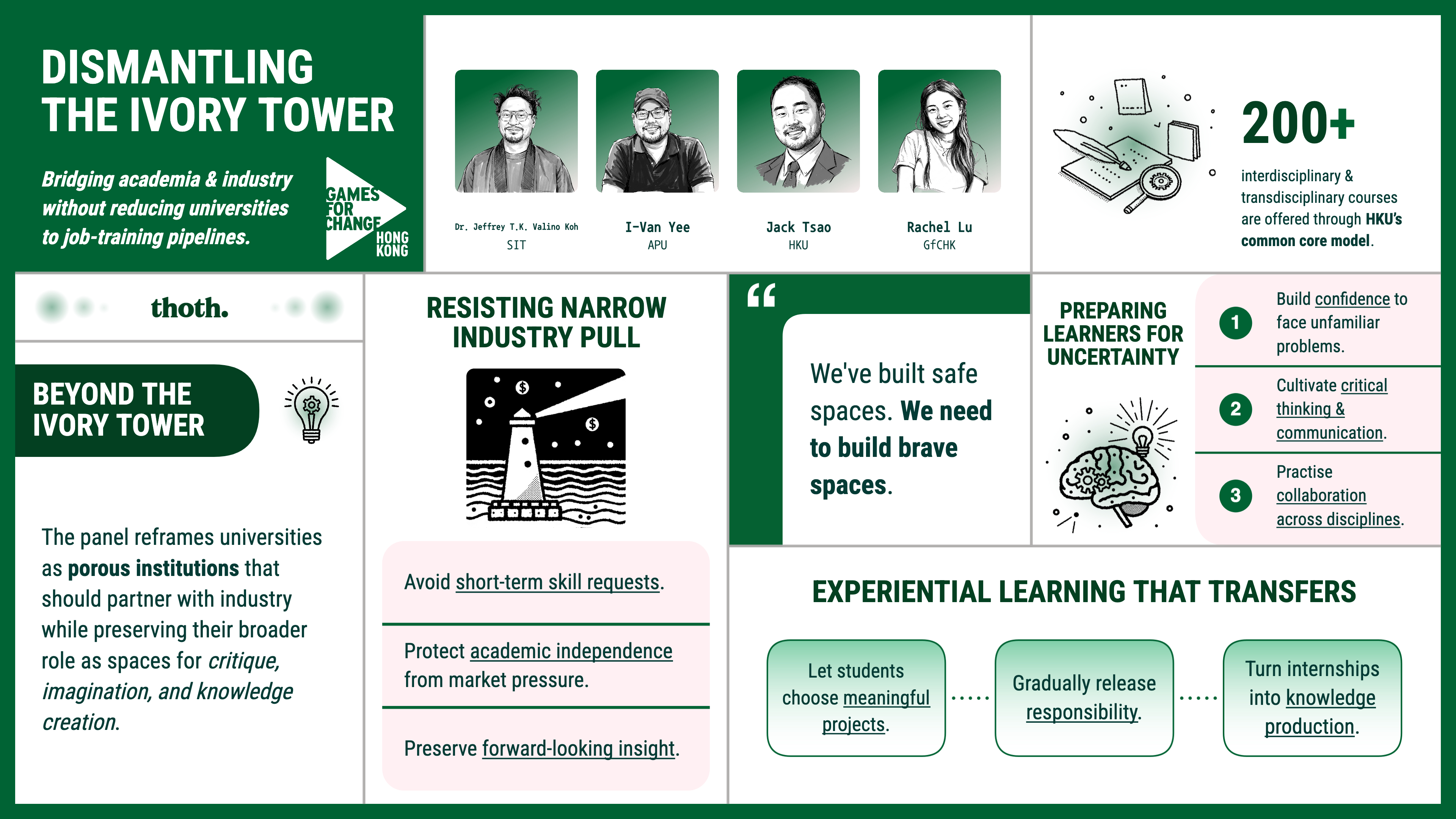
I like this room. It's very games for change color. I like that. Hong Kong you agree? Yeah. Yeah. You know one thing I had issues with CTU is that the campus design is not up to date. It's not up to date at all. How about Hong Kong PolyU? PolyU is better. Yeah. Because I think with such a strong engineering programs as CTU, most of the things are designed by engineers. Fine. Yes, exactly. A lot of things stitch together. I'm one of the engineers. It works. But UC has got a great building. School of Creative Media. Yeah, that's... Yeah, Ren Shaw. It's the best building on campus. No, let's cut that out. But I'll share a couple more things with you guys afterwards about campus stories. I guess we can start on time. Can everybody hear? us just okay? I think we don't really need this, right? Or is it better? Because I feel like it's a bit echoey. Yes? I think you're okay with that. Without or with? Is it recorded or you're not? Oh, it's there. Okay. Yeah? So without? Or with? All right, I'm gonna do it with the mic then. Cool. You eat. I should pass it to him. Well, welcome to our... panel. This is a panel called, what's our theme? Dismantling the Ivory Tower. Their faces. Well, it is, well, my honor to welcome all of you to be spending the next, I think, 40, 45 minutes with us. My name is Rachel. I'm your moderator today. I'm the community lead at Games for Change Hong Kong, and I'm also a first year PhD student at City University of Hong Kong. I have the extreme honor to welcome our three inspiring panelists here. We have Jeffrey. So Jeffrey is an artist. He is an inter... designer. He designed so many different great things, including catwalks many years back. He's now, his focus now is on transdisciplinary learning and cultural robotics. He is with Singapore Institute of Technology. So Jeffrey has very impressive CV. Trailblazer and we also have Jack here. So Jack is common core director here at Associate director here at Hong Kong U and I've known Jack for five years now. I was actually a master's student education here at Hong Kong before. And Jack has been very, very supportive of a lot of the initiatives that studios and Games4Change have been hosting on and very passionate about bringing future learning into higher education. So that's Jack. Also have last but not least, Ivan. So Ivan is a lecturer and ecosystem manager. So he builds ecosystems and partnerships and all sorts of cool things with Asia Pacific University in Malaysia. And he used to be with MDEC. Yeah, the Malaysia, yes, the government agency to... promote digital economy. So very, very impressive background as well. So yeah, like all three of them, actually all four of us have had years of experience with industry, you know, of some sort. Jack also scaled up a startup, forgot to mention that before. So, and we are all now within the system of higher education. I think that gives this panel a very unique perspective, I would say, to talk about what's going on, because I think the debate of the relationship actually between higher ed and industry has been there for at least 20 years if I'm not mistaken right since the 1990s where you know like the so-called third information third revolution of technologies which is like information technologies and now people are saying that you know we are being disrupted again by technological development so I think this topic is very relevant to you know not just people within the higher ed but also partners collaborators you know within our to actually have a genuine I guess discussion about what's what's going on right to understand the problem instead of jumping right into the the solutions which which I will of course touch on later So yeah, with that, I think perhaps we can start by thinking about the problem first, right? I think earlier we had a very quick discussion about what is the problem, right? Like what is the nature of the relationship? If anything is broken, what's broken in the first place? Jack, you're nodding. What do you think? So, I mean, the title of the talk is around Ivory Tower. And I think one of the... metaphors that gets used to describe the university, the Ivory Tower is a bit tired. It's been, it, and it's a, I think it's an external description of the university as a critique of the university, being too siloed, kind of doing its own research, too theoretically based, not practical. But the university has moved on from that image, which I think is a very maybe extractionist kind of image because I guess the university was a apparatus of the of colonialism but I think nowadays it's probably moved on from that a lot and it is actually very porous so as academics we do work a lot with industry with communities we do a lot of partnerships we try to get students to be more agentic and and to try to create their own initiatives and and do a lot of things so i think that image we need to maybe which is representational that metaphor needs to be change a little bit we need to find new metaphor for the university uh beyond the ivory tower um maybe i'll say that so far uh coming from coming from malaysia a little bit different i guess uh some of the issues that we have is mainly about uh policy and then and some old structural things that were very hard to change uh and then industry is changing so fast every day ai is coming into the picture but the whole system is not catching up and then mostly the universities in Malaysia are governed by agencies which actually control some of what we can and cannot teach or how we deliver it. you know, it even boils down to how much time you, the students are supposed to spend on a certain topic, which I think now is just, it's irrelevant because we don't control that kind of things anymore, but it does restricts academics in a sense, you know, so I think if you want to, you want to, you want to evolve beyond what we're currently doing, we do need a little bit of freedom. So I think that's one thing on the Malaysian side of things we are trying to move forward towards, yeah. Maybe to add on is, I guess maybe to frame it as an opportunity as opposed to just looking at it as a problem. I think academia is ripe for disruption. It is it's been primed for disruption for a very long time and the kind of medieval system that we inherited from Bologna in the 1400s is something that we kind of hold on to. But I also feel that that that rightness for disruption makes the university vulnerable and this vulnerability can be taken advantage of by the right actor with the right influence and the right money. And I feel that in some sense we need to protect ourselves from that. And that's maybe a hint of my opinion on. the relationship between industry and and academia and that's to say too i i came from industry i've only been a professor for about three years you know i run my own company i work with a lot of big multinationals um but i escaped to university because of that work and i see that work permeating now into the university and it concerns me actually Perhaps you guys can also share more about, right, like what makes you think that the impact, right, from industry is actually stronger than, you know, what publicity is saying these days, right? Because most of the news and most of the socials, the sentiment is that, oh, you know, higher ed or just school systems in general, right, need to catch up. What's the nuance in that, right? Like they're not coming out from nowhere, obviously. And what is the disconnect there? And what's the misconceptions that we tend to have on these kind of topics? Perhaps Jeffrey can. Sure. I mean, the complexity is there and I cannot even begin to think about how I would unravel that. On the one side, you have students who are now expecting to have jobs like right after university university in some way is a kind of you know prerequisite to kind of getting that job and that expectation kind of trickles down to everyone who is in the university to kind of make that a reality on the flip side of that you have the school demanding that that there's more relevancy in the work that we're doing and therefore the quick validation of that relevancy is often through kind of industry partnership. But I also feel that that is, it's almost cannibalistic where kind of industry influences the university so much that we are no longer contributing what maybe we originally contributed to a thriving ecosystem of industry and we are now simply just trying to facilitate kind of this quick band-aid which doesn't really help anyone students get shorted universities are now doing things that are basically kowtowing to industry money and industry gets no forward thinking insights to kind of revolutionize their own business. It's almost this vision. circle of quarterly and annual returns and yeah. Oh yeah yeah so I totally agree with that I think the university's role is to I guess unsettle or disrupt what's currently happening within communities or within industry and so if it's just satisfying the demands of the industry then you know, we don't really get anywhere. Maybe the it's you know, the the progress is more incremental. It needs to be more imaginative in terms of how it can disrupt. And I think Lindsay's kind of talk this morning was quite interesting in terms of how can we play, I think, in the university setting, how can we experiment with different things so as to disrupt that model, to disrupt, or give possibilities for how communities or industries can, or societies can reorganize in better ways. And I think that's very important. And, you know, if we, if we think universities are training their students then the ultimate victims are the students because then they go out and then they just you know they might graduate four years later and training for something but then they don't get a job so and it's I think it's it's maybe arrogant for universities also to think that they know what's going to happen in four years time so I think it also needs to be we need to take a risk in terms of training well exposing our students to different kind of experiences in a broad way so that they can graduate with more possibilities. It's really interesting because one of the issues that we were having was that we know some of the universities are starting to do something like they call it um with no criticism to anyone but it's like work-based learning where um they kind of relegate the training to the companies where they send them out for their internships but the internships are like ridiculously long like one year durations and then uh so for me i like i'm thinking about like are the universities sometimes also passing on the the responsibility of training them to the companies and typically because the internship they don't get a full salary or such so they they tend to be utilized as like very very affordable labor you know yeah So there's something that I thought that is interesting in your point that corporates are coming in as well, but at the same time are universities just letting go of everything and then you train them, then where does the university's role come in? That's one issue. It's interesting to think about it that way. Right. I mean, I'm involved in the work integrated learning at HKU and I'm part of the committee for that. Our view of that is, so students actually get full pay and they can work six months and they get credit for their experience in the company. But our thinking is also how can we... make students knowledge producers rather than just working an internship, taking instructions and maybe getting delegated really menial tasks, which then the students feel like, oh, this is just, this is very boring. And actually, if they get that, then they actually don't want to work in that industry. So how can they be more gentic in ways which is not just a typical traditional internship? Yeah. I do see a benefit in that and knowing what you don't like. I know we're kind of always looking for what we like, but it's also important to know like what doesn't align with your ethics and what you're just not down with. I think that's and we find that out through kind of real world experiences. At the same time, I feel like especially in an applied university like mine, there's so much directive about competency based learning. And it makes sense. Like if you're a nurse and you can't find a vein and pull blood and you can't demonstrate that to me, then you know, you're not graduating. But at the same time, competency is about teaching someone, demonstrating that you can do this skill within a closed environment. And I feel that that's not enough. Actually, capacity is even more. important because how do you do that thing in a situation that you didn't expect for? How do you do that thing in a in in with variables that are not controllable? And sometimes and we talked about this a little bit. You know, I throw around this word called pedagogy and and just to explain that a little bit with with pedagogy, we're training students who do not have prior knowledge. They're pre-career. With andragogy, we are training learners who have some type of prior experience and we're building off of that. But with andragogy, we are training people to enjoy learning. And I almost feel like the university has lost touch with this idea of the joy of learning. You know, and I wanted to go to university not because I wanted to land a job at some consultancy. I wanted to go because I was interested in, you know, the thing at the time or learning that I wasn't interested in that thing and finding something else out. And currently with my students, it's such a straight line. Like they feel... Generally, they feel like for me to get this job, I need to take these steps and then I will get that job without even understanding whether that is going to be enjoyable or not. And I don't know whose fault that is. Maybe society has just accelerated to the point you know where if you're 25 and you don't have your career figured out like you're screwed I don't know but when I was 25 I was dropping out of school actually working at Starbucks and you know so I don't know if society has just changed that expectation acceleration but which is why I I would love to critique it but it is also such a complex nest of things that I don't understand fully Thank you. I think one of the common themes I'm picking up here is that the generic framing of university as an entity itself seems to be way too wide to capture a lot of the nuances that's going on in in this world right like job readiness is one of the hottest topics across the world I believe when I went to undergrad we had a career service office that basically prep students for interviews right like they give you career consultations as to you know what your strengths are what your weakness are that was not as prominent as Now, I think nowadays career service office are almost triple expanded in a way not just as staff but their exposure on bulletin boards their you know programs being run almost every month in on campus so I think the but like you said Jack like unis probably don't really know what future would look like and to be fair I don't think anyone in industry in government in you know any kind of sectors would say 100% that this is what's gonna happen right So, but if we if we do that, we set ourselves up for failure. And I feel like the the training is not training to fulfill a role that could be obsolete by the time you graduate. The training maybe could be. as are you cultivating the right disposition for this person to succeed no matter what happens coming out and and so often because of that industry tie-up you know I was just telling these my colleagues here about you know I have a I have a sustainability advisory committee and this whole committee comes from industry and they tell me like, oh, you know, what we are lacking right now are people to write life cycle assessment reports. We need like carbon reporting. And then, you know, the university's like, okay, let's set up this whole curriculum up and do that. And then the next year we have a talk with them and they're just like, oh, yeah, no, we don't need that anymore. We need people in the field, you know, to do like science. And it's just like, if we keep chasing what the industry wants in this short amount of time, we will always fail to provide that. So, and if anyone has ever hired someone for their company, you know that fresh out of school, that person's not going to be ready. I mean, fresh out of my first degree, I was still an idiot. I still had to learn on the job, you know. And so I think the expectations have changed so much. across the board, yeah. Yeah, I mean, when I talk industry, they actually don't need, unless it's a professional degree. They actually don't need students with particular skills because they're going to do the training anyway. They've got graduate programs where they take you through the technical stuff. They're actually very, very desperate for students that are critical thinkers, communicators, exercise creativity, collaborate with each other, interdisciplinary collaboration, transdisciplinary collaboration. So those things are the things they lack. We still have students going out, leaving our university, not having those kind of basic capabilities and then they're struggling to find jobs. I mean, one of the, I think, I guess one of the advantages we have at HKU is our graduate fulfillment of our graduate jobs is close to 100% so we don't actually have to cater that much to industry which is an advantage so it allows us to kind of have more flexibility in terms of our curriculum but I mean I think a lot of universities that's not the case and so if the the graduate job statistics goes down then that's a cause for concern and then then they have to react to that right so So we're actually going through the same thing like we do meet the panel, we join, we meet companies, we ask them what they want, right? Then they give us feedback and then occasionally, yes, we do try, okay, how do we put this into the course? And I think in that process, I noticed that we're actually stressing them out enormously because like for example i i we teach the game development program right and really depending on which company you ask a mobile phone company they want to want databases behind they want to know all this stuff you talk to a triple a company they want different skill sets altogether then for us to try to merge all these requirements and and put them to the students i think i have started to see like there is an issue there's just so much time in a day you know and if they spend all the time just learning different skills they have no time to apply it then it is it's still a problem you know they know the theory of it but they haven't had time to really just dig deep and then improve in that field they graduate then some of them they're just just burnt out you know yeah yeah because i'm if thinking back my past time I'm from multimedia right when I graduated I think if I could model a cup and make it look like glass I was fantastic I could get a job you know but now the students when they graduate if they're a game art student they need to do photorealistic characters with proper rigging and animation that The expectation is so much different from back then. I look at their work and sometimes I feel bad for them sometimes. So we do try to adjust the workload for them, but it is a problem that's ongoing. I almost feel like we're jamming too many things in the curriculum for the students, and they should have more room to just play and do other things. I mean, learning how to do these things, you can... they can learn by themselves, right? So how can we teach them to learn for themselves? And then if they need to learn that skill, they can learn for themselves. But we're just like, okay, you need to do all these courses to get this degree. And it's like too much. Yeah, it is really much very much like a check mark thing that happens and I feel like really our jobs as educators in my opinion is to instill confidence in this person this person should feel confident coming out not that they know everything in a kind of arrogant way but a confidence in that oh if there's going to be a problem that I'm facing you know like like dr. Gray said I can play this out I can think of the scenarios I can experiment And if you are not in the disposition to approach this problem as an opportunity to do that, then there's no amount of skill training that's... Gonna give you that actually Yeah, yeah, I summarize I think How would I put it I think vision is a general like a general architecture of almost everything here. I mean, motivation comes along with a vision. Confidence comes from vision. Capacity, right? Willingness to solve a problem, willingness to pay, to play, to experiment, to explore is to have a vision that you know either staff faculty or the students personally has a stake in it and I agree I think nowadays the job outlook right like there's such a big pressure and overshadowing a lot of the building of that part of vision and what is actually interesting hearing from all three of you is that youth all of you are actually building very, very transdisciplinary curriculum projects inside of, well, your reign, right? I mean, I wouldn't say the whole university, but, you know, in areas that you can experiment. on you can play with. I mean APU is known for project-based learning. There are a lot of industry infused initiatives at APU. Jack you work with so many industry partners. I mean I was with the Presto studios right like we collaborated on so many different fronts and Jeffrey you design factory right like it has so many front-end hands-on learning aspects of it so I would be curious to you know know that given so much how would I say I wouldn't say toxic but so much pressure from the performance in job market how are your programs being set up and how would that make the learning and exploration more meaningful for the students in you know in your reign of course not the not the we are not trying to change the world like once and for all right but within the areas where we do have the influence on how are your programs set up and what is the philosophy how do you manage to do it I just pass. I mean, for me, transdisciplinary practice is a buzzword that schools kind of push around. But for me, I think... that for transdisciplinary practice to happen you actually need to build bridges first so the first thing in my opinion is the idea of disciplinary gravity when we have different disciplines work together they need to be held in a a state of collaborative tension and so often especially in a technology university like mine you know the creative practitioner falls in line underneath the technologist and all of a sudden you have a hierarchical kind of working relationship in a transdisciplinary team. So the first thing is how do you build a common language between disciplines? How do you build a common method and practice between disciplines that does not hold one discipline over the other but holds them in a productive tension. I've really been looking at like anti-disciplinary practice, Joy Ito MIT lab. I've been looking at non-disciplinary practice, the idea that disciplines should just dissolve and it's actually a waste of time to even thinking think about that. And so what I try to do in my program is just to make sure that you know you as a nurse you know things that the designer and the engineer don't know but also the designer and engineer knows things that the nurse doesn't know. But on top of that, the community person knows things that both of you don't know. And so how do you create a model for earnest and equal equity-based collaboration where one knowledge does not take precedent over the other? It's very difficult. And of course egos come into it and all of that stuff. But for me, trying to find that balance is really where the potential for transdisciplinary practice to be successful. Yeah, for our office, we have over 200 courses. They're offered by faculty and they're trans well interdisciplinary or transdisciplinary and so students all our undergraduates have to take six courses at the moment and these courses are from art humanities science technology global around global issues China AI and so they're offered by all these different faculties and professors and so the our students get to get a taste of different courses throughout the undergraduate no matter if they're you know training for as a lawyer a doctor or architect or or in business or social work whatever they get to choose. And so that's the curriculum and then that gives them kind of different breaths. But also they get to work with students from different disciplines. Most of the assessments have components of group work and so they get to do group work. They absolutely hate it. but you know they have to do it so because it's not the easiest thing and also when they're working with students from other disciplines there's a lot of disagreements of course students free ride but these are all issues that they'll face in the real world as well but we also have the co-curriculum which we encourage students to take different experiences and this is purely voluntary but we offer a lot of funding platforms for them to travel to set up their own initiatives they can hold mental health fairs they can organize their own own game jams or hackathons they can travel overseas and and lead other students to for example Mongolia, Philippines or Myanmar. And so we try to encourage that and of course not just us but also faculties and schools across HKU also kind of give them those experiences. And so we want them to have different disciplinary experiences, cross-disciplinary experiences, but also experiential experiences, which then allows them to be able to get a greater sense of the world, because our teachers always tell us, yeah, you know, our students don't actually, when they come to HKU, they've just been studying and they don't really know much about the world and this allows them to kind of get a sense of the world before they graduate. For our games program in Asia Pacific University, we actually doubled down a little bit on specialization where, because games is There's so many disciplines in it. There's art, there's design, there's programming typically. So we changed the syllabus from something that you learn everything all at once and we broke it down to maybe if you're a student, you are more aligned along the art pathway, you just learn game art and then game programming. But along the way, we connect them back together in project classes. That's when they cross over and then they learn the skill sets of both sides. And we find that that works a little bit because we found that you to teach someone who's into art a little programming then they get stressed out and there's not something they want to do and to teach a typically a maybe more logic based program okay now you gotta do concept art that's was that's also not something that they want to do so we split it up and then we created pathways in between so whenever they come to project classes they actually uh get to focus on their specialization and then we do that repeatedly the project classes are our our i'll say a key selling point where the game is something that allows them to play they learn the the skill set somewhere else but the project classes they make the games according to certain specifications you know and in the beginning we tighten the specifications then we slowly loosen it as they get older and more mature you know and it's interesting because you see them you see them mature they learn things which not specific game development, project management, dealing with arguments, which always happens, right? Dealing with free riders, right? How do you handle that? Yeah, so we've created a whole system based on that so they can even peer review their teammates to a certain extent, right? So we find that helps, in a sense. So we build a whole structure around that. What I found really inspiring actually is that you spent well we spent a lot of time you know talking about the impact of industry to universities but in your practices actually it's been run like an industry like a project right so what do you think is the main difference between the two right because I initially right like on one one end there's the the job else aspects the job readiness the skill that's you know, very, very task-based and has no information or enlightenment on capacity building, confidence and vision. On the other hand, the projects and initiatives that you guys are doing are also industry-like in a way that encourages group work. It encourages systems thinker. It brings different disciplines, different jobs, natures into the same group and they are kind of forced to merge, right? Not just personalities wise, but skills wise, knowledge wise, capacity wise. So what's the difference? Like my... Industry does not own collaboration. So I mean, I... Okay, maybe the things that I teach have a shadow of how industry works, but the main difference in my class I feel is power, and it is the student who retains the power to decide what they want to do. do in enact that power if they're working in an industry and anyone who's ever worked a blue-collar white-collar job knows that you do not have the power the the boss and the shareholders and the board and that your manager they have the power to tell you what to do and you do it because you need to earn a wage and you want to feed your family and you want to go on that trip or whatever so in the classroom it is I It is not like the industry for my class because I make sure that the power differential is as minimized as possible. Yeah, I have to give a grade, but you decide. what project you want to do and you decide who you're going to work with and you decide what's an important topic for you to discuss and that is the power you have as a student in your classroom to do that right I'm just going to bring it back to games I think like so I think when we're kind of developing the capabilities of students this is how I'm thinking about things now is How can they move within structured spaces? And, you know, get, you know, how do they play other people's games? How do they form coalitions? kind of circumvent the rules or play with the rules to then win win or flourish in the game maybe flourish is a better word and then also how do they create their own games in spaces that are not defined and so this kind of smooth and created spaces is kind of how I'm thinking about things I know Lindsay you mentioned the rhizome and I think the rhizome is a very interesting metaphor for thinking about these things you know how can you move in hierarchical spaces and how do you think how do you move in kind of rhizomatic spaces is something that I'm what I'm thinking about in this education and I think that's what maybe the foundations of education maybe we can think about that more I don't know I don't know like students are here okay good so don't just reveal like like I just go back to the the way we design our project so if we actually have like three projects that they do before they go for their capstone you know and then the in the first one we actually we tell them who their teammates are So we fix the, we constrain everything. You know, so they find out they don't like to work with their teammates, right? They know who they don't want to work with. Then the second project, we actually give them... they release we release the constraints a little bit so okay your team should have one programmer and two artists go figure it out you know then they negotiate and stuff like that and the third one we we we release it even more so you can pick whoever you want to work with but in that process they found out that no matter who they pick they end up not liking the person so that's the process the moral of the story because we wanted them to as as they reach their capstone it's fully their responsibility even like for we control things even like the game engine they use we start off with like godot engine to start off then they go into unity and then they learn unreal engine right but for the capstone it's fully their responsibility to know what kind of career you wanna build, what kind of projects you wanna work on, you wanna do a commercial product. So it's like they pick their own poison at the point. But of course we'll be there to just catch them in case they go off the edge. So that's how I think like releasing the responsibility to them bit by bit is something that academics should do. Does that answer your question? Yeah, of course. I think the... takeaway is to enable right to and to empower that is the biggest difference even though the formats the projects are showcased right like the games that are probably studio level quality, fidelity, or we are like simulating some sort of like group work, teamwork, negotiation. skills, competence, all of this, but it all comes down to how empowered and how much motivation and vision that students were allowed to explore within such a safe environment, I would say. Because I think that to be exposed in industry level jobs, the risk for failure is really high, right? Like it's not like I get to, you know, change a person to work with for the next semester. It could be, you could be stuck on that same position. with the same team for years, right? And we, well, I mean, I've, I've lived my life in industry as well. And the constraints that where students were exposed in internships and practicums might not be the best way for them to develop their competence. So that, yeah. And just to add to that, like, even if you do your job well in industry, it doesn't mean you're guaranteed a job. We see what's happening across the industry, right? So I think even at that point, it's, again, it makes me come back to think about the disposition of the student and you know what type of per type of person they are coming out and it's not necessarily defined by a skill it's defined by an attitude and an approach and an outlook you know I feel like that should maybe be the ultimate outcome as opposed to making sure this person is ready to be obsolete by the time they graduate yeah yeah yeah I'll just add point to I think students need to be uncomfortable in their university education. But at the moment, the mechanisms for that is actually not available because we're the customers but also we ask them for their satisfaction at the end as well right so we do these evaluations and if you make them too uncomfortable they're gonna mark you down and that's going to then affect your career and your promotion chances and all that but the thing is we we need to make them uncomfortable because the world is uncomfortable it's unsettling of course they should have fun and I believe that the fun at play and is important but I think making them you know putting them in situations of conflict where they have to make judgment where they have to react then I think it's really important. We just had some students come back from so I had this project that I get students to go to Myanmar and then then they self-organize their trips to Myanmar every year and So they did this in January and they said, oh, we went to Myanmar to do this trip and then they got stopped by the military and then they had to then try to explain to the military what they're doing. And then, you know, they were kind of temporarily arrested and all that. So, but that's a great experience because then they came back and they were so excited to tell me about that. And, you know, they all survived and everything. But um, but but they'll remember that experience forever and um, but that was a really important disposition I think uh and for for them to have to go through to to experience that fear and experience that uncertainty and that ambiguity and I think we need to have more experiences like that for the students so I don't think safety is necessarily We've built safe spaces. We need to build brave spaces. Brave spaces, yes. Yeah, that's great. I have nothing to add to that, actually. But I'm quite glad. I've been teaching a few universities and one of the cool things about my current place is the students are very autonomous. They do their own thing. Even the next room over, there's one of our students that won the game jam. So they actually self-coordinated themselves and then they're training their juniors to prepare for game jams now. And that's without the lecturers going after them. In previous places, we tend to have to hover over them. Guys, game jams are important. Tell them about it. But here, they seem to like, they're auto-run. They're doing their own thing. And I think, for example, they're doing something that's uncomfortable to them, which is unique. and I think most people who've reached a certain level have always lived in discomfort. And I've seen the amount of things Prof. Lindsay has been doing in his... keynote today i was like where does he find the time for all this a game a week and all that and i'm sure writing papers and going you're flying around it's like like that's death the definition of uncomfortable if you're carrying my round right yeah so that's just something that i've been i after today like i do hope that be something i can translate to the student itself you know in order to survive whatever changing stuff that's coming up i mean no no lecturer knows what's happening next one year now i think that the gap has become so short with ai around the corner right the I wouldn't know whether I can guarantee students jobs at all, you know, but it's not our job to guarantee them jobs anyway, right? Just to equip them with enough skill sets to survive. Yeah, my university had this policy of saying the clients are not the students, the clients are the companies. Yeah, like, wow, right? So there's a different mindset, but yeah. But I think that's a great point is also making ourselves uncomfortable So if we're not feeling uncomfortable, then we're we're too comfortable and there's something wrong with that Yeah, so we need to be also be experimenting and doing things and playing around and I think that You've got a really good wrong model there. We are running out of time and I do want to have you know the audience to be able to you know either share their thoughts or you know ask a couple of questions to our panelists while they're here while they're still here later on but you know if we've got any questions from the audience. Hi, I just want to ask you guys, like, you know, when you're working with all the different companies and all the other stakeholders involved in, you know, the classes you're building and running how do you manage expectations because it now I'm coming at this from the experience of having worked in the local private schools up in mainland China and the thing is that it just seems like every stakeholder has like a limitless demands no one wants to set any boundaries so then like you know you and so like you'll because of that everything is all completely chaotic and it just falls on the teacher to try to like you know do everything be everything everywhere all at once and it's just oh you know what I mean like how do you guys like you know manage this and just kind of put your foot down say hey look okay there are only certain things that the university can do hey company you guys got to like you know chip in as well hey parents like look we we can't like you'll prepare everything for your kid how do you balance that expectations of the stakeholders you're working with right yeah yeah i mean i always ask when i start working with them i always ask them um what do you want to get out of this um and sometimes it's just like they just want an opportunity to to then say in their corporate report, they've worked with HKU students and it's great, but I always go, what do you want to know that the students can then offer? to you and then that's a different starting point than just kind of saying oh we want this experience can you do this so I always kind of try to do it from a research angle as well so it's kind of like our students can help you do this research what is it that you want to know and I think that's produced some interesting results like I work with ARAP very closely which is a multinational design so ARAP a multinational design company and every year we do something and it's always like, oh, what do you want to know that can be useful for you, for your company, for your clients, for the governments that you consult with? And then how can our students then deliver that? And so our students then become knowledge producers instead of kind of consumers and we have to satisfy them. So I don't know, that's a great framing. I think that's worked for me. Yeah, starting from the, I guess, what the stakeholders might want to uncover that they don't already know. Yeah. We have, sorry, just one response for one question. Oh, okay, sorry. I don't want to keep him for too long because you might need time to prepare. So maybe we'll have two very short questions. if there is anyone go ahead go ahead maybe your last one so hi um i'm just curious uh as educators for ages uh and you see that the students develop from this generation to that generation so what are the major changes in them that you saw throughout the years and how are you going to bridge the gap to prepare them to the industry out there where the team the whole team of them are probably from the from the uh elder generations so how do you prepare them in terms of maybe attitudes to uh for them to move into the industry to have a smoother you know work experience I mean, I don't feel concerned. I mean... Thank you. Thank you for the question. I guess the change I've seen is just greater anxiety. and and maybe that's not just for students maybe that's for all of us but but definitely in my students I've seen it like since COVID there's been a very distinct change in in students that I I can tell maybe that's anecdotal I don't know if you guys feel it as well how to prepare them Wow I don't know I'm trying all sorts of stuff really but but you know, we sometimes we just won't know for for decades even. And so like I think I do things. I try to. do things that I feel are right but to have certainty and knowing that they're the right things I can't say that I have so I mean honestly like I just hope I don't fuck up that's basically what it comes down to and I try to just do my best and and and hopefully there's something to be taken away and and we we put them in a bit put the students in a position the learners in a position to be able to to kind of survive out there. I have no answer. I'm sorry. I'm sorry about that. What do you think, Jack? Or just one? I think it's great to kind of just say, hey, let's together I always you know I do really wacky experiments and you know we explore things for example we we did a exploration of AI and plant humanities recently and it's a new field and we just explored and I said to the students would let's just learn together and see what you produce and they produced these amazing prototypes which I was superly impressed by so and I gave three talks about their prototypes so yeah I think it's kind of humility as well as a as an academic and also kind of just telling them hey we're gonna go through this journey together and you're probably going to impress me with ideas that I cannot think of. And so I think that also inspires him a little bit. Thank you and thank you for your thoughts. Now I'm a corporate educator as and I work within businesses doing corporate education. My wife is an academic and a PhD student at the moment, so you can imagine what the debates are like at home. I've heard lots of talk about what do universities have to produce for businesses and what businesses expectations of universities and honestly we could go on about that that all day and and we do there's a bit that's that's missing and there's another thing that universities produce and that's research and a lot of extremely good quality information that honestly businesses could make better use of now if we look at life sciences and things like that then then obviously the linkage is is is more obvious do you think there's an opportunity for students going into the business world to have a far more continued relationship with the education that they've had? And do you think that presents a better opportunity for universities? style research to have a greater presence in businesses. I mean I'll give it a stab I mean for me it's it ultimately comes down to expectation of outcome and I mean increasingly the school universities IHLs and institutes of higher learning the demand for them to be productive in an applied manner beyond just kind of blue sky research is a pressure we all feel in the university. However, that is still not profit driven. It is not driven for the stakeholder, stakeholders, state shareholders benefit. And so for me, yes, I think what you're proposing can happen, but fundamentally the organization of the corporation, does it allow that? And if it falls out of line with the profitability of the company, then I would say no, it doesn't allow that. So, so if the research also happens to make money, then great. But if the research is not making money for the company, I don't see it working, honestly. Even if it's like a potential for money in the future, like an innovation in... Investment or yeah, like a super collider for example I've been a corporate trainer before so I can see both sides of it and corporate training tends to be very pragmatic It's kind of implementational and this is you know, these are things that you can use and then off you go I think for universities there and I've talked about this earlier is there's a space to unsettle how things are and to reimagine things in a different way. And so without, for example, with our work integrated learning program, our cooperative learning program when we send students into internships they're working their full time and what we do is we actually get them to do assignments around industry analysis and their workplace analysis and then get them to write case studies around their work and then this allows them to then produce knowledge about how things are working within that internship and how things can be improved or kind of responses to it, not really solutions, but responses to that. And so that's our way of maybe trying to get students to be knowledgeable. producers and doing research as they're working in these internships. Yeah, but I totally agree. There is a lot of things that, you know, when I was a corporate trainer and then I did my PhD, I thought, oh, that's a bit simplistic. Maybe I can insert some of that knowledge.
MADE WITH