2 of 9
Transcript
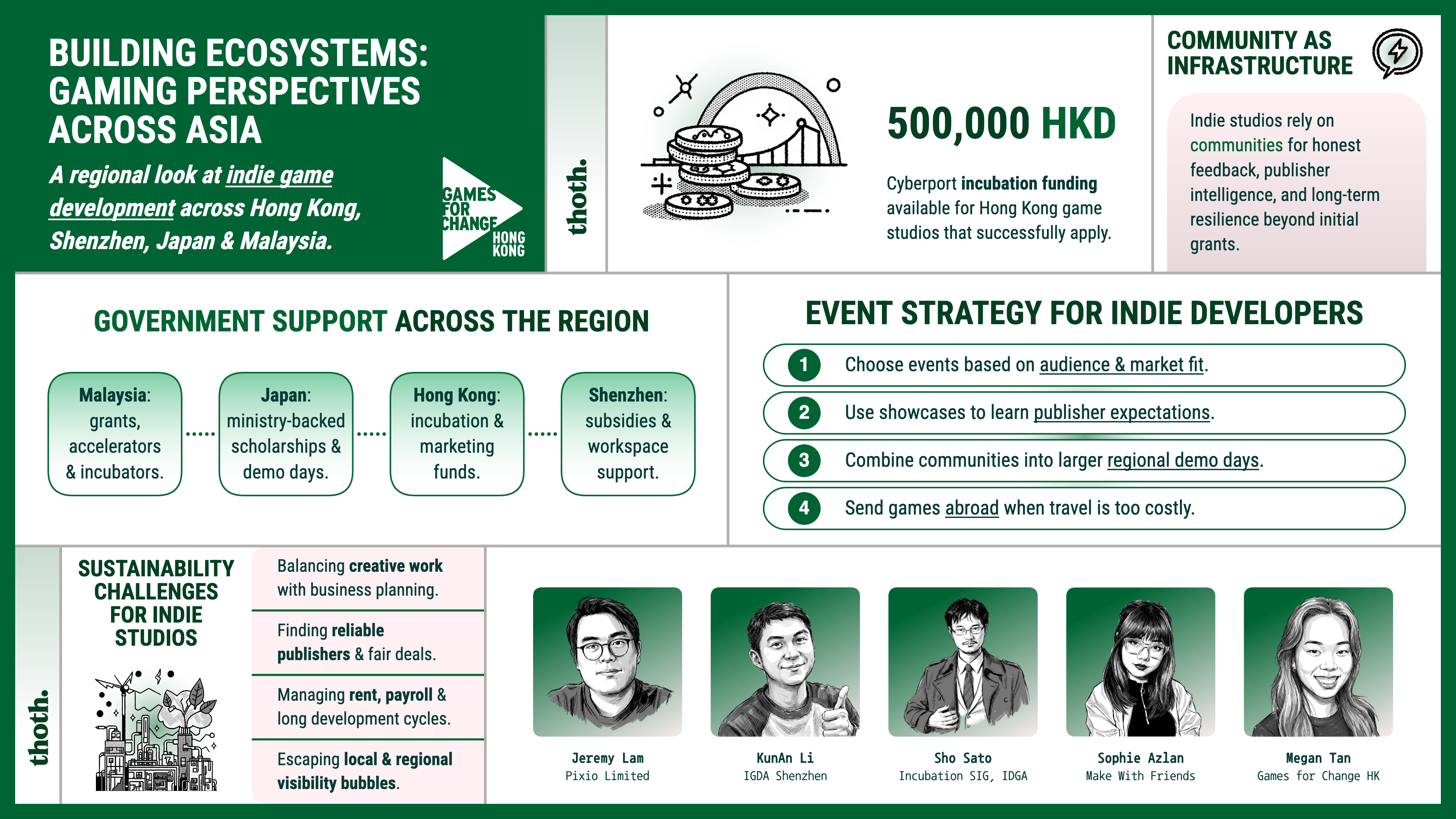
Hello okay I just give me a breather Thank you so much. Good afternoon everyone. Thank you for joining us for this talk. So my name is Megan and I'm the program lead for Games with Change Hong Kong. It's my pleasure to actually moderate this afternoon's session which is building ecosystem gaming perspectives across Asia. Now across Asia the game and interactive media industry is growing at a breathtaking speed yet if you look closely at at the situation the reality on the ground can really differ from region to region. and each region operates with its own unique gaming ecosystem with a mix of government funding private capital talent pools which is something that we're gonna hopefully get into during this talk yeah so um just a quick disclaimer if it's not apparent this is actually my first time So if you think I'm nervous, if I look nervous, I am nervous. But this is a topic that I'm really eager to dive into and have a conversation about. So I hope you're just excited as I am equally nervous. Yeah. Okay. So just just to start, I want to introduce our incredible panel. of industry leaders and community builders from across Asia. So first we have Jeremy Lam, the chair of Hong Kong Game Developers Alliance and the co-founder of and CEO of Pixio Limited here in Hong Kong. Next, oh yeah, I heard somebody clapping. Yes. So next, joining us from across the border in Shenzhen is Kuna Kunan Li, Chair of International Game Developers Association, IGDA, Shenzhen. He's also the executive executive committee of the Global Game Jam. in Shenzhen and he's the co-founder and educator of Art Deco and Dev Miko where he teaches game design to young adults. Flying in from Tokyo, we have Shou Sato-san, chair of the SIG Growth Game Incubation Program for IGDA. IGDA, yes. Oh my gosh. Okay, Japan, co-founder of the Indie Game Incubator and IGI and CEO of Ludimus Inc. And finally, Kataka. Finally, joining us from Kuala Lumpur, Malaysia is Sophie Azan, lecturer at the University of Wugong, Malaysia, Schools of Computing and Creative Media. founder of make it make with friends studio and the founder of out crowd Malaysia okay that was a lot and it's just a brief introduction that I could put together of their background so the main point they know their stuff they have experience it have long experience within the game industry and they are here to share that with us So if you want to learn more about their other amazing things, feel free to scan the QR code on the back of your badges of the agenda and you can see their background. Yeah. So let's dive straight. in so yeah so i just want to start with a show of hands how many people here consider themselves like indie dev um or hoping to get into indie dev okay okay there's a sizable amount that's something that i'm also looking into as well so and part of it like a major concern that i have when researching was about support So when I was researching about all this, I was surprised by the number of initiatives offered by the government in all your different regions about how to further indie studios. develop and their development so could you give us a quick overview of some of the notable government initiatives from your respective regions and how that has actually helped the local gaming industry Okay, all right. Hi, everybody. Thank you again so much. I'm so excited to be here among legends, to be honest. These are all people that I followed their work for years, and now I get to be comparing in the same stage. It's like, oh, okay. So over in Malaysia, the majority of our support from the government, it comes in the forms of grants and also other forms of opportunity, like accelerator, incubator. There are a couple of... programs that the government puts together with third party entities and then you know indie studios get to apply and we get to take part in those opportunities as well which is really exciting so the grants they do come in different forms they are meant for different sizes of projects and they're also available to different sizes of studio so in a way they are very aware of the types of studios and the scale of the studios and they tailor the programs to each and every one uh respectively of course these are all limited programs so you really have to get in while it's hot uh but the fact that these are available in the first place is amazing right so that's what's happening in kale okay thank you uh so then uh from my post and I'm going to talking about the Japan Japanese matters in Japan from a national perspective we have two industrial two ministries working for the game industry Minister of economy trade and industry and the agency for cultural affairs and the Minister of education and the Ministry of economy working mainly for the economic part of the game and the agency for cultural affairs working for the cultural part of the game but sometimes they all go up and they compete each other and then actually the yeah as for the ministry of economy they do the soul food game acceleration program from three years ago and then They support like 10 to 20 teams of the Japanese game develop Japanese indie game developers with like a kind of scholarship and or grant with no duty to return and like a five million yen like to I don't know maybe like a forty thousand dollar or something to the each team and then we we do have a like a business support and like some of the demo day connecting with like a like a more than like 70 to 80 game publishers and investors and in the meantime for the agency for cultural affairs they do have several like a program they also have working with CESA game industrial association Japan to have a top game greatest Academy and also they also work with some of the educational institute had to have like an international game development gay student training program and from my perspective I'm also working for IGT A Japan and working with a game publisher and to start the game publisher training program called a global game growth gateway so then they have uh what was on like five or six years ago the japanese government does almost nothing about the video game support when i talk about like please support the indie game uh what is indie game is it a game coming from India or something so yeah but uh now that's changing very drastically yeah I am very happy to see that yeah thank you I barely can speak for the whole China because China is just too big but what happened in Shenzhen is amazing uh I work in Shenzhen, I live in and work for in Shenzhen for like 10 years, about 10 years, but the heart of Indie, I think, just gets started since last year. We have, I'm the chair of IGD. Senzen but like in the same time there are four local game community indie community happening in Senzen same time so every month we have activity we have gathering we even have like indie expo so government start to notice hey what are these young people doing and they start to realize okay actually they can support like what they support for black me wu gong so uh there are some discussion internally uh i barely know bet and there are some we call Hong Kong, Wenjian, like red title document. They don't tell you exact amount you can get, but they say they're supporting and so they allow private incubator rent the office and ask for the budget from the government and give a free workspace for the indie developer. Like another perk to consider. Again, I'm not spoke for the government because I get I did get benefit Our company got subsidy for about 50 thousand uh i'm b no yeah yeah yeah so um there's something going on um but we can have a chat later yeah yeah yeah i'm sure it it's it's booming it's booming yeah yeah yeah yeah jimmy so for hong kong i think hong kong out of all four cities here we're like the smallest in terms of the game dev scene however since our government is really rich we have a lot of funding support so first off we have a cyber port which is located on Hong Kong Island so what they do is they have an incubation program and they would give us five hundred thousand Hong Kong dollars if you can apply and if you get in you get five hundred five hundred thousand Hong Kong dollars uh just for the studio and then additional two hundred thousand for marketing and then so there's some other like follow-up funds as well uh so funding wise there's that and then there's another uh institution called ccida uh they are based they are previously called create hong kong so they deal with any uh they're a government agency and they deal with all the the cultural and creative stuff here in hong kong so they fund a lot of the movies they fund a lot of the games and one current project that they do is is called GEPS, which is a marketing scheme for games. So instead of giving people money to develop games because there's a lot of risk involved and they don't want to be involved with that, they instead give money to games that are already made. So what happens is if you apply and you already have a game, they would give you 500,000 Hong Kong dollars to just market your game. So that one is pretty interesting as well. And I also run Game Dev Happy Hour with Johnson over there. We do a meetup every month. We get together and talk about games. We share our findings. uh we drink beer or other drinks uh and we have a lot of fun right megan yeah yeah that's it for me game studios um so just so that they can get off the ground but yeah but as i was saying um they get the studios off the ground but they don't necessarily mean that they can it's hard to tell about their long-term survival right um it's because you never know how much how long these kinds of grants and programs can last. So what does, what do you think that maybe these indie studios may be still trying to find that they can Sure sure sure yeah, and that's a very good question I like to how JNC answer from the point of view of the incubation sheik we are like a group of the game incubator accelerators in the 61 countries around the world and then looking at the that condition that I feel that like the successful incubator always works with a local game developers community and then they interact with each other and then having a like discussion and for example uh the if you how jnc is open a game incubator the lot of like like again publishers and investors are coming but some are very good publishers but others are not so good publishers sometimes but sometimes they deceive some some people and then they had a very bad deal and they don't do a good thing but sometimes yeah if you have a very good community you can share the information about like what is a good publisher what is a bad publisher what is a good deal from investor So then, yeah, I feel that like a search like information sharing is a kind of key part of the gene developers community and it's also the hard part. the essential condition of the better function of the game engine better. Maybe, yeah, yeah. Yes, thank you. To sort of match what Sato-san said actually, Malaysia does operate very similarly where we, our community is so important to us in our development. It is incredibly common for the average Malaysian developer to retain your day job. and then also continue with the game development process, right? And then these games are in development for years upon years. There are a couple titles which have been development for up to eight years and still haven't released, ultimately. Further? Okay, cool. So it is hard to do the game, which is why the community is so important. And we do the same thing where we talk about publishing, we talk about, you know, what are the best pathways in order to ensure release and similar things like that. We do have difficulties after that initial grant, right? That's one of the things that we mentioned, right, about the difficulties of like getting the game to launch, where everybody has an idea. I think that's the best way to put it, right? Everybody has an idea and not every idea makes it to the end. So everybody is trying to get extremely creative with making sure that things make it to the end. Self-publishing is definitely one of the ways. Just keeping something small is also one of the ways thinking about scale. But ensuring that you have that community to remind you that you're not going crazy. It goes such a long way, right? So that's what's been going on in Malaysia as well, yes. So in Shenzhen, at least I can speak from my personal experience. I think it's always about risk and opportunity control. I mean, you want to work on an indie, you want to work on your own game idea, but you still need to buy So and even pay for your rent. So at least from what I did, I teach people making game to help support my indie career. But I know some case might not be so realistic. I mean, just you're good at teaching doesn't mean you're good at making game. So I would definitely recommend do the correct like scheduling. We have a developer in our community. He spent three months just test play in the community. Because you have other player, FIFA, and we always be on the same page. to other developer we say don't say my game is good if you say my game is good get out of the room so you get those really harsh feedback to like boost your game and that's really valuable and to be honest because since and indie just happened in a year so the thing we have discussed might come true real soon like those developer are like in a burst to ask for the need like how do they sustain for next year how do they survive and there's no game incubator in senzen at least as far as i know but yesterday I know one called Kentobia they are sort of government granted because Tencent left the original office so that part of office need to be doing something so thing happen in Sun Zhen now yeah it's changing every month like happen really fast yeah so for me I do think that in in Hong Kong it is important to really think about the developers they're actually especially the indie ones they're actually entrepreneurs like in order for you to get a lot of the uh fundings from the government um they don't fund you as a person they fund your studio as a limited company here in hong kong so i i i see them as entrepreneurs so when i'm when i'm a lot of them like i meant i mentor them with a lot of other uh industry veterans and sometimes they get really like oh you need to remind them of things you need to like tell them to do this and do that and i'm like they're not my employees they're not like i'm not responsible they're not my kids so uh one thing we we have we can't lose sight of is they are their own entrepreneurs they they should be taking a lot of initiative uh and they should be responsible for their own you know financial well-being of their studios and all that so if once they start doing that then the industry becomes a lot easier to manage and the industry becomes a lot more vibrant and there's a lot more going on I feel like yes because I think it's really interesting to hear all because while you're while everyone is like talking about how it's super important for all these indie studios to really think about sustaining themselves by thinking about the on the business side i feel like Maybe what is there some is there an aspect in terms of what the current I don't know maybe it's the is it if it's the way game developers are getting into building an indie studios that they feel like they don't want to focus more on the creative side that they tend they might accidentally or God forbid but like lose out on the business side. Right. And because of that, they may not be able to survive the next year. I feel like that's something that is, at least for me, that's something that's really. concerning about sustaining an ecosystem here in Hong Kong, yeah, in general, but also across like different regions. At least from my understanding here in Hong Kong, we don't have like big major publishing houses. Maybe there's a couple. There's Kepler, but there's it's not like as vibrant. Yep, great. It's not as vibrant as it is in Japan or maybe and yeah, so I also feel like Malaysia might be in a similar situation or where as we've discussed in previous conversations that for for indie studios in um malaysia they don't they when they want to look for a publisher they kind of have to turn outside uh because there's not much there's not a lot of local ones so i want to see from your point of view sophie like how how what your opinion on that um general idea as well okay so malaysia has no publisher inside you will hear that most of our studios are self-published which is just uh after conversion 500 bucks on steam gets you a long way basically right uh local ringgit But basically, majority of the games in Malaysia are self-published or they do turn to external publishing studios since we don't have our own, right? And then in terms of the sustainability of the studio itself, like how do you get... out there how do you get that reach that is such an impossible thing to do getting out of the malaysian bubble let alone the southeast asian bubble let alone the asian bubble right because we are definitely existing within our own silos how do we ensure that kind of sustainability and everything going forward the most common indie game developer story is that you will be let's say you're working in the studio you're going to do a lot of work for hire outsourcing and then hopefully that will fund your original ip right and then uh there's also studios or uh developers that look towards the working as an outsource primarily but now we are seeing such a shift honestly it's not as sustainable to rely on solely the outsourcing situation uh the majority of the students that i interface with upon graduation they do have such difficulty landing jobs as an outsource developer and now they are looking inward on the creation of original ip and of course that is its own situation as well where you're making one thing and then how do you market it and then also they get stuck in the bubble of i just want to make the game i'm in my little hole i just want to do the thing right and then they don't consider the part about okay how do you market it who's your target audience how do you make something that is not just for you right that is such a thing when you start thinking about making something that is not just for you but for something bigger and then ensuring that it can land with that so how we go from here is definitely we have to find ways to cultivate our original ideas and then also look for those publishing opportunities and we rely a lot on community word of mouth can go so long but also I think that we will be seeing more Malaysian titles published by international publishers. I think that is definitely on the horizon. We have such amazing work coming out of our country. You know, Gigabash is definitely one of the big ones, right? That is one of the big ones. But then we also have other titles that have worked with other publishers. No Shoot Roads, you know, Two Roads Two is coming. out from Shuwaisha Games. You know, Shuwaisha Eros 1 came from Chorus Worldwide. And then also, we have other titles, like I know that Kuei is coming out. And also, over hours, they've had support from Xbox, ID, Xbox. Xbox has great presence in Malaysia as well. And, you know, these opportunities, they are coming our way. It's just a question of if we're ready for the opportunities to take advantage before the world moves on. And that part is so scary. right everything moves so quickly i think we're all in regions where the development scene moves at an incredibly rapid pace and also whether we like it or not we are also impacted by whatever happens in the western world right so how do you stay on top of what's going on in the americas and then you stay on top of what's happening in the asian region and then your backyard and you're like oh well i gotta pay my electricity bill this month if not oh no game right so it is hard but it's happening and we have to adapt and we are um and we'll see what that means yes i think that's definitely like a strategy for us to in hong kong to replicate as well because we have some kind of a similar situation like uh i don't know in your case when you're when you're growing pco in general if you had to figure out how to publish this and because there's not many support um it doesn't mean that maybe in some this really small Yeah, so when I first started uh roughly roughly 10 years ago when I finished my first game and when I shopped it around uh I got No deals, so no publishers would pick up my game. Luckily, we were forced to do self-publish. We learned it. We published our first mobile game on iOS and Android. We got... featured so it's that that's like basically luck and then then we when we got featured uh our game uh kind of i wouldn't say we made a lot of money but we broke even uh and that helped us make our second and third and fourth game so i i i think we got lucky back then uh if we were to do it again now in 2026 then i think you kind of must need a publisher, especially if you're in the mobile space. And the problem with the mobile space compared to say Steam is that there's a lot of institutional knowledge in mobile. because of how the ecosystem works, how monetization works, and how putting ads in your game works. There's a lot of non-game development knowledge associated with it, which requires a lot more from the game designers or the studios to kind of understand. If you're making your first game, that's a huge hurdle for you to get over. And there's also that there's just too much competition in the mobile space. And so I would say one thing we do here in Hong Kong is that every year in August, we bring 20 teams to ChinaJoy and the goal of that isn't to say get any deals or to like show off our game or anything I mean that's a secondary goal our primary goal is to basically let the indie teams kind of meet more publishers just just to get them together get them to talk talk to each other because they wouldn't know what they need until they talk with the publisher and have them tell them what they need to change in the game, what they're looking for, what are deals like, what are contracts like. They need to hear that from actual publishers. I mean that's really interesting to say that you're going to all these conferences getting to all these conferences help in terms for the studios to understand the actual landscape and the realities of actually entering the market and so actually Sasasa and Kunat just had a just came from a conference just two days ago even like when we were on a quick call they were actually in the venue trying to figure out all the technical issues and like it was actually really cool to see that that so much going on and it was in shenzhen yeah yeah yeah so uh so can i get from your experience at the conference itself what do you think of the situation as well so uh i want to bring a really interesting perspective um who has the most player on sting which country china but the reality at least in shenzhen um there's no mature indie publisher um so if it doesn't exist i would say Oh, I mean, they are good publisher in the world, but from the history, at least from when I worked in China, it's a web game and then mobile game and then Steam like indie, but like internationally, Steam being out there, at least myself, I mean, I'm 12 year Steam player, I mean, but for China, it's just recently hot, like people start playing Steam. So I would say, because the advance of AI and all of that, every developer they can potentially be average publisher. I mean, if you want to look for publisher, they provide you fund, they help you share the burden of the cost. I think that's the right attitude to collaborate. But like, if they only sign a deal to share your gain, then that's sort of contract you need to discuss with your community member. I mean, I would not say no, because they might have something behind and you haven't discovered yet because developer tend to be introvert they don't know what's the tree in the deal so I mean Having your friends, like close friends, as a developer or someone who has experience to share the experience in the company, I think that's crucial. Yeah. And sorry, I kind of skipped the question about the S4, but S4 is going well. Like we have 30 indie game showcasing, but we have more than 30 submission. So we only offer this limited space. And we also got sponsors from the Tensengen Institute. And our largest sponsor is Shenzhen Video Game Expo, they of Shenzhen Video Game, Shenzhen Game Show, sorry, Shenzhen Game Show. Yeah, yeah, they sponsor our whole booth. Yeah. uh from the uh my point of view uh how can i say that uh this is a kind of global program that like a game publisher located in the very very how can i say that fewer or fewer countries or regions like in the like uh a europe western europe or america or japan japan or part of like china or part of korea and then many countries feel the same problem for the like a lack of the connection with publisher or lack of a connection with investor. For example, or when I talk to the like African developer or the Latin American developer, we've never seen like a publisher or a publisher in Africa continent, almost zero I think. And in the in the meantime, Latin America, they have several scouts are coming from Europe. are staying in the Latin America, but its number is very, very limited, right? And then, yeah, actually the hardware they have a lot of, lot of hardware difficulty, same similar difficulty. Even in the US, the hardware game publisher, mainly the game publisher. you're living in the west coast and if i talk to like a midwest midwest developer southern developer they say that they they also say the very similar problem so in my opinion as a like igd incubation shake uh i think that like uh this is uh we need to combine the three things uh into one or one thing uh in order to solve this problem first the venue like the event and the second the community like like all of you and the third the incubation program actually i'm thinking on the doing a kind of the code demo day or the code exhibition of the some of the like several game best community or game dev incubator to the one place because from the for example you you can think that like uh american if the american public for the american publisher if my incubator say that we will have a demo day in japan we will have a five titles so please come to the please come to japan for come to japan with ultra cost so that it should be very very tough to pay for the cost to use three dates to go to Japan only watching the five titles. But how about doing an East Asian demo day? Well, how about doing an Asian demo day? Well, like such things would we, or maybe we can like bring the certain topic like the mobile game demo day or like how you see demo day focusing on the horror game or the demo day focusing on action game or something such a like a topic focused event will be more efficient for the game publisher and investor and I tried some the kind of pilot edition of the call like a demo day between the Japan and Europe a few years ago and it was very successful 40 to 50 game publishers coming from the both from the east and west so then I think we could do that in the how you can say the more bigger thing for the whole Asian like developers yeah Just from like from personal experience, I actually got the chance to go to like an event like that. which was Gamescom in Singapore at the time. Yeah, it was such an eye-opener to actually be able to see all these different types of developers across like Southeast Asia and other countries that flew in to Expo at Gamescom Asia. So, and I understand that in Southeast Asia there's a lot of these type of events as well. Like the just a month or two ago was Indie Jam where at the event there was the you had the indie game jam session but you're also exhibiting the works from what would be a lot of the students and young developers from their experience from yeah from their experience in terms of making a game like in a short period of time so is is that something that you feel like has been successful in terms of kind of at least showcasing what all these games could be for publishers in Southeast Asia? Okay, so in Malaysia, definitely our big capstone events, the big ones that everybody goes to, we do have Level Up, which is the part of the government... initiatives. That one, Level Up, is a, it's primarily a B2B. They had a B2C portion at one point, and that's usually where a lot of the big players go. And then Indie Jam is Magic Rain. We love you, Magic Rain. So the Magic Rain was able to showcase around 60, 60 indie devs this year across the region, and also that included student developers. And also there were several games that were created over the course of, let's say about a week for a student game jam. One of the games is actually being showcased in the hall. So later on, please do check it out. But these kinds of events are such a big deal because now we are actually dealing with the kids who and the upcoming developers who are coming up in the world post-COVID. right the pandemic fundamentally changed how the independent game scene works because we were malaysia definitely relied a lot on physical events we have these things called game dev hangouts which were organized by uh international game developer association malaysia chapter and then also a lot of the other community spaces would sort of like uh get in on those right and so everybody had a really good time uh typically it was like come over showcase your game uh one guy will sponsor a lot of pizza and then everybody comes for the free pizza because indie devs love pizza yes exactly right and then they get to showcase things and you're yelling at each other like check out my game okay that kind of thing right and then covet happened and everything disappeared So as an industry, as a nation, we had to come together and figure out what are we going to do next, right? And then everybody got very used to digital showcases and digital events and showcasing things in a virtual space. And then when events started coming back, the first level up that happened post-pandemic was in 2020. I want to say it's like 2022, 2023 around there, yes. And it was so different. because nobody knew how to act anymore because now we were dealing with a new generation of developers who did not have that same level of nostalgia or reverence for these kinds of physical events so in a way it did wipe the slate clean and it gave people different expectations of what we should be asking for out of these events and what we should be looking to gain from these fiscal events but also it's like um you know what are the systems that we put in place now what are the things that we're going to do so you know malaysia continues to be heavily reliant on community support alongside our existing government initiatives a lot of it is built on the backs of people as opposed to processes i can say this as somebody who has been doing a lot of community work without crowd and also that is adjacent to women in games asia working alongside igda malaysia and also other community spaces right but a lot of it is built on the backs of people who want to make things happen as opposed to existing processes and we need to sustain those in some kind of capacity right but it's hard I think. But it's also a lot of fun. You can tell. Yes. So I hope that answered the question. Yes. Okay. So. Because that's all in terms of Southeast Asia and in the wider Asia area, there's also things like Tokyo Game Show. I don't know if anyone has ever been. I have never been either. I really wish I could go. How is that? Do you feel like that's another level that, because I understand it's a huge event and trying to showcase all these games. the within the I don't know three four days and then it's five days this year right yeah it yeah it has additional day it's a for the some days some exhibit some small exhibitor it could be a nightmare nightmare one more day Okay, all right. Actually, first of all, I feel that for the international indie game developers, Tokyo Game Show is not always the best. event to enter the Japanese market because they have a lot of triple A companies and they also have some of the small companies and they have some of game ready companies so that it's not like an indie focus event not like a big summit in Kyoto or some indie connecting Korea or like in the we play Atari in China so yeah so it but at the same time and also for example for the newbies and for the game industry sometimes when when they go to toyo game show they think that like oh i want to meet with a capcom or konami or square enix order to get a deal but actually these three companies almost don't have an indie game the indie game section recently square enix uh started uh yeah uh like a full yeah the square enix had a very very small like uh indie game publishing division for international developers but uh it's located in london so yeah so yeah so that that's actually how can i say that i feel like a lot of like i heard a lot of disappointment from international developers so however however if you focusing on the like how can i say that some of the like uh uh something like a target to like talk to the and write in the publish in the right time, the Tokyo exhibiting Tokyo game show could work well, I feel. yeah they have a selected in this uh like uh 80 or something and then actually they're like judged by the now 10 and 20 or 25 judges and then yeah they select in based on the like genre and the level of the completion and then they also have a like an indie game event called sense of wonder night it's more like how to nsc focusing on the uniqueness of the indie game so yeah i think how you can see that once you understand like the how to use it uh very well then maybe how to say that you could optimize the how to say that your presence in the Tokyo game show but anyway usually if you don't have any particular idea I usually recommend the bit sound yeah one example from our community the game is called meow meow chat sending it wasn't selected by Tokyo game show but they have over 5,000 fans on RedNote and again it's been published and the publisher published it again and the finance looks good so I mean you don't have to go to Tokyo Genshi to prove or to get what you hopefully to get to get just I don't know but I mean it's it's fun to go there because you you experience all everything you want like indie uh honami those big game title and you get the latest over everything a bit i mean uh i do feel i mean compared to china i do like tokyo more It's funny, Sato-san said Tokyo Game Show has no indie scene because Hong Kong government has been sending indie teams to Tokyo Game Show for the past five years. Yeah. Yeah. So many delegations. Yes, the delegations. Yeah, yeah, yeah. that they had sometimes to go back with a disappointment. Yeah, so it was really a lot of the deals that they could sign there was often not from for Japanese companies, often from like a different country's company coming to Tokyo Game Show as well and then meeting in Tokyo Game Show. But yeah, I've also heard a lot about like the Busan Indie Connect and the other other basically other ones um in in Hong Kong we don't really have the issue that Megan talked about because we have so few indie teams we never went like for example this year when I was trying to send 20 teams to ChinaJoy when I was picking it last week I was picking 20 out of 24 and one of them was trying to scam me uh it was like you have you have no game there it's like just all ai art like it's it's it's it's because we have so few teams um most of our programs have a like the fill rate is just enough so most people can go and we used to also have our own uh conferences um because hong kong as a financial hub of the world uh we have a lot of uh crypto stuff and web three games and so when that was a thing we did a lot of that uh but now that's not a thing so we don't have any nft games anymore so now we that those all died uh so now we don't have any of those conferences yeah um again i'm not spoke for the government side but um qinghai it's uh say is the second harbor place for Hong Kong people to start out or grow and my company is and my studio is there so perhaps we could have some gathering events there yeah yeah yeah Yeah, I see. So then, yeah, I thought how can I say the one more thing about the Tokyo Game Show is that like, you know that like most Japanese people can't speak English, right? And then they are, most of them are very shy people. So then whenever they come to your booth, indie game booth, and then they play your game, they are smile and then going back with a no, no, like a comment or something. So this is like a lot, this is another design. appointment. I don't know why there are many like developers. Yeah. So maybe my answer is first maybe with the truth we summit and then if you feel to need to connect with more company maybe you can go so go to the Tokyo game show. Yeah. Yeah. Yes. Just to add on to the Tokyo Game Show conversation, because I want to add in, so Malaysia has been sending a delegation. We have a pavilion that goes every year. It's a collaboration between multiple industries. What's it, MDEC and OSMATRATE? So, but the thing is, it's true, a lot of the Malaysian delegation that goes over, it is less of the indie devs and more of the service providers. So we are seeing, yeah, we are seeing definitely more service providers. and they're able to get some deals from that. But then that tends to be the majority of our Malaysian representation over at Tokyo Game Show, is true. Yeah. Can I ask for these service providers, is it outsourcing studios or is it more so like... really B2B kind of? Oh, good mix, good mix. We do have some outsourced studios that have gone under the Malaysian pavilion. And then one of the other ones that went in, I think they were doing some metaverse stuff. So that's the other one, yes. Like also the like a CZ company or the CZ company, like a fashion rep company. Yes, exactly. They are like a hard case, an important partner for the Japanese bigger companies as well. So true, true, true. So that's the... majority of like the kind of Malaysians that managed to make it over to Tokyo Game Show I just wanted to contribute to the conversation yes I mean like out of like I mean hearing all of this is like it makes me think like if you it's it can be worth going to all these kinds of game show just to at least understand the market and the landscape of it and I feel like if it's not just it's not to be salesy but like if you ever get the chance to I think it's definitely an eye-opener for everyone here in the room who's trying to put something out there just so that you have um a clear view uh yeah right so i feel like as part of that as well i wanna just earlier you were talking about creating some kind of cross collaboration between regions as well like early uh a few days ago you were even talking um somebody was talking about having like a game exchange with um between Malaysia and different countries in terms of like introducing the games to other countries and just really that broadening the whole ecosystem as well. So I wanna maybe you could elaborate a little bit more on that and see how that could also how in the past years it it has kind of opened your eyes into yeah so Sending people overseas is expensive. I'd like to thank my university, the University of Wollongong, Malaysia for sponsoring my trip here. Let's go. You know, just to kick things off. But sending people overseas is super expensive and it's difficult because there's so many things to consider, right? So one of the solutions that we managed to come up with as a community, Outcrowd Malaysia. So Outcrowd is a grassroots community initiative for women and marginalized folk in the Malaysian games. and games adjacent industry. So, uh... We started just sending the games. That's the easiest way to put it. Our first event, we called it the Games Exchange. We collaborated with Noble Steed in Australia, where we sent over five Malaysian-made titles to Melbourne, and they sent us back five Melbourne-made titles as well. And we had like a public event. A lot of people came over. We had about maybe 40 people come over to try out the games, which was a big deal because it was like a Friday night or something. So people came after work and they were getting ready to play. And it was just so incredibly interesting because you really get that perspective. of what kind of games can be fostered in a different kind of country, a different kind of environment. And then we were able to replicate the success of that particular event. with our first official cross-play as we have branded it furthermore. We did that with Gumbo in New York City, another games collective based in Brooklyn, right? Yeah, so it was so exciting because they have their own co-working space and we're like, whoa, you know, we would love to have that. But the type of games that we got from Gumbo versus the type of games that we got from Noble Seed, they were curated with the insight of the people who organized from those communities, right? They were so different. They were so different. It was really cool. The Melbourne games, they were like artsy. So they were like thinking about, you know, like big, what's it like, big brain ideas of like, what's it like, religion, spirituality. They were tackling topics of like, there was one particular game where you get to play through the works of Claude Monet. artist which was crazy right and then the games coming out of New York they were like thinky games there was a twine game that we ran off my really busted horrible Chromebook which was falling apart but it was a twine game so we could do that and it was like uh playing as a sentient ai that is supposed to industrialize something or rather and the types of games that we received were just so amazing and it really showcased to some of our students and up-and-coming developers like wow you can make games about this and it's like yeah because it's an art it's a medium it's a business you can make games about basically anything it's a vehicle for your ideas right so uh in exchange also we were able to send over malayian titles that normally would not be able to out of the bubble because even though steam is incredibly accessible after the conversion rate it is still 500 bucks local which is a lot for people that's like that's like your rent you know so most of our games are on hio which is extremely saturated as a as a storefront so it's really hard to get that visibility there are so many fantastic ideas coming out of the country but we just don't have the visibility to put it out there so by having these kinds of events and i'm so excited for the up-and-coming one with hong kong Right. So we were just talking about that the other night. Yes. So it's just going to be so amazing that we have that opportunity to showcase like what's great about us to other places and to also bring in things from other places. Because again, if we can't send the developers, we can at least. send their art right and um these kinds of initiatives are so important to growing our industry because you don't know what you don't know so this is a great way to showcase what you may not know and what you could know right yeah yeah really inspiring thank you thank you yes i feel like you could do something similar with not just in malaysia but just even hong kong with um japan um even within the greater bay area yes like there's so many opportunities here and it's not always just limited within just like a physical space oh yeah yeah sure so i think that's i had a signal earlier from one of our that it's actually been a while so I want to actually open the floor up to everyone here if there's any questions that you would like to ask maybe it's about what we just talked about or maybe you have a new question that feel free to voice it up yes my question is this I already know a little bit so as Chinese developers like we are facing a lot of like challenges from social like commercial games which is huge and all the like government policies so what do you think is That's a really interesting question. So in China, I mean, at least as far as I know, game wasn't a favorite thing before. But some indie game does show the culture side of the China. and show the greatness of China and they get supported by the government. I'm not saying you cannot do other thing else, but it does help. Yeah. And also Chinese martial art, Chinese fantasy, those are and even romance of three kingdom, those are the be advocate. Yeah. For us, it's more like the developers here in Hong Kong often target a global audience. I don't know if it's because a lot of the developers here are more adept with the English language and then they're more connected with the Western cultures. Maybe they watch a lot of like the Western cartoons growing up. So they have they're more in in tune with the Western like audience and they could kind of sell their games overseas. One one funny thing was when I first went to China Joy the first time like many many years ago I was trying to get my game into China and that was the time when the ISBN hit so it was like a lot of games were being pulled off shelves for not having the ISBN number. They were asking me to take their games to the Western audience instead. So I think there's like a a lot that we can you know work work together on and I think for developers the main skill is know your audience and know know a broader audience like as broad as possible in terms of countries but be very specific with which type of audience you're serving like are they like what kind of games they like what what what does your game do for them specifically for this panel talk and thank you so much for joining us I just want to pass this to everyone here. Oh. So just a quick note. For everyone else I know, as I mentioned there is a holiday pinot which will be handy. So if you are, please stay behind and enjoy the rest of the day. And there's going to be more talk later on from seven. also within the media track so you uh all right thank you thank you so much Yeah stay closer yeah yeah yeah actually the the student who asked the question he's one of the mainland China students who's studying in Malaysia so that's an example of like the Chinese student who's had Oh, China's something. Yeah, yeah, he's actually from China, but he's currently doing a bachelor's of engineering in Malaysia. Previously he had studied in another country. So it's just interesting because we are getting a lot of students from China in Malaysia to study and then come back home so that's really interesting I don't know what that's all about because in terms of video games education China's students are in line with the state of the art I see so when it comes to game design or game design you also like take on your studies yes So I hope that we'll have more talents coming to help us. I was the person who asked the question just now. Yes yes What's your schedule after the conference? Oh yeah yeah uh Indigo is in Waterdown but uh I I'll send you some of our uh events and by 24 p.m. I would love to have you here. I would love to have you here. I would love to have you here. Yeah it's fun yeah I didn't I mean well I didn't present it but I mean I'm not going to head for the part of the course I never went there I think it's fun yeah it's fun yeah I'm so low weight like scale I'm forced to push like this uh it's just happened to me like that was the thing happened a year ago so it's it's just right yeah just one year yeah so because yeah because we started IT here so they have so much entire policies
MADE WITH