1 of 9
Transcript
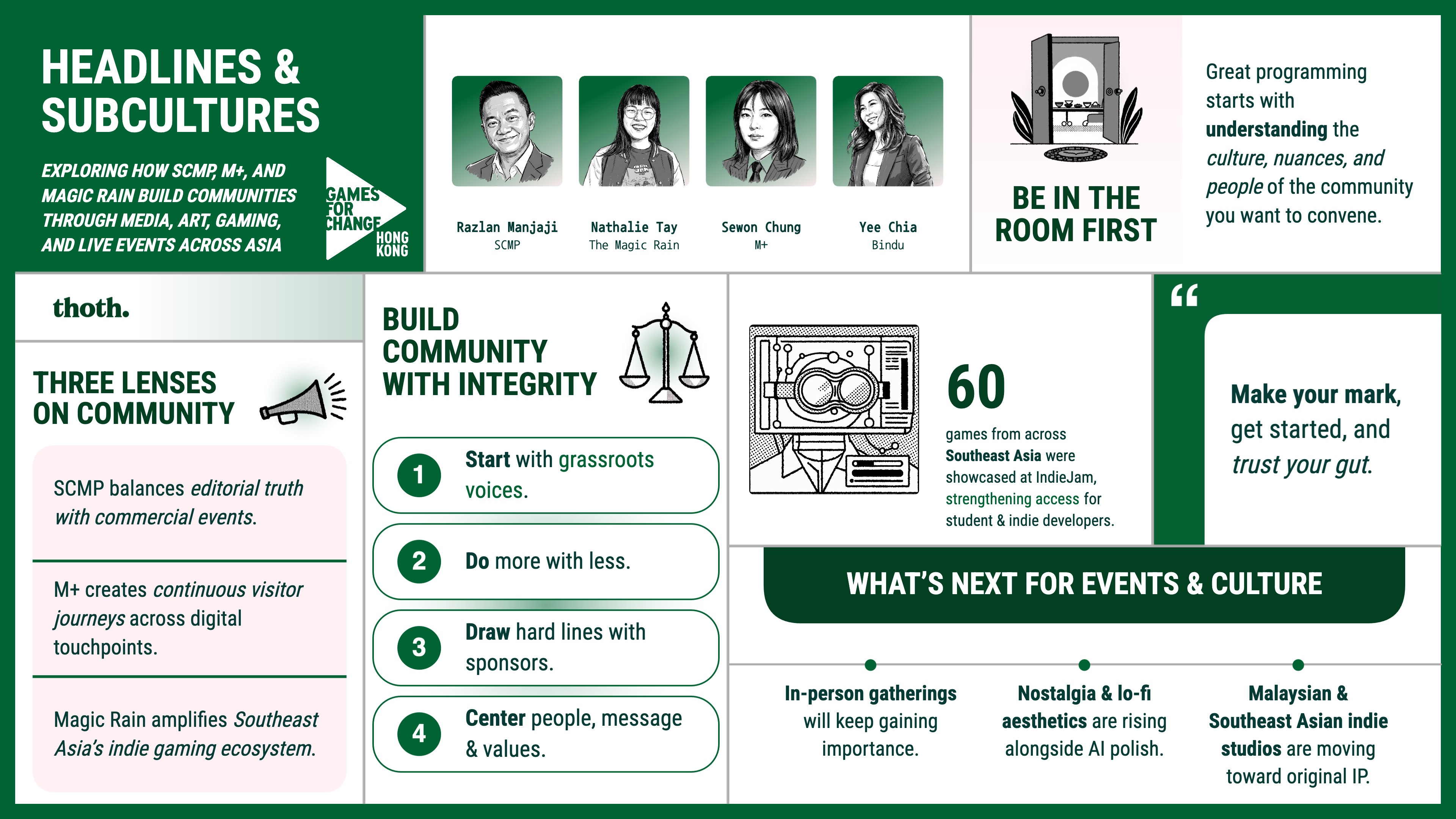
non-Hong Kongers who are working in like Hong Kong-ish brands. So, um, I'm E, uh, like Kanye West's Yeezy. Uh, I'm an artist and a founder. I make infographics for events and conferences. So with Razlan, we're both very— Razlan, we're both very excited that we don't have to work at a conference, but we are part of the panel today. Yeah, um, so, um, I have with me like 3 very diverse, um, creative adjacent community builders?
So, uh, Razlan has spent 18 years at South China Morning Post. It's so impressive. You lasted for so long in media. You must love it. No. Yeah, yeah, okay, um, let's speed through this. And, um, so we are a pretty, like, laid-back panel, so questions, interruptions, disagreements are all greatly celebrated. Um, yeah, chewing loudly is fine. Yeah, go ahead and grab your coffee, it's fine. Yeah, um, so, uh, Razlan Manjaji, he has the strangest LinkedIn title I've ever seen. He's like, name: Community Builder, line: P&L— Yeah, he's a piano builder. Okay, um, so Sewon has a very, like, um, fascinating story.
Uh, she's an active artist and a designer, and she very newly joined M+ 2 years ago from US. Korean American, so she has another, like, deeper layer of, like, stories about how, like, being in between different intersections of Asia is in terms of building her communities. And then, uh, last but not least, we have Nathalie, who flew in from KL, and she has a very interesting job that appeals directly to the demographic at Games for Change, which is indie game developers, builders, um— players. And, um, I will start by having 3 to 4 questions.
Yeah. Also, um, one small thing to mention, uh, I'm also launching like our info— live infographic feature. So as we are talking, like AI is generating like summaries and illustrations into a final infographic block. Okay. Session— like, question number 1, like, we all prepared for this. Like, Razlan, show them your, like, notes. Haha. Hmm. You wrote everything without ChatGPT, I checked. And then he kind of— I'm so impressed, I love Asia. Yeah.
Because I spent time in SF and like Americans are just like, you know, yeah, okay, okay, uh, so, so, um, Ermon is a museum, SCMP is a news platform, and Magic Rain is an entertainment media platform. Yet each of your storied institutions have turned to live events to activate community and revenue. Do you all three find yourselves running two roles? Have you each shifted focus with different teams? And how do you navigate the balance between both?
So just pass the mic down like this. Okay. Okay. Uh, hello everyone, uh, Razlan Manjaji from SCMP. my— I'm doing this right? I hardly do this, like, I'm always behind the scene at my events, so this is the first time I'm under limelight. So if you cannot hear me Like this, okay. I don't do karaoke. Okay, uh, so the question is about the two different roles or different identity have to play in the company. I think working for media, there is a lot line between commercial, like, like getting revenue, getting money, uh, and also editorial integrity. In my role, I have the unfortunate responsibility to straddle the line. Uh, it is always very challenging to be in a room where you have to say— SCMP is objective, neutral, and factual when it comes to reporting affairs of the day. At the same time, you have to pay us money so that I can get into that conversation.
It's a difficult role to play, but I am very fortunate because, uh, like my introduction, I've been in company for 18 years. I know the storylines that I can use to basically straddle the line. And honestly, after being in the events role, not for 18 years but for about 7 years since COVID, um, I had— I find that the best work that SCM MPA has done in events is when we— told that line very, very well.
But to make it relevant for you guys, I just— I like to, I like to position myself by telling people that I'm like running a newsroom where I serve champagne to people so that they're happy. in that newsroom. But the fact— the fact and the story that we told, that we tell in that room still needs to be true. That's how we position our stuff. Good morning, everyone. Um, thank you for being here today, and, uh, like Yi shared, um, my title is Head of Digital Content in the Curatorial Department at M+, which is, uh, um, I guess, ah, made top 20, um, most visited contemporary art museums in the world within the first 4 years of opening, and so actually, in fact, it's a very young museum, only 5 years old. old as of, um, this September, so a very young museum. And my role is working on digital content, um, that goes inside the museum as well as outside the museum, um, and so So in some ways, I really think about each of our experiences. Like, if you think about what happened when you woke up this morning, and all the channels that you used before you got here— I mean, for me, definitely spent my morning, um, Instagram and Threads, um, and definitely a little bit of Outlook and Google, um, made my way here on Uber and Google Maps and made it here, um, for the first time on this beautiful campus and And thinking about all of the different points that we kind of have to touch in order to arrive somewhere, it's not that those different moments for me are dis— um, disjointed. They're part of my journey. And so in many ways, I think of myself as someone who is creating those digital touchpoints for our visitors so that it feels continuous. And so I, I, uh, that's kind of like the way I think about my work and M+, um, and then in previous roles, uh, where I worked at, um, major art museums as well as in tech, um, at Samsung in Silicon Valley. So feels like just pretty much creating a, a journey for our audiences.
Hi, good morning. Um, so quick introduction also about The Magic Rain and what we do. Um, so we're a gaming media outlet, but we're also event organizers. We're one of the only, um, organizations in Malaysia that specifically focus on gaming media and events. Um, I think for us, I, I always like to describe us not so much as a traditional media outlet or even event organizer, but more of ecosystem builders, right? Because how it is in Malaysia, um, especially with all the work we do with indies in Malaysia, um, and even across Southeast Asia, we're still very small and we're growing very rapidly, but it still is quite small compared to the rest of the world. So a lot of the work that we do ends up being, um, how can we amplify this industry further through both events and for media. Um, I'm not envious of Razlan's role of having to do news news. I'm happy that my media outlet, um, it's mainly as as an amplification platform?
uh, for games that might not otherwise get picked up by bigger news outlets, right? Or, or more international coverage. At the very least, what we can do is make sure that they are covered on a regional level. So that's mainly what we do on our side. Okay, so my question is not on the list. But I think what is so interesting that all of you are describing a sense of direction in all your roles. So like Razlan's role is like very like, uh, it's like, it's like a balance of like tensions, like between two opposing forces. Like, how do you keep your, like, journalistic integrity and brand integrity, but still make sure, like, the numbers number?
Whereas like Sewon Chung, like, I like your, your sense of weaving. Like, it feels like you're orchestrating like a journey, but the journey is very unlinear and has a, a lot of like UI/UX fault lines through the entire process for a very diverse range of audience from like, you relativist collectors to, like, very, like, neo— to, like, contemporary art, like, public, like, viewers? Whereas I feel like, Nathalie, you have a very nice role. It's— it feels like you have a strong core and, like, your job is to amplify.
So my question for all three of you is like in this like journey mapping for each of your cultural— your organizational DNAs, what would be like two things you would share to a colleague who is new to the organization? thing, thing. Who has the answer? I, at the very least, have one, if not two. Maybe the two will come later. I think for me, number one is definitely the grassroots matter more than you think, right? When we do events and we do media, um, we touch point with the grassroots a lot because that is usually where— where all the changes is beginning to happen, right? We, we speak to a lot of, um, students who are doing their first project, who have fresh ideas. We speak to studios who are trying to break away from the traditional molds, you know, and all our events come back to support those movements because usually they, they have what they want to do. Um, they have the capacity to do what they want to do within their industry. They may not have the capacity to market it, um, or yell about it to people. Um, someone very wise once told me that, you know, you can do all the good in the world, but if you don't have a marketing person, there's to yell about it, nobody's gonna know about it. And so we often step into that role where we work with grassroots. So tangentially, what, um, I try to tell I always tell people when they come and collaborate with us or work with us is that, you know, there— you have to start to learn to do a lot with very little, I think. At this point, our team is very small. We don't have the luxury— we work to look— work with, like, very big corporations, um, or very big budgets. Um, but there is a lot that you can do just with very minimal But it's creativity, it's tenacity, it's— I think having a very strong why, and that is what pulls you through to the end.
See, I found my number 2. Hmm, that's a really good question. Um, I think because my career has been built in both like art institutions and major kind of these museum institutions as well as in, in tech, um, in Silicon Valley, um, it, it's interesting because I always say museums are not necessarily where, you know, the quickest innovation happens. I'll put it out there. Um, and having been at, you know, an AI startup before, or, or Samsung's innovation group, for example, where, you know, rapid prototyping, you know, making mistakes, um, iteration are kind of core part of what you have to do, and you have to move very quickly and be very agile. Um, and sometimes I've, I've felt like, um, the museum can be kind of a large, slow-moving shipping container. Um, and the work of the digital kind of team is really, um, being kind of on speedy boats to see where can we head together, um, and how can you move this kind of shipping container. And something that's quite unique about M+, I've been there for 2 years as of this month, um, is that because it's still quite young, um, there's a sense of experimentation. It really feels like a startup in many ways, and so for me that's quite exciting. Um, and it's so rare for a curatorial department to have a digital team, like I have developers on my team, technologists that are kind kind of, uh, prototyping and iterating. I'm going to bring two of them this afternoon to join the workshops, um, and in fact, if any of you are interested, um, would be very much interested in working with you all as, like, interns or volunteers, um, but, you know, we're always thinking about how do we create innovation within a museum space that feels seamless and feels natural, doesn't feel like just a cherry on top because you decided you need something like, you know, XR, AR, or whatever keyword is, is trending now, but how can we make sure it feels like it was meant to be there, right? Um, so yeah, those are things I think about a lot.
Test. Test, test. Oh, okay. We're back. Um, oh my gosh, where was I? Do you mind repeating the question again? Do you want to repeat into the mic? So what we do at IndieJam is a tough battle, I have to be honest. Um, so IndieJam, just quick intro, is at this point Malaysia's largest, um, indie game showcase. This year in April, we showcased 60 games from across Southeast Asia, a mixture of— majority industry work, um, some student work.
Um, the event is unique because it addresses a need that we have in Malaysia to make things more accessible for students. So attendance to the event is completely free. developers can apply for free booths as well because it's meant to address, um, smaller teams that cannot afford to booth at bigger events, right? And then the onus lies on us to make that work through— through sponsorship, through partnerships, sometimes even government funding.
Um, but it's kind of the fight that we've decided to fight, right? Um, because accessibility to knowledge and exposure to industry was huge issues that we had in, um, especially the young game developers. developer side of things in Malaysia, um, if they couldn't afford to go for the bigger conferences, there was also kind of an unwillingness from the younger generation to step out of their comfort zone. So for was to try and make it as accessible as possible and also use the accessibility to tell the students, hey, what are you gonna lose? You don't even have to open your wallet. Please come and talk to somebody from the industry that you're going to join, please. So that, that ended up becoming how we do the events. Um, it, it is quite a struggle in terms of trying to get funding to keep keep it going, but I think this is where it comes back to the why of, like, why do we want to do this?
Now it's our responsibility to find, um, pathways to see how we can keep it going. So I think the way I'm understanding the question is in terms of, um, mass appeal, um, a bit. How do you kind of appeal and grow an audience? Um, and so still maintain your core, I think is the question you're asking, and I think it's something that's quite interesting about the museum space is that we have a mandate around education and what we must do and— and kind of understanding that role versus other roles of more commercial spaces. Um, and so I think that clarity is really helpful. At the same time, I think remaining relevant is really important because for sure Sure, we know, um, that one, the biggest competitor for any events is probably Netflix.
aka staying home? And, um, and as far as, you know, experiences go, people are really drawn to what's immersive and what's cool and what's trendy, you know, um, like whether it's team labs or team lab adjacent types of events, people love to go and take an amazing photo of themselves immersed in some kind of environment, right? And so how does a museum like M+ respond to that? What we did was bring a new an exhibition called Dream Rooms, which is a series of environments created by women artists, um, expanding from the '60s and '70s. So going back in history to show, no, this is not just new, there's there's a historical element to it, and of course you can take amazing selfies and be in a feather room, you can have all of your fun experiences, bring your friends and family, but there's something else, um, that you can learn and take away, um— that kind of brings you back into history. And so I think that's kind of the fun and the challenge of thinking about what we can uniquely do, what we know people are, you know, hungry for, and then understanding Understanding the kind of the greater landscape of the competition, which is certainly wanting to stay home for all of us that are just inundated with, uh, you know, stimuli.
Wow, thank you so much. I feel like all your answers are so inspiring in terms of how resourceful everyone is. In terms of straddling, like, different, like, mandates? Um, I have a sensitive question. Feel free to share as much as you're comfortable with. Um, were there any event partners or sponsors that you took on that you wish you said yes or you wish you said no? Chatham House rules, um, we can anonymize— Yeah, which I can scrub clean because this is my software.
Hahaha. Yeah, um, I, I just feel like this is such an important question because a lot of life is not always about just saying yes. It's also about saying no sometimes. And like, are we all in the privilege to say no sometimes? Okay, you have an answer. Okay, I can take the easy way out and say that, oh, I wish I had sponsors, uh, but I'm not going to do that. I'm going to tell a story about a sponsor I wish I did not take on, but I took on and I learned my lesson. So, um, yeah, so if the angle is go this way, car— okay, so I used to run— I run a lot of very official-sounding current affairs, finance, also known as very boring events, uh, where the objective is for the sellers to find potential buyers. And because of that, uh, the room— the, the requirements for people who finance, underwrite events are very transactional.
That's to say, I'm here, I pay you this buttload of money because I want to get clients, right? Excellent clients. So there's this new client, prestigious brand that first worked with us, and they want very specific — niche community that you can't find on LinkedIn because it's not the kind of demographic details that you can unearth from LinkedIn. So we managed to find them anyway. I can't tell you what it is because then become very obvious, but let's just say some of you here might be off the target, but because— but, uh, the reason why you're in the target group is not something that you share in public. So I have to figure out how to find you and times 100 into the same room.
Let's not go there. Okay, so, so we did that, and as we go along, the, the, this client become more and more demanding, uh, more and more specific with what they want, uh, they want to exclude everyone that in any way competing with them for the same audience, etc., etc., to the point whereby the brand integrity is at stake. That's to say, if you do this, we send a signal to the market that SCMP is— Basically bowing to the pressure of this very important sponsor.
So, I draw the hard line and say that, let's not make it exclusive. Let's find another similar sponsor and let them compete with them— between themselves into that room. And we found a new sponsor within 3 days. and inform that sponsor that you have a competitor in the room. You can choose to go in or go out. That created a tension that I never felt before. I still remember I took that call from this original sponsor while I was at a birthday dinner.
And the tension was— anyway, I— the words was exchanged. I should not repeat it here. They are in— They are in because I got the right people in the room that I— they kind of understand they overplayed their hands. And right now, I choose not to work with them anymore. Look, in events, there are often instances we have to say no. We have to draw the hard line. It's not so much about what the boss tells you, you can or cannot.
It's not so much about the numbers. It's the— it is about integrity. And I mentioned just now, numbers I can say that I have X times the revenue and I— um, profit already. I think it's interrelated with the instances where I say no, sometimes. — some very dubious opportunity. So I think they're connected. Hmm. I think the example that I'll share, um, is from San Francisco. Um, so for about 5 years I was at a museum called Exploratorium in San Francisco. Um, it opened doors in the '60s, um, as one of the first museums museums where you can touch everything, um, and it's known for kind of interactive exhibits and prototyping on the museum site, um, and one of the sponsors that the Fort Worth got years ago. This is before, um, Waymo, uh, was, um, you know, actively driving through the city. Have you— have you been in Waymo before? Okay, yeah. So it's now kind of everywhere in San San Francisco, you can actually take it like an Uber. Um, but before the self-driving cars were widely available, they were still kind of in prototyping stages for a very long time, and they, uh, were sponsoring something at for a tournament, it was kind of like everybody was very, very, very worried about it, um, and, and I think the way it panned out and the lesson that I take away from it — that informs the way I think about sponsorships today is putting people first.
What is— what is the message that we want to share? What do we want our people to take away from this? What's the message and what's the experience? And so what we ended up doing is, um, there's an intersection between kind of dedicated to human perception anyway with exhibits around it. So, um, so with Waymo engineers, we created like an exhibit where people can see how LiDAR sees people and objects and places. spaces to understand kind of, uh, spaces. And so that was one of the more effective ways of showing the technology and increa— improving the way people understand the world and this new kind of emerging technology. technology without it taking over, say, the entire museum experience or, um, or kind of impacting the integrity of, like, what, you know, other developers were thinking that they wanted to create inside the museum. So I think Collaboration can be, you know, possible. Um, I think the more— most important thing I think that I think about still to this day is, you know, centering people, the message, and core values.
I've been spending the last two answers thinking about the most politically correct way I can say any of this. Ah, er, I will do my best. Um— You will scrap— So the way that the gaming industry, especially from an event organizer's standpoint in Southeast Asia, is that when corporate sponsors— um, it's not so much a matter of — of saying yes or no to corporate sponsors. It's that there's still a really big gap to convincing sponsors that this region is worth it, right? And that's kind of our unique struggle in trying to let them know, okay, you have to support, you know, the growth of it, otherwise it's never going to boom into, you know, wherever the rest of the world is. is, and we, we are constantly in this conversation of, like, explaining to them potential. But what that also means is that we're constantly trying to get, um, and we're constantly facing people trying to undercut us, right? Because they see the size of the events, the size of the coverage, um, even the size of the games are much smaller than they are overseas, right? And so they're thinking, okay, I'm gonna I'm not going to spend all of my budgets on bigger gaming conferences. Um, I'll try and give like a little bit here, you know, it's their chump change from their budget. And then as an event organizer or or oftentimes, sometimes as the representative of, of the community, it's up to us to argue for more.
—um, and argue for more, not necessarily, um, even because our event is like, um— how do I put this? We're arguing for more because we, we need to show that we are worth that amount, you know, because there is potential. There are games from this region that are internationally successful. successful, but we need money coming into events and platforms and the ecosystem here so that— It can grow. because it, it's not going to grow if there's no belief and there's no funding coming in. Um, and so that's, that's really our struggle. It's, it's about saying, um, the yes, no, maybe a bit A bit more? Can you give a bit more? It's— that's the struggle rather than a clear yes or no, I would— I believe.
Thank you everyone for very, very wholesome answers. Everything was politically correct. Yeah, um, I guess like a quick scan in the room, how many of you have burning questions? Raise your hands. One question. Okay, 'cause that would determine how I close off the Q&A versus, like, the closing. Two? Feels like a bidding war. 3. Okay, um, so 1, 2, 3, um, we will, um, have 3 of you, like, have more Q&A first, and then I'll close off with a nice reflective question.
Clement, Ivan, and— I don't know— I just wanted to ask, like, within— like, if you're looking towards the future, like, say, 2 to 5 years, what are some kind of big, uh, movements or shifts that you are anticipating in you— what you do? Hmm. 2, 3 years. Well, I think the biggest shift that I experience now is combination of wanting things to be more in person. I think we're kind of craving this— type of environment? Because it's— this can be, say, you know, on Zoom, um, or some kind of conferencing software, but there's something very special about this. And I, I feel like that's sort of the, the experience of having lived through the pandemic, um, from— for all of us, um, and I'm encouraged to think about spaces like museums, um, becoming spaces where where people can gather in this formation. And so I think that will continue in the next 2, 3 years. I feel very confident about that. And another thing that I am paying attention to closely is the sense of nostalgia, even for a past that we've never lived, even for a past that didn't quite exist. Um, I think there's something about, you know, just being very, very interested in intrigued by what's less polished, um, because AI makes things— every— everything so perfect. So I think we're— there's something really, really interesting about, um, the type of— I even like brain memes that are coming out and, and sort of the, um, you know, what gets trendy out of nowhere, um, you know, the pixelated text. There's just something interesting about all of this, you know, and just wanting to bring that back like video of camcorders, for example, when we have the highest kind of HD technology in the pocket of our hands. And so, um, so I think there's something really, really interesting about this, um, this movement kind of going forward and then backwards and then creating something new. So, um, that's been on my mind a lot.
I want to say about— on your point about in-person, um, okay, usually my conferences are much larger than this, uh, and, and it brings it a host of different opportunities and and also different sets of problems. But I do like small events like this because everyone right now is looking me in the eyes. It should make me very nervous, but I don't feel that because I felt like you about what I said— what I'm going to say. So in-person events is going to continue growing its importance, and getting people in the room, uh, and getting important people in the room at the same time as everyone else is an art. It's a game of— ah, a game of probability and a lot of luck. So to be able to do that well at scale, at speed, is It's the formula to success. So the question was, what do I see 2 to 3 years from now? What I do know— my, my target will keep on going up. It would never come down. So I have to keep generating more for the company for sure.
But I do look at in-person events, uh, in— the ability to convince people, the people of the same— share the same purpose, mindset, objective in the same room, it will continue to grow in the coming future. Uh, virtual digital rooms has its role, but I think it will continue to diminish, uh, in the event ecosystem. I definitely echo, um, what you guys have said about in-person events. We've definitely seen a boom post-COVID in Malaysia as well. Um, but to answer Jack's question specifically— Specifically to the industry that I work in, I deal with a lot of, um, Malaysian indie studios and Malaysian game development students. Um, where I see that moving in 2 or 3 years— 3 years is quite exciting because we've always been known as an outsourcing hub, not just Malaysia, but Southeast Asia as a whole.
Um, how that's exciting in the next 2 or 3 years is that we've seen a lot more people making the transition to doing their own studios, making their own stories. So my hope— as an indie gaming enthusiast, but also event organizer, showcase organizer, is that we're gonna see more original IP coming from Malaysia, um, from these young developers. So I'm, I'm very excited to see that. I'm going to use this opportunity to lean into one of the questions.
Which is like the idea of like Asianness, or how do you like, um, share or like translate like geography between like your own like personal experiences, your own stories, but also like your local community. and the communities you serve. So for example, SCMP targets a very broad audience, but it's still very, like, Greater Bay Area focused. M+ has a very interesting mandate where it's both— has a contemporary Chinese history, but it also is very future-seeking. And then, um, Nathalie is like obviously like, you know, looking a lot in like Southeast Asia and like trying to figure out how much do we agglomerate or how much do we like kind of like build? Yeah.
Uh, so I'm a Malaysian, so fellow— there are fellow Malaysians on this panel, hopefully in the room, so I'm very proud of that. SVMP is a homegrown Hong Kong company. We are also very proud of that. Uh, but we do do a lot of events and convene, uh, convene different audiences around the world. Um, case in point, uh, this Friday I'm flying to Kazakhstan. For those of you who do not— does not know, it's in Central Asia. I have not been there. I do not know the people. I can't pronounce their names yet. And I'm going to meet ministers and CEOs and associations and chambers.
Why we are doing that? Because I truly believe you cannot program an event— Not being in the room— same room as the people that you're going to convene. You have to understand the nuances, you have to understand the culture, you need to understand how they operate. So the same goes to when I'm going— I, I have planned an event in Japan, so I've been talking to you a couple of times. I just did an event in Indonesia, Jakarta, in February, my biggest event to date. And before that, I went to Jakarta 7 times to make sure I do the right thing for the, for the people— I prefer for the people of the host city.
So understanding who— understanding and be a part of the community you want to serve is going to be very important. And to do that at scale, you better have more, um, people to help you with. Hmm, okay, so I'll make it quick. Um, so I'm Korean American. I was born in Korea, raised in Korea and the US, and I've lived previously in Mexico City and Shanghai, um, prior to living here in LA. in Hong Kong. And, and so in some ways I think about my identity in, uh, kind of, I guess, woven ways. And I, I see, I think, Hong Kong culture and history in a similar kind of path, and something that I've noticed walking through M+, even as a visitor, is when you look at the labels of the artworks and the artists, it'll say where the artist, uh, was born and where they practiced practice their art and it's just multiple places. And there's just something so comforting about that for me as someone who kind of belongs or feels a sense of belonging to multiple places instead of displacement, so— So in some ways I, I feel very excited about M+ becoming a place of belonging for those that kind of feel a sense of belonging to multiple places, um, and the fact that Hong Kong has— is the number 3 most visited art museum in Asia.
is, is pretty awesome. Um, so, so I feel very excited about Hong Kong being this sort of, you know, centralized location for a global contemporary art museum and, and what that means for for Asia, um, and the diaspora and the global perspective, um, is exciting. So yeah. I'll try to make this quick. I— So a lot of what we do with IndieJam is about Southeast Asian pride. It's Malaysian pride, it's Southeast Asian pride, it's about telling our stories, um— A little bit about, um, the, the regional gaming conference scene is that I think at this point Gamescom Asia and Thailand Game Show is one of the biggest conferences in Southeast Asia. Southeast Asia. Um, and I really think to it when I think about the impact that this region can have internationally, right? Because my event is still very far from getting to that stage. I can see it, you know, times 100 at Thailand game show or people who come for Gamescom Asia.
because these are people who are flying into Asia or this region, Southeast Asia, for the first time. And then their first time realizing that there is this level of polish in the games, there's this level of creativity, And it's also culturally completely different from what they have in the West. So that's been really interesting, um, to see. And it's, it's very nice to see also in the region that there are more and more events, um, like Gamescom, like IndieJam, um, they're coming up and shining the light specifically on what the region has to offer.
Can you yell your question? Yeah, you look like you— you can— I— I— thank you. My name is Kat. I recently joined Tatler magazine as an editor. Thank you for sharing today. especially your candid sharing regarding the question of sponsors and dealing with difficult sponsors. But on that topic— sorry, on that topic, when it comes to community, I think it's very easy for quote-unquote community to become a marketing exercise. I suppose to keep things quick, in one sentence or two, how do you ensure the communities you build are authentic?
You're lucky I have an answer. I think for us it's very much going back to— You know, where the industry starts. Um, within DGM, we do so much work with students, and that is kind of a built-in reminder for us of, like, how do we keep it grounded? How do we keep it authentic, right? Because believe me, If, if things are not organized well, if they're, um, messy, if we're not addressing their issues, the students will make it known.
right, and that really keeps us grounded to addressing their issues because ultimately— and I've really seen this over the past, like, year or two— um, they're the ones entering the industry, they're the most gung-ho, they're the most excited to have that sense of community. Um, whereas people who are a little bit more senior in the industry might be already kind of jaded about it, but it's the youngsters who are really excited to get get the community going. And so by keeping an eye on, you know, what they want from it, that also informs us like what kind of community that they want to have, how we can help facilitate that. How do we keep it authentic to their needs and wants?
Okay, 2 sentences-ish, um, I think probably it's like any other relationships in life, um, if I spend all my time telling you everything and and asking you for things, you're probably not going to be my friend. And so I really think about content strategy in the same way. It's straddling what we want to say and what people want to hear and what they need. Okay, uh, two sentence— sentences. So first, I can't do this for all events, but some— for some events, I actually start with the sponsors first. I talk to them, I say, what is important to you? What do you speak about? and what do you want the community, community to talk about? Because the newsroom, we are very opinionated. We have a lot of things to say. I tell you, this is the news of the day, but more often than not, people people in the room have a totally different agenda and priorities. So I reverse the process. I don't ask the editor, I ask the sponsors.
Second, I'd like to be on the youth part because it's very, very special to me. So one— there's one event that I started inviting the schools to bring their students into the room. Uh, they were so excited to come believe it. They were bringing the laptop and typing notes and everything. But after the event, they tell me that, thank you for allowing us to be in this room. Nobody did that for us before, and they changed things. Next year, I put them on stage, so they have their say. I, I don't script it, I just ask them questions and they come up with their own responses to the topic. The event is about inclusion, some something that is applicable to everyone. So that's how we build a community of youth, and how— that's how we build a community of supporters of SCMP who believe in the same purpose.
No, no, there was this question that, um, the panelists wanted to answer. So the question was, um, imagine you at the very early start of your journey, right? Your first employment contract, your first, like, news article — your first event, what would you have told yourself then? But it needs to be like one sentence because we're at time. I know it's like, oh, so stressful when I'm the moderator. I'm terrible. Yeah, but okay, um, I'll give you guys like 10 seconds to think. Shout out to Gentee and Teddler because that's how Vincent and I met, and that's also So I still think like, um, Tatler Genty is one of those like magazines that does this impossible thing between bridging luxury and actually having good people in the community. So like, yeah, it's— we appreciate it.
All the time, yes. Xiao wei, xiao wei, yes. I already forgot what's the question. Okay, uh, something that you should know. I do? Okay. Okay, so, uh, first thing, your first sponsorship contract with a new client, you think that is the most important, but it's not. I think over the years I have clients who come back to sponsor the same event again and again. And you see the budget they give you keeps dropping.
It's actually something that is not— bad. Is it something good? It means that you have built something durable, something for long-lasting that people believe in, in the long term. Go for it. Hmm, okay. I think— what I would probably say is— make your mark, get started, and trust your gut. Um, Yi and I talked a lot about mark-making for our, our practice, so yeah, just get started. And then in terms of trusting your gut, it's usually based on your lived experience and wisdom. So it's not just intuition, there's something else there. So— One sentence.
I think definitely open your eyes and ears. Um, I do a lot of work at the grassroots and communities. You have to stay as open-minded to understanding how things actually are, not your interpretation of how it is. Amazing, amazing. We had such a great panel. Thank you everyone for, like, giving us some 47 minutes of your life to this interesting conversation. I've never been as— I stressed as an exam. Yeah, thank you everyone for your heartfelt responses, for your very authentic sharing, and most of all for everyone, like, you know, time for like coffee break and the next session.
MADE WITH